
Veylix | Tailwind CSS E-commerce Admin HTML Template is a modern and professionally structured administration dashboard template designed for eCommerce businesses, online store managers, developers, and digital agencies building store management interfaces. Built around Tailwind CSS and HTML, Veylix provides a customizable front-end foundation for creating an administrative interface where store operators can organize business information, monitor operational data, and access essential management sections. Whether you are developing an online retail dashboard, a multi-category eCommerce administration panel, or a custom store management application, Veylix can help streamline the interface design process and establish a consistent visual foundation for your project.
A well-designed eCommerce admin dashboard should make complex information easier to understand and routine management tasks more convenient. Veylix can be customized to reflect a business’s operational requirements, brand identity, and preferred administrative workflow. Its utility-focused styling approach also allows developers to adjust layouts, spacing, typography, colors, and interface components as the project evolves.
An effective administration dashboard should prioritize clarity, usability, and access to relevant information. Store administrators often need to review sales activity, manage product information, monitor orders, and navigate between different operational sections without unnecessary complexity.
Veylix is intended to provide a structured visual foundation for these administrative workflows. A well-organized interface can use dashboard cards, navigation menus, tables, forms, and data presentation areas to help users locate information and understand the state of a store.
The design can be customized for different business models, including small online shops, larger retail operations, marketplace projects, and custom eCommerce platforms. Developers can adjust the interface to accommodate the number of management sections, the complexity of the data, and the needs of different administrative users.
The exact dashboard layouts, included pages, and interactive components should be verified in the official Veylix product documentation.
Veylix is presented as a Tailwind CSS eCommerce admin HTML template. HTML provides the structure of the interface, while Tailwind CSS uses utility classes to control visual presentation and layout.
This approach can help developers customize the dashboard without rebuilding every interface element from scratch. Styling changes can be made by adjusting utility classes, modifying the project’s design conventions, and extending the existing markup where appropriate.
Potential customization tasks include:
The exact Tailwind CSS version, build process, JavaScript dependencies, and source structure should be confirmed in the supplied documentation.
A dashboard overview can help store operators understand important business information at a glance. Veylix can be customized to present relevant metrics through summary cards, tables, charts, or other supported interface components.
Depending on the requirements of the application, these metrics might include total orders, sales revenue, order status counts, product totals, customer registrations, and recent business activity.
A store manager could use an overview page to identify pending orders or review sales trends, while an administrator of a marketplace project might need a broader summary of operational activity.
The specific metrics and data visualizations depend on the supplied components and the backend implementation. An HTML template does not automatically calculate live sales figures or retrieve information from a store database.
To display real business data, developers must connect the interface to a suitable API, database-backed application, or eCommerce platform. Calculations, permissions, and data validation should be handled appropriately by the application’s underlying systems.
Product management is a central requirement for most eCommerce administration systems. Veylix can provide a visual starting point for designing product listing pages and related administrative interfaces, depending on the layouts included in the package.
A customized product management section may display product names, images, categories, prices, stock indicators, publication status, and available actions.
Administrators may also need forms for adding new products, editing existing listings, updating descriptions, assigning categories, and managing product attributes.
For stores selling products with multiple variants, the interface may be extended to represent sizes, colors, materials, or other product options. Businesses with large catalogs may also require search, filtering, sorting, pagination, and bulk editing.
These are potential application features rather than guaranteed built-in capabilities. Saving product changes, validating prices, updating inventory, and synchronizing information with the storefront require backend functionality or integration with an existing eCommerce platform.
Order management is another important part of an eCommerce administration interface. Veylix can be adapted to present order information in a structured format that helps administrators review transactions and understand fulfillment progress.
A customized order table may display order identifiers, customer references, order dates, totals, payment status, and fulfillment status. Individual order pages can provide more detailed information about items, quantities, shipping details, and relevant notes.
An application may use status categories such as pending, processing, completed, cancelled, or refunded, depending on the business’s workflow.
Administrative actions can also be designed for reviewing orders, updating statuses, or opening detailed records. However, changing order statuses in the interface does not automatically update a payment provider, warehouse system, or shipping service.
Functional order processing requires appropriate backend logic, authentication, authorization, and integration with the relevant commerce systems.
Customer information is important for businesses that need to manage orders, service requests, account details, and customer communication. Veylix can be customized to provide a front-end interface for displaying customer records and related administrative information.
A customer listing might include a name, email address, registration date, order count, or account status, depending on the application’s requirements.
Individual customer pages could present relevant account information, order history, and administrative notes where appropriate and permitted.
For larger systems, customer management may require search, filtering, pagination, role-based access, and secure handling of personal information.
Because customer data can be sensitive, the completed application should implement appropriate access controls and data protection measures. A static HTML template does not automatically provide secure user authentication, customer record storage, or permission management.
Accurate inventory information helps online stores understand product availability and reduce operational errors. Veylix can serve as a foundation for designing inventory management interfaces, depending on the supplied components and the application’s needs.
A customized inventory page may display product identifiers, stock quantities, availability indicators, and reorder information. Additional sections could help administrators identify low-stock items or review inventory changes.
Businesses with physical products may need inventory workflows for receiving stock, adjusting quantities, managing warehouses, or tracking product variants.
These functions require an appropriate data model and backend logic. The interface alone cannot guarantee accurate stock levels or synchronize inventory across sales channels.
For multi-location businesses, developers may also need to connect the dashboard to warehouse management software or a dedicated inventory system.
Business analytics can help eCommerce operators understand performance and identify trends. Veylix can be customized to provide visual areas for displaying metrics and charts where suitable components are included or added.
Potential analytical views include sales over time, order volume, product performance, customer activity, and comparisons between reporting periods.
A chart can help administrators identify changes in sales activity, while summary tables may provide a more detailed view of underlying figures.
The usefulness of these visualizations depends on the quality and accuracy of the source data. Real analytics require data collection, appropriate calculations, and integration with the application’s backend or reporting service.
If the template includes chart libraries, developers should review their versions, licensing terms, and configuration requirements before extending them.
Administrators may need to access store information from desktop computers, laptops, tablets, and smartphones. A responsive dashboard helps keep important controls and information accessible across different screen sizes.
Where supported by the supplied implementation, Veylix can provide a foundation for adapting navigation, summary cards, tables, forms, and other interface components to different viewports.
Responsive behavior is especially important for dashboards containing wide data tables or complex navigation structures. Developers may need to adjust column visibility, provide horizontal scrolling, reorganize cards, or simplify navigation on smaller screens.
The completed interface should be tested across common device sizes to confirm that controls remain usable, text stays readable, and essential information does not become difficult to access.
The exact responsive layouts and browser support should be verified in the original template files and documentation.
Administrative dashboards commonly rely on consistent interface components for managing data. Veylix can be customized to support a coherent visual system across forms, tables, buttons, navigation items, status indicators, and content sections.
A reusable component approach can make the interface easier to maintain as the application expands. For example, consistent form fields can be used for product creation, customer editing, and store configuration.
Tables can be adapted to display different types of information while maintaining consistent spacing and typography. Status indicators can help users distinguish between operational states, provided the labels and meanings are clear.
The exact components included in Veylix should be confirmed in the official product listing. Additional components may need to be developed according to the project’s requirements.
Veylix is an HTML admin template, so its primary role is to provide the front-end structure and presentation of an administrative interface. Developers can integrate the design with a suitable backend application to support real business operations.
Possible backend technologies include PHP, Laravel, Node.js, Python, Django, or other frameworks compatible with the project’s architecture. The appropriate choice depends on the development team’s experience, data requirements, security needs, and deployment environment.
A complete eCommerce administration application may require:
These capabilities require implementation and should not be assumed to be included in the HTML template. Developers should establish a clear separation between the front-end interface and the server-side business logic.
Administrative interfaces often provide access to commercially sensitive information and important business operations. Security should therefore be treated as a core requirement when converting Veylix into a functional application.
The finished system should use appropriate authentication, authorization, server-side validation, secure session management, and protection against common web vulnerabilities.
Access to customer information, order details, financial metrics, and administrative actions should be restricted according to each user’s role. Sensitive operations should be validated on the server rather than relying solely on front-end controls.
The application should also use secure deployment practices, appropriate HTTPS configuration, maintained dependencies, regular backups, and suitable monitoring.
A visual HTML template does not automatically provide these protections. They must be implemented within the completed application and its hosting environment.
An admin dashboard is generally an internal interface rather than a public storefront, so its main purpose differs from that of a customer-facing eCommerce website.
Veylix can be integrated into a larger application that manages a public store, where product information and other content are displayed to customers. In that arrangement, search engine optimization should primarily be addressed in the public-facing storefront.
Developers may need to ensure that product data entered through the administration panel supports descriptive titles, product descriptions, image alternative text, and other relevant content fields.
The dashboard itself should be protected from unauthorized access and configured appropriately for its intended internal use. Search engine indexing rules should reflect the application’s security and deployment requirements.
A well-structured admin interface should remain responsive as the volume of products, orders, customers, and reports increases. Veylix’s performance will depend on the supplied source files, JavaScript libraries, data volume, and integration approach.
Developers can improve performance by optimizing assets, avoiding unnecessary scripts, using efficient rendering patterns, and retrieving data in manageable quantities.
For larger datasets, server-side pagination, filtering, and sorting can help reduce unnecessary data transfer. API responses should be structured carefully, and expensive calculations should be handled by suitable backend processes.
Regular testing and dependency maintenance can help keep the dashboard reliable as the application evolves.
Veylix may be suitable for eCommerce developers, online store owners, SaaS developers, software agencies, marketplace builders, and businesses creating custom administration systems.
It can be particularly useful for developers who want a Tailwind CSS-based interface foundation instead of designing every dashboard page from scratch. The template can be adapted to different product catalogs, operational workflows, and administrative requirements.
Developers with knowledge of HTML and Tailwind CSS can customize the presentation, while building a complete working application generally requires additional JavaScript and backend development skills.
Before choosing Veylix, consider the specific management screens required by the project and verify that the supplied components align with those needs.
Before purchasing Veylix, review the official product listing and documentation to confirm the included dashboard pages, source files, Tailwind CSS version, JavaScript dependencies, responsive features, browser support, and build instructions.
Verify whether the package includes the particular product tables, order views, customer pages, charts, forms, or other components required for your application. Check whether any premium libraries, fonts, icons, or third-party assets require separate licenses.
Remember that an HTML admin template primarily provides a front-end interface. Database connectivity, secure authentication, real-time analytics, product management, order processing, and inventory synchronization require additional backend development or integration unless explicitly documented as included.
Veylix | Tailwind CSS E-commerce Admin HTML Template provides a customizable foundation for developing administrative interfaces for online stores, retail management systems, and eCommerce applications. Its HTML and Tailwind CSS structure allows developers to create a consistent dashboard experience, organize operational information, and adapt interface components to different business requirements.
Whether you are building a custom store management system, developing an eCommerce SaaS platform, or creating an administration dashboard for a client, Veylix can help streamline the front-end development process. With appropriate backend integration, secure access controls, reliable data handling, responsive testing, and ongoing maintenance, the template can be adapted into a practical administrative interface that supports day-to-day eCommerce operations.
1. All digital products are the most recent version, with no possibility of free updates. After payment, you can request an update to the most recent version for 5 days if a new version is released. We free support within 5 days.
2. If a license is required (Excludes WHMCS license , we provide only method not license), please contact us via email or ticket for assistance with activation. Our license is only valid for activation and does not include support.
3. We provide Mobile, PHP script installation services for $19.90 / ₹1700. Please create a backup after installation as we do not support re-installation. For mobile app source code, we do not offer installation services.
4. If you have any questions, please contact us by email [email protected] or create a ticket on this page
5. Please note that any digital products presented on the website do not contain malicious code, viruses or advertising. You will receive the original files from the developers. We do not sell any products that have been downloaded from other websites.
6. The response time can last up to 6 hours.

Archivue - NextJS Interior Design Landing Page Template Archivue - NextJS Interior Design Landing Page Template is a modern website template designed...
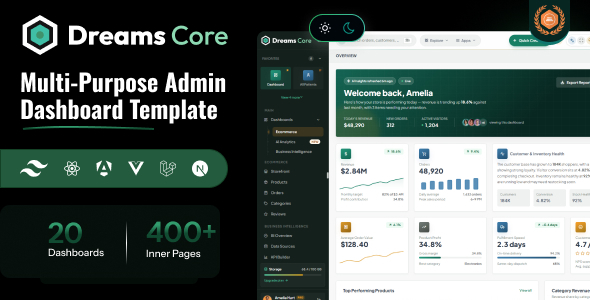
Dreams Core - Multi Purpose Tailwind CSS Admin HTML Template Dreams Core - Multi Purpose Tailwind CSS Admin HTML Template is a...
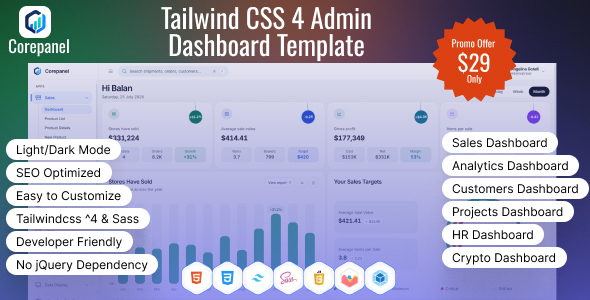
Corepanel – Tailwind CSS 4 Admin Dashboard Template Corepanel – Tailwind CSS 4 Admin Dashboard Template is a modern administrative dashboard template...
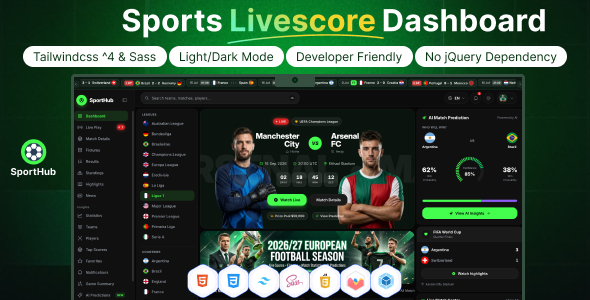
SportHub – Sports Live Score & Analytics Dashboard HTML Template SportHub – Sports Live Score & Analytics Dashboard HTML Template is a...
