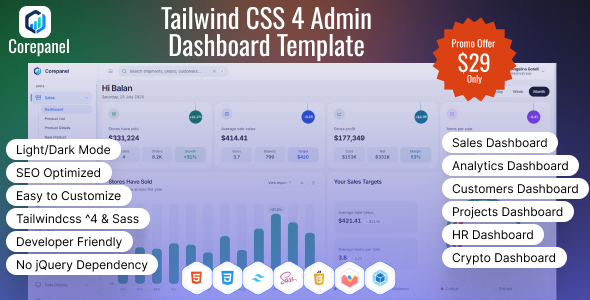
Corepanel – Tailwind CSS 4 Admin Dashboard Template is a modern administrative dashboard template designed for developers, startups, businesses, and software teams that need a professional interface for managing application data, monitoring business activity, and organizing administrative workflows. Built around Tailwind CSS 4, Corepanel provides a customizable foundation for creating clean dashboard layouts, management interfaces, and web application administration panels.
A well-designed admin dashboard helps users access important information, review business metrics, manage records, and navigate application features from a centralized workspace. Corepanel is intended to support these needs with a reusable interface foundation that can be adapted to different industries, application types, and business requirements.
Whether you are developing a SaaS platform, a customer management system, an e-commerce administration panel, or an internal business application, Corepanel can serve as a starting point for creating a structured and professional administrative experience.
An effective administrative dashboard should make information easy to understand and routine tasks straightforward to perform. Clear navigation, consistent styling, and well-organized content areas help administrators find the information they need without unnecessary complexity.
Corepanel is designed for dashboard-oriented interfaces, providing a foundation for organizing application information into suitable sections. Depending on the layouts and components included in the purchased package, developers may be able to adapt the interface for summary cards, data listings, configuration screens, reporting sections, and other administrative workflows.
The dashboard can be customized to match a project’s visual identity and operational requirements. A consistent layout and reusable interface components can also help maintain a cohesive experience as the application grows.
Tailwind CSS 4 is a utility-first CSS framework that enables developers to style websites and application interfaces using utility classes and a modern styling workflow.
Corepanel is positioned around Tailwind CSS 4, making it relevant to developers who want to customize dashboard interfaces using this styling approach. Developers can adapt supported colors, spacing, typography, layouts, borders, and other visual elements according to their project’s requirements.
Tailwind CSS can help streamline styling changes and maintain consistency across interface components. It is particularly useful when an application needs a customized visual identity without relying entirely on a large collection of individually written CSS rules.
The exact implementation should be confirmed in the supplied source files and documentation, including the build process, dependencies, component structure, and supported browser requirements.
A dashboard overview gives administrators a convenient place to review important application information. Presenting selected indicators in one location can make it easier to understand operational activity and identify areas that require attention.
Corepanel can be customized to display metrics that are relevant to the application being developed. Depending on the included components, developers may be able to organize summary cards, activity sections, reporting areas, and other information panels.
Potential dashboard metrics include:
These are examples of possible dashboard content, not a guarantee that every metric or a live analytics system is included in the original template.
Real-time information requires an appropriate data source, accurate calculations, and integration with the relevant application services.
Many administrative applications need structured interfaces for reviewing, searching, and maintaining records. Well-organized data presentation can help users locate information and understand the status of business operations.
Depending on the components included with Corepanel, developers may be able to adapt data tables, record listings, summary views, and other administrative elements.
These interfaces could be customized for managing customers, employees, products, orders, subscriptions, tasks, or other application records.
Operations such as creating, editing, deleting, searching, sorting, filtering, and exporting data require corresponding application logic. Developers should verify which interactions are implemented in the supplied package and add the necessary backend functionality where required.
Forms are an important part of administrative interfaces. They allow users to enter information, update records, configure preferences, and perform routine management tasks.
Corepanel can serve as a starting point for form-based interfaces, depending on the input components and layouts included in the purchased package. Developers can adapt the available elements to suit workflows such as customer management, profile editing, product entry, and application configuration.
A well-designed form should provide clear labels, logical field organization, appropriate validation messages, and useful feedback after submission.
Frontend validation should be supported by server-side validation for production applications. Database storage, secure processing, and business rules require additional application logic beyond the visual form interface.
Charts and data visualizations can make business information easier to understand. They help administrators review trends, compare values, and evaluate operational performance when supported by accurate data.
If Corepanel includes chart components or reporting layouts, developers can evaluate them for use in analytics dashboards. Additional charting libraries may also be integrated when the project requires particular visualization features.
Potential applications include revenue monitoring, sales analysis, customer activity reporting, subscription statistics, and operational performance reviews.
The actual chart types, libraries, and interactive reporting capabilities should be verified in the supplied documentation. Live analytics requires a reliable data source and correctly implemented calculations.
Every organization has its own brand identity and administrative requirements. A customizable dashboard template provides a foundation for adapting the interface to those needs.
Corepanel can be customized through its supported styling, layouts, content, and components. Potential customization areas include:
Tailwind CSS utility classes can help developers make consistent styling changes across the interface. The exact customization process depends on the supplied code structure and any additional styling conventions used by the template.
Administrators may access application information from desktop computers, laptops, tablets, and smartphones. A responsive dashboard helps ensure that important information remains accessible across different screen sizes.
When customizing Corepanel, developers should test navigation menus, dashboard cards, forms, tables, charts, and other interface components at different viewport widths.
Wide tables and complex reporting sections may require special handling on smaller screens, such as horizontal scrolling, responsive column layouts, or simplified information displays.
Testing the completed dashboard across common browsers and devices helps identify layout issues and supports a consistent user experience.
SaaS Administration Panels
Create an administrative interface for a software-as-a-service platform, with customized sections for account information, application settings, and operational reporting.
Business Management Dashboards
Build a centralized interface for presenting business metrics and organizing administrative workflows.
Customer Relationship Management Systems
Adapt the dashboard for customer records, leads, activities, and sales information. Advanced pipeline management and automated communication features require suitable backend functionality.
E-Commerce Administration Panels
Develop interfaces for managing products, customers, orders, and inventory information. Live inventory updates and transaction processing require appropriate integrations.
Analytics and Reporting Applications
Create dashboard views for visualizing business performance and presenting reports from suitable data sources.
Project and Task Management Systems
Customize the interface for tasks, assignments, project progress, and internal operational workflows.
Custom Web Applications
Use Corepanel as a starting point for administrative interfaces in client projects or internal business systems, subject to the applicable license terms.
A dashboard becomes more useful when its interface connects to real application data and business logic.
Depending on the project architecture, Corepanel’s interface can be extended to communicate with suitable backend services and APIs. Potential integrations include REST APIs, database-backed applications, reporting endpoints, authentication services, and third-party business tools.
For example, a customized dashboard could retrieve customer records from an API or display business metrics calculated by a server-side application. These capabilities require appropriate implementation and should not be assumed to work automatically in the template.
A production application should also handle loading states, network errors, form validation, and failed requests appropriately. Access to sensitive information must be protected through backend authorization rather than relying exclusively on frontend controls.
Administrative dashboards may expose sensitive business information and privileged operations. Security should therefore be considered during the development of the complete application.
Before deployment, verify whether Corepanel includes authentication screens or a functional authentication implementation. A login interface alone does not provide a complete authentication and authorization system.
A production application may require secure session management, role-based access control, protected API endpoints, server-side permission checks, and appropriate data validation.
Developers should also review dependencies, environment configuration, asset handling, and deployment settings. Sensitive operations must be enforced on the server rather than relying only on hidden interface elements.
The exact security features included in Corepanel should be confirmed in the supplied documentation.
A well-maintained dashboard should remain responsive and manageable as the application expands. Developers can review the supplied code structure, reuse appropriate components, and optimize how interface resources and data are handled.
Performance considerations may include minimizing unnecessary assets, optimizing images, avoiding excessive network requests, and introducing pagination for large datasets.
Tailwind CSS 4’s styling workflow can support consistent design adjustments, while an organized component structure can help simplify future maintenance.
The appropriate optimization strategy depends on the actual template implementation and the requirements of the application being developed.
Corepanel may be suitable for:
Its suitability depends on the included pages, components, source files, documentation, and the amount of additional development required.
Before starting development, review the supplied documentation and confirm the project’s software requirements.
A typical Tailwind CSS 4 dashboard setup may involve the following steps:
These are general setup steps. The exact commands, dependencies, framework requirements, and deployment process should follow the documentation supplied with Corepanel.
Corepanel is an administrative dashboard template intended to support web application development using Tailwind CSS 4. Before purchasing or deploying it, review the included pages, components, source files, dependencies, browser requirements, documentation, and license terms.
Do not assume that a dashboard template automatically includes a production-ready database, authentication system, role-based permissions, live analytics, payment processing, or a complete business management application. These capabilities must be verified in the supplied package or implemented separately.
For production use, ensure that API communication, data validation, access controls, error handling, and backend operations are appropriately implemented and tested.
Corepanel – Tailwind CSS 4 Admin Dashboard Template provides a foundation for creating modern administrative dashboards and management interfaces with a contemporary utility-first styling approach. Its multipurpose positioning makes it a potential starting point for SaaS platforms, business management tools, CRM interfaces, reporting dashboards, and custom web applications.
With appropriate customization, reliable backend integrations, responsive testing, and careful attention to security and maintainability, Corepanel can be adapted into a professional administrative interface that supports the specific workflows and information needs of your project.
1. All digital products are the most recent version, with no possibility of free updates. After payment, you can request an update to the most recent version for 5 days if a new version is released. We free support within 5 days.
2. If a license is required (Excludes WHMCS license , we provide only method not license), please contact us via email or ticket for assistance with activation. Our license is only valid for activation and does not include support.
3. We provide Mobile, PHP script installation services for $19.90 / ₹1700. Please create a backup after installation as we do not support re-installation. For mobile app source code, we do not offer installation services.
4. If you have any questions, please contact us by email [email protected] or create a ticket on this page
5. Please note that any digital products presented on the website do not contain malicious code, viruses or advertising. You will receive the original files from the developers. We do not sell any products that have been downloaded from other websites.
6. The response time can last up to 6 hours.
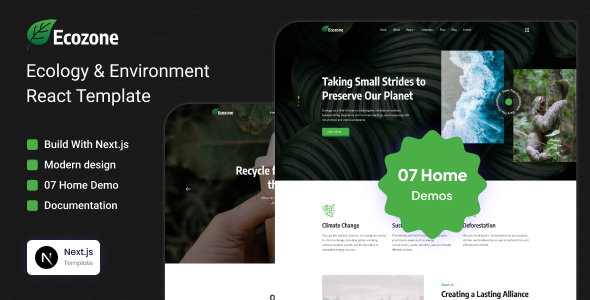
Ecozone – Ecology & Environment Next.js Template Ecozone is a modern, clean, and nature-inspired Ecology & Environment Next.js Template designed for environmental...

Archivue - NextJS Interior Design Landing Page Template Archivue - NextJS Interior Design Landing Page Template is a modern website template designed...

Mizzle - Technology & Corporate Angular Tailwind CSS Template Mizzle is a modern and feature-rich Angular Tailwind CSS template designed for technology...
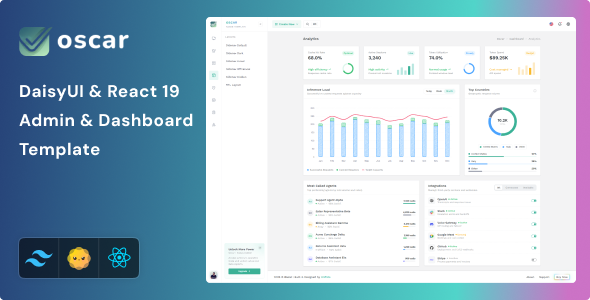
Oscar - React Tailwind CSS DaisyUI Admin & Dashboard Template Oscar is a modern, powerful, and highly customizable React admin dashboard template...
