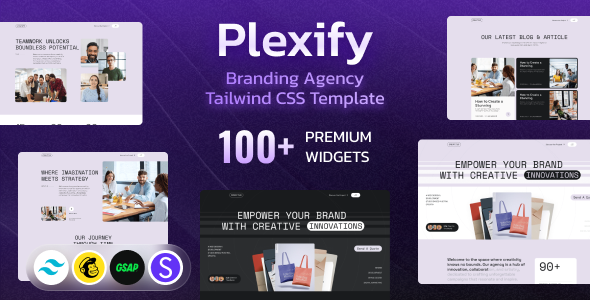
Plexify – Branding Agency Tailwind CSS Template is a modern website template designed for branding agencies, creative studios, graphic designers, digital marketing companies, and brand strategy consultants who want to establish a distinctive online presence. Built around the Tailwind CSS styling framework, Plexify provides a foundation for presenting creative services, showcasing brand identity projects, highlighting design expertise, and communicating the value of professional branding solutions through a polished website.
In today’s competitive digital landscape, businesses need a recognizable identity that communicates their values, personality, and market positioning. A professional branding agency website helps demonstrate how creative strategy, visual design, and consistent messaging can strengthen a business’s presence. Plexify can be customized to present these capabilities through project showcases, service descriptions, agency introductions, and client inquiry sections.
Whether you operate a boutique branding studio, manage a creative agency, provide brand strategy consulting, or work independently as a visual identity designer, Plexify can serve as a starting point for building a professional portfolio and agency website. Its actual page layouts, interactive elements, and included components should be verified against the official product demo and documentation.
A branding agency website should reflect the creativity and strategic thinking that the agency offers its clients. Visitors often evaluate the quality of a studio’s work, its visual consistency, and its approach to problem-solving before deciding to start a project.
Plexify is positioned for the branding and creative services industry, making it suitable for businesses that want a contemporary and visually engaging digital presence. The template can be customized with carefully selected typography, distinctive color combinations, professional imagery, and clear content sections that reflect the agency’s identity.
A well-structured website can introduce the agency’s philosophy, explain its services, highlight selected projects, and guide prospective clients toward a consultation or inquiry. The design can be adapted to minimalist brand studios, bold creative agencies, corporate identity consultants, and multidisciplinary design teams.
By maintaining consistency across headings, visual assets, buttons, and page layouts, an agency can create an online experience that supports its brand positioning.
Branding agencies often provide several related services, from initial research and positioning to visual identity development and ongoing brand communication.
Plexify can be customized to present these offerings through dedicated service sections or individual service pages, depending on the included layouts and components.
Potential service categories include:
These are suggested service categories rather than a guarantee that every service page is included as a ready-made layout.
Each service page can explain the agency’s process, deliverables, intended audience, and project outcomes. Clear descriptions help prospective clients understand the difference between strategic consulting, visual design, and broader marketing services.
Agencies should tailor this content to their actual expertise and avoid presenting services they do not provide.
A portfolio is one of the most important elements of a branding agency website. It gives potential clients an opportunity to evaluate the agency’s creative style, design capabilities, and experience across different industries.
Plexify can serve as a foundation for presenting completed branding projects through image-led layouts, project cards, featured case studies, and individual project pages, depending on the available components.
Potential portfolio categories include logo design, visual identity systems, packaging, editorial design, digital branding, corporate identity, and marketing campaigns.
An individual case study can be customized to explain the client’s background, project objectives, creative direction, design decisions, and final deliverables. Showing the thinking behind a project can communicate strategic expertise more effectively than displaying a logo alone.
For a stronger portfolio, use high-quality original visuals, consistent image presentation, and concise descriptions. Only publish client work that the agency has permission to display, and accurately represent the agency’s role in each project.
Successful branding involves more than choosing colors and designing a logo. It can include audience research, market positioning, messaging, differentiation, and defining how a business should communicate with its customers.
Plexify can be adapted to explain the strategic services offered by a branding consultancy. Dedicated content sections may describe discovery workshops, brand audits, competitor research, positioning exercises, audience definition, and messaging development where these services are part of the agency’s offering.
Explaining the process helps potential clients understand how the agency approaches a branding project from the initial brief through concept development and implementation.
Agencies can also communicate their working methodology, collaboration practices, project milestones, and expected deliverables. This information helps establish realistic expectations and supports more productive client conversations.
The homepage is often the first opportunity to communicate an agency’s identity and expertise. It should help visitors understand what the agency does, who it serves, and why its approach may be relevant to their business.
Plexify can be customized to introduce the agency through a prominent headline, concise value proposition, selected projects, featured services, and clear calls to action.
Additional homepage sections may include agency statistics, client testimonials, team introductions, recent work, frequently asked questions, and contact information, depending on the available layouts and customization.
A focused introduction can communicate the agency’s specializations, such as startups, lifestyle brands, technology companies, retail businesses, or established corporate organizations.
The goal is to guide visitors through the website naturally while providing enough information to encourage them to explore the portfolio or discuss a potential project.
Tailwind CSS is a utility-first CSS framework that enables developers to build custom interfaces using predefined styling classes. This approach can make it easier to adjust spacing, typography, colors, layouts, and responsive behavior directly within the markup.
As a Tailwind CSS template, Plexify is relevant to developers who want a flexible frontend foundation rather than a website tied to a particular visual editing platform.
Depending on the supplied source code, developers can customize page structures, modify styling utilities, update visual components, replace images, and create additional sections to suit their requirements.
Common customization tasks include:
The exact setup depends on whether the package includes plain HTML, JavaScript, a framework integration, or a build process. Review the documentation and project files before making major changes.
Potential clients may discover a creative agency through search engines, social media, online directories, or direct referrals. A responsive website helps ensure that the portfolio and service information remain accessible across smartphones, tablets, laptops, and desktop computers.
When properly implemented, Plexify can provide a foundation for layouts that adapt to different viewport sizes. Navigation, project galleries, service cards, and inquiry sections should remain usable without unnecessary horizontal scrolling or difficult interactions.
Responsive design is especially important for image-heavy portfolio pages. Project imagery should scale appropriately, text should remain readable, and calls to action should be easy to use on touchscreens.
Before launch, test the actual pages across common browsers and screen sizes. Custom animations, interactive navigation, and third-party widgets should also be tested to confirm that they behave correctly on mobile devices.
Search engine optimization can help branding agencies attract businesses searching for logo design, brand strategy, visual identity services, and creative consulting.
Plexify can provide a frontend foundation for an SEO-focused website, but search visibility depends on content quality, technical configuration, competition, website authority, and ongoing optimization.
Recommended practices include creating unique page titles and meta descriptions, maintaining a logical heading hierarchy, using descriptive URLs, and developing dedicated pages for important services.
Portfolio case studies can also provide valuable search content when they explain the project background, creative approach, deliverables, and industry context. Image alternative text should describe relevant visuals rather than repeat unrelated keywords.
If the template uses a frontend framework or build process, developers should ensure that important page content and metadata are accessible to search engines. A Tailwind CSS-based design does not automatically provide complete SEO functionality.
Additional tasks may include configuring sitemaps, canonical URLs, analytics, structured data where appropriate, and performance monitoring.
Creative agency websites often rely on large images, project mockups, brand presentations, and visual assets. These elements can improve the portfolio experience, but oversized files may slow down page loading.
Developers can improve performance by using appropriately sized images, selecting efficient file formats, optimizing fonts, removing unused CSS and JavaScript, and avoiding unnecessary third-party scripts.
The actual performance of Plexify depends on the supplied code, hosting environment, image assets, page complexity, and additional integrations. The website should be tested rather than assumed to be optimized by default.
For portfolio pages, consider loading important content first and avoiding unnecessarily large image galleries on initial page load. Performance testing can help identify bottlenecks before the website is published.
A branding agency website should make it easy for potential clients to discuss their business goals and project requirements.
Plexify can be customized to present contact details and inquiry options such as email links, telephone numbers, consultation requests, and contact forms. A project inquiry form might ask for a company name, contact details, project type, approximate budget, and a short description of the client’s objectives.
These are possible additions rather than guaranteed built-in features. Functional forms require appropriate submission handling, validation, spam prevention, and reliable message delivery.
Agencies may also connect their website to a customer relationship management system or lead management workflow. Such integrations can help organize inquiries and follow up with prospective clients, but require separate configuration where not included.
Only collect information that is necessary for the inquiry process, and provide suitable privacy information when handling personal data.
Testimonials and client feedback can help communicate the value of an agency’s work. When presented accurately, they provide context about the collaboration process, communication quality, and results achieved.
Plexify can be customized to include testimonial sections or client feedback on appropriate pages if the available components support them. Agencies can also present client logos, industry experience, awards, or project milestones where they have permission and evidence to do so.
For stronger credibility, use genuine testimonials and obtain consent before publishing client names, company logos, or other identifying information.
Avoid unsupported performance claims or fabricated endorsements. Transparent information helps prospective clients evaluate the agency and understand what it can realistically deliver.
Plexify can be considered for a range of creative and professional service businesses, including:
Its suitability for a particular project depends on the actual included layouts, source files, styling system, and additional functionality required.
Before using Plexify, review the official documentation and confirm the included files, framework requirements, dependencies, and any required build tools.
A typical setup process involves downloading the template package, extracting the files, reviewing the project structure, installing dependencies if required, and opening or running the website according to the supplied instructions.
Developers can then update the agency’s branding, replace demonstration content, customize services and project pages, and configure navigation. Additional work may include connecting inquiry forms, setting up analytics, and preparing the site for production hosting.
Before publishing, test all important links, verify images and typography, review responsive layouts, check page metadata, and confirm that forms work correctly. Remove placeholder text and ensure that all portfolio projects, client references, and service descriptions are accurate.
Plexify – Branding Agency Tailwind CSS Template provides a starting point for building a professional website for branding agencies, creative studios, visual identity designers, and brand strategy consultants. Its Tailwind CSS-based approach offers a flexible foundation for customizing service pages, presenting creative portfolios, communicating agency expertise, and encouraging client inquiries.
By combining a distinctive visual identity, well-organized case studies, responsive layouts, search-friendly content, and reliable inquiry workflows, businesses can adapt Plexify to support their branding and digital marketing objectives.
Before purchasing or deploying Plexify, review the official demo, included pages, source files, documentation, framework requirements, and licensing terms. Confirm which layouts and interactive features are included and which require additional development so that the finished website meets your business and technical requirements.
1. All digital products are the most recent version, with no possibility of free updates. After payment, you can request an update to the most recent version for 5 days if a new version is released. We free support within 5 days.
2. If a license is required (Excludes WHMCS license , we provide only method not license), please contact us via email or ticket for assistance with activation. Our license is only valid for activation and does not include support.
3. We provide Mobile, PHP script installation services for $19.90 / ₹1700. Please create a backup after installation as we do not support re-installation. For mobile app source code, we do not offer installation services.
4. If you have any questions, please contact us by email [email protected] or create a ticket on this page
5. Please note that any digital products presented on the website do not contain malicious code, viruses or advertising. You will receive the original files from the developers. We do not sell any products that have been downloaded from other websites.
6. The response time can last up to 6 hours.
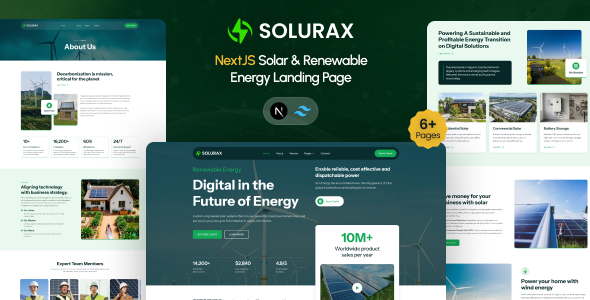
Solurax - NextJS Renewable & Solar Energy Landing Page Template Solurax - NextJS Renewable & Solar Energy Landing Page Template is a...
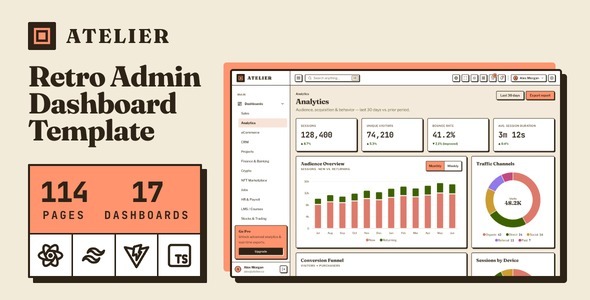
Atelier | Retro Style Admin & Dashboard Template Atelier | Retro Style Admin & Dashboard Template is a distinctive administrative interface template...
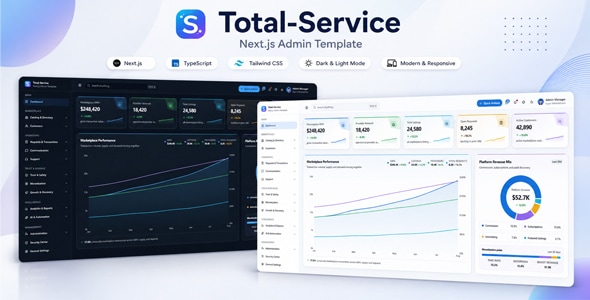
Total Service Next.js Admin Template Total Service Next.js Admin Template is a modern administrative dashboard template designed for developers, businesses, and service-based...
Admina - Tailwind & Nextjs Admin Dashboard with shadcn UI Admina - Tailwind & Nextjs Admin Dashboard with shadcn UI is a...
