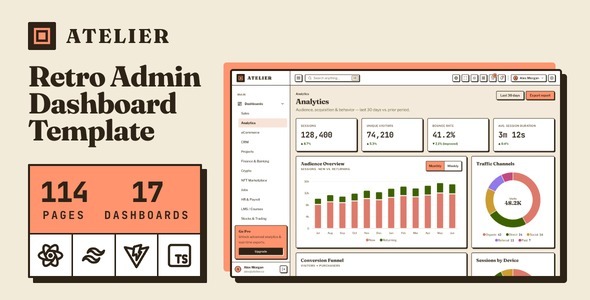
Atelier | Retro Style Admin & Dashboard Template is a distinctive administrative interface template designed for developers, designers, startups, and businesses that want to build professional dashboard experiences with a retro-inspired visual identity. Combining an administration-focused layout with vintage-inspired design aesthetics, Atelier provides a starting point for creating management panels, business dashboards, internal web applications, and customized backend interfaces.
Administrative dashboards are essential for managing application data, monitoring business operations, organizing records, and accessing important system functions. While many dashboard designs prioritize conventional corporate styling, a retro-inspired interface can offer a more recognizable visual identity for products that value creativity, personality, and distinctive branding.
Atelier is suited to projects that want to combine practical administrative workflows with a visually differentiated interface. Developers can customize the layout, typography, colors, navigation, and content to match the needs of a particular application. Whether you are developing a creative agency dashboard, a content management interface, a business administration system, or an internal management portal, Atelier can serve as a foundation for further development.
Atelier’s defining concept is its retro-style visual direction. Retro-inspired interfaces can draw on vintage typography, nostalgic color palettes, expressive design elements, and distinctive visual hierarchy to create an experience that differs from conventional dashboard layouts.
A well-designed retro dashboard should still prioritize usability. Administrators need to locate important information, navigate between sections, review records, and complete routine tasks efficiently. A consistent layout can help balance visual character with practical functionality.
Depending on the layouts included in the original package, Atelier can be customized with dashboard summaries, navigation menus, content sections, data views, forms, and other administrative interface elements.
Developers can adjust the styling to create different visual directions, including minimalist vintage interfaces, colorful retro-inspired dashboards, editorial-style management panels, or creative business administration tools.
The exact components and layouts available should be verified against the original product preview and source files.
A multipurpose admin dashboard can support a variety of applications that need a centralized interface for managing information and workflows.
Atelier’s retro-inspired appearance can be particularly relevant to projects where visual identity is an important part of the product experience.
Potential use cases include:
These examples describe potential applications rather than a guarantee that every workflow is already implemented.
An effective dashboard helps users understand important information at a glance. Instead of navigating through multiple pages to find essential data, administrators can review selected summaries from a centralized overview.
Atelier can provide a visual starting point for organizing dashboard information, depending on the components included in the supplied package.
Potential dashboard elements include summary cards, status indicators, recent activity sections, quick-action links, data tables, and chart areas where supported.
For example, a project management application might display ongoing projects and task statuses, while an inventory system could highlight stock levels and recent product updates. A content management dashboard might focus on publication activity, drafts, and recent content changes.
The underlying data and business calculations must be connected to the appropriate backend services. Static visual elements alone do not provide live reporting or automatic data updates.
Clear navigation is important when a dashboard contains multiple management sections. A structured navigation system helps users understand the application’s organization and locate the tools they need.
Depending on the available layouts, Atelier can be adapted to include navigation menus, headers, sidebars, page titles, content panels, and other common administrative structures.
Developers can organize application sections around the actual workflows of the product. A business dashboard might include customers, reports, settings, and activity records, while a content management system may focus on posts, categories, media, and user permissions.
Consistent page layouts can reduce confusion and make it easier to maintain a unified visual experience across the application.
When customizing navigation, developers should consider how menu items are grouped, which actions are most frequently used, and how the interface behaves on smaller screens.
Administrative applications frequently require forms for entering information and tables for displaying structured records. These components support tasks such as reviewing data, editing entries, managing products, and updating business information.
Atelier can serve as a visual foundation for these workflows where suitable form and table components are included.
Potential interface applications include:
Additional features such as pagination, sorting, advanced filters, bulk actions, data exports, and inline editing may require additional development or compatible libraries.
For applications that manage large datasets, developers should also consider efficient database queries, server-side pagination, clear validation messages, and useful error handling.
One of the main advantages of using an admin template is the ability to customize its appearance according to a product’s identity.
Atelier’s retro-inspired concept provides a starting point for developers who want an administrative interface with a more distinctive personality. Colors, typography, icons, spacing, borders, backgrounds, and page sections can be adapted to suit the intended application.
A creative business might use a more expressive visual palette, while an internal business tool could adopt a restrained retro aesthetic that keeps information easy to read.
Developers can also establish reusable styling conventions for buttons, forms, tables, navigation elements, and dashboard cards. Consistent styling can make the application easier to maintain as additional pages and functionality are introduced.
The extent of customization depends on the original source structure, included styling resources, and the requirements of the final project.
Administrative applications may be accessed from desktop computers, laptops, tablets, and smartphones. A responsive layout helps users access important information across different screen sizes.
If Atelier includes responsive layouts, developers can customize the navigation, cards, tables, and content sections to support the intended devices.
Important areas to test include sidebar behavior, navigation menus, dashboard summaries, form controls, wide data tables, and interactive buttons. On smaller screens, some components may need to be rearranged or adapted to remain usable.
Tables may require horizontal scrolling or a more compact presentation, while navigation may need to collapse into a mobile-friendly menu.
Responsive behavior should be verified in the original package and tested across common browsers and viewport sizes before deployment.
An admin template can help reduce repetitive interface work by providing a foundation for common dashboard layouts. Developers can then concentrate on connecting the interface to application-specific logic and data.
A typical workflow includes reviewing the project structure, identifying available layouts and components, installing required dependencies, and configuring the development environment.
The next step is to customize navigation and page content, connect interface elements to the relevant routes, and implement the required backend functionality.
Depending on the original implementation, the template may need to be integrated with a backend framework, database, authentication system, or external API.
Developers should review the supplied documentation, supported technologies, and licensing terms before making extensive changes. Version control and testing can help maintain stability as the project evolves.
A dashboard becomes functional when its interface is connected to the underlying application.
Atelier can serve as a frontend foundation for integrating supported interface elements with backend services, depending on its source architecture.
Potential integration tasks include loading records from a database, submitting forms, updating application settings, retrieving dashboard statistics, and communicating with external APIs.
For example, a customer management system could connect a record table to customer data, while a reporting interface might retrieve business metrics from an analytics service.
Developers must implement suitable request validation, authentication, authorization, loading states, and error handling to support these interactions.
External integrations and live data functionality should not be assumed to be included unless explicitly stated in the original feature list.
An administrative dashboard can expose sensitive information and important application controls. A production system should therefore include appropriate security measures.
Depending on the application architecture, developers may need to implement authentication, role-based permissions, protected routes, server-side validation, secure session management, and activity logging.
Sensitive operations should be authorized on the server rather than protected only by hiding buttons or menu items in the frontend.
Additional recommended practices include using HTTPS, protecting environment variables, keeping dependencies updated, restricting database access, and maintaining reliable backups.
The template’s design does not automatically provide a complete secure administration system. Developers should verify which security capabilities are included and implement the remaining controls before using the application with real business data.
A dashboard should remain responsive and understandable even when it contains large amounts of information.
Developers can improve the user experience by organizing related information into logical sections, using clear labels, minimizing unnecessary interface elements, and providing meaningful feedback after user actions.
Performance considerations may include limiting unnecessary JavaScript, optimizing images and other assets, reducing redundant network requests, and loading large datasets efficiently.
A visually distinctive retro style should not compromise readability or accessibility. Sufficient text contrast, keyboard navigation, descriptive labels, and predictable interactions can help make the interface more practical for a wider range of users.
Testing with realistic data and common administrative workflows can reveal usability problems before the application is deployed.
Atelier may be useful for a variety of professionals and organizations.
Web developers: Customize an admin dashboard for a new or existing web application.
Creative agencies: Build distinctive management interfaces for creative workflows and client projects.
SaaS founders: Develop an administrative interface for managing application data and settings.
Freelancers: Create customized dashboard solutions for client projects.
Product designers: Adapt the retro-inspired styling to match a defined product identity.
Business software teams: Establish a starting point for internal management tools and operational dashboards.
The amount of additional development required depends on the original template, the application’s technical architecture, and the features needed for the final product.
Atelier | Retro Style Admin & Dashboard Template offers a distinctive starting point for developers who want to create administrative interfaces with a retro-inspired visual identity. Its dashboard-focused purpose makes it relevant to business management systems, creative tools, SaaS administration panels, content management interfaces, and custom web applications.
By customizing the available layouts, navigation, styling, and data presentation, developers can adapt the template to different workflows while maintaining a consistent interface. Additional backend development and integrations can extend the design to support live data, record management, authentication, reporting, and other application-specific requirements.
Before purchasing or deploying Atelier, review the original demo, included page layouts, source files, framework requirements, dependencies, responsive behavior, and licensing terms. For developers seeking an admin interface that combines a distinctive retro aesthetic with practical dashboard customization opportunities, Atelier is an option worth considering for the next web development project.
1. All digital products are the most recent version, with no possibility of free updates. After payment, you can request an update to the most recent version for 5 days if a new version is released. We free support within 5 days.
2. If a license is required (Excludes WHMCS license , we provide only method not license), please contact us via email or ticket for assistance with activation. Our license is only valid for activation and does not include support.
3. We provide Mobile, PHP script installation services for $19.90 / ₹1700. Please create a backup after installation as we do not support re-installation. For mobile app source code, we do not offer installation services.
4. If you have any questions, please contact us by email [email protected] or create a ticket on this page
5. Please note that any digital products presented on the website do not contain malicious code, viruses or advertising. You will receive the original files from the developers. We do not sell any products that have been downloaded from other websites.
6. The response time can last up to 6 hours.
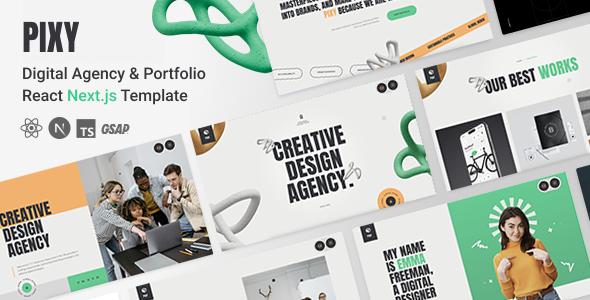
Pixy - Creative Agency Portfolio NextJS Template Pixy - Creative Agency Portfolio NextJS Template is a modern website template designed for creative...
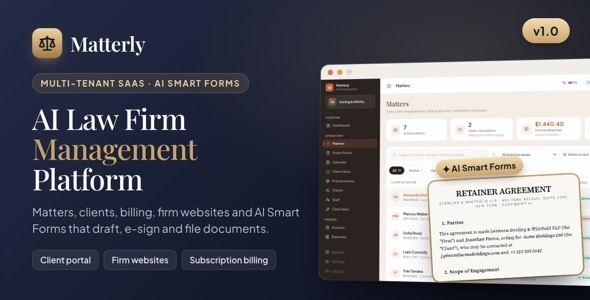
Matterly - AI Law Firm Management SaaS With Smart Forms Matterly is a modern and intelligent law firm management SaaS platform designed...
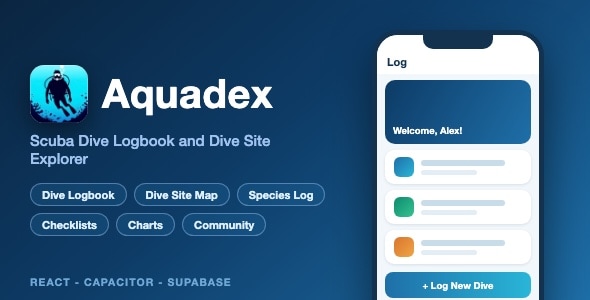
Aquadex | Dive Logbook and Dive Site Explorer With Species Log - Capacitor Explore underwater destinations, document memorable dives, and record marine...
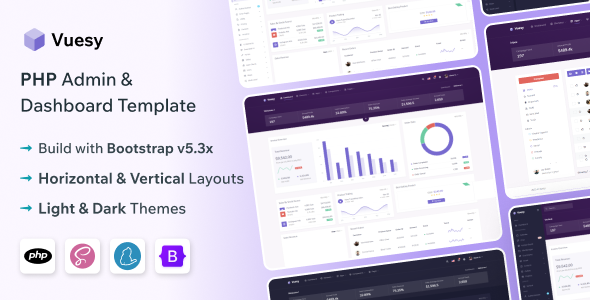
Vuesy - PHP Admin & Dashboard Template Vuesy - PHP Admin & Dashboard Template is a modern administration interface designed to help...
