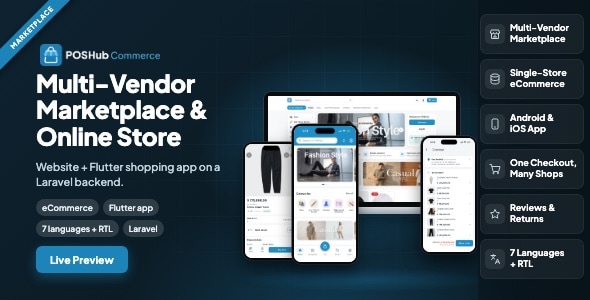
POSHub Commerce | Multi-Vendor Marketplace & eCommerce Platform is a comprehensive eCommerce solution designed to provide a foundation for building and managing a multi-vendor online marketplace. It is suitable for entrepreneurs, retailers, startups, and businesses looking to establish a centralized digital shopping platform where multiple sellers can offer products to customers through a shared storefront.
A multi-vendor marketplace brings buyers and sellers together within one online ecosystem. Instead of operating a traditional single-store eCommerce website, marketplace owners can allow multiple vendors to register, manage their product listings, and participate in selling through a common platform. This creates opportunities to build an online shopping destination across different product categories and business niches.
POSHub Commerce is designed around the needs of a modern marketplace and eCommerce business. Its concept supports a centralized platform where marketplace administrators oversee operations while vendors and customers interact through their respective shopping and management experiences. The project can serve as a starting point for developing a branded marketplace with customized product management, order workflows, vendor operations, and commercial features, depending on the modules included in the supplied package.
The multi-vendor marketplace model allows several independent sellers to operate within a single eCommerce platform. Each vendor can have a dedicated presence while the marketplace owner maintains control over the overall shopping environment.
This structure is useful for businesses that want to create an online marketplace without requiring every seller to develop and maintain a separate website.
Depending on the included functionality, a marketplace system can be extended to support:
The exact vendor capabilities and workflows depend on the implementation included with the product. Additional development may be required for advanced seller verification, automated payouts, vendor subscriptions, or complex commission calculations.
A smooth shopping experience is essential for attracting customers and encouraging repeat purchases. A modern marketplace should make it easy for visitors to discover products, compare available options, review product information, and complete purchases.
POSHub Commerce provides a foundation for developing a centralized online shopping experience where products from multiple sellers can be presented through an organized storefront.
The shopping interface can be customized to match different business models, including general marketplaces, fashion stores, electronics marketplaces, home and lifestyle shops, beauty product platforms, and specialized retail businesses.
Depending on the supplied frontend features, the shopping experience can be extended with product collections, category navigation, product detail pages, promotional sections, shopping cart functionality, and customer account features.
A well-structured storefront also helps marketplace owners organize their product catalog and present a consistent brand identity even when products are supplied by different vendors.
Vendor management is one of the most important parts of a multi-vendor marketplace. Sellers need a convenient way to join the platform, maintain their business information, and manage their participation in the marketplace.
A vendor management system can provide a structured onboarding process through which sellers submit their details and receive access after the required approval process.
Depending on the included modules, vendor functionality may be extended to support:
Marketplace administrators may also require the ability to review seller applications, approve or reject accounts, manage vendor permissions, and monitor seller activity.
For commercial use, additional features such as business verification, tax information collection, seller agreements, and automated vendor settlements may need to be implemented according to local regulations and business requirements.
A centralized product catalog helps marketplace administrators and sellers organize merchandise in a consistent format. Product management is particularly important when multiple vendors sell similar products or operate within overlapping categories.
The platform can be customized to support product information such as product names, descriptions, images, pricing, categories, stock quantities, and other relevant attributes, depending on the included product management modules.
Potential catalog management capabilities include:
Inventory management is important for preventing customers from purchasing unavailable products. A more advanced implementation may include stock adjustments, low-stock notifications, inventory history, and synchronization with external retail systems.
For marketplaces with complex product variations, additional customization may be required for sizes, colors, models, product bundles, and other configurable options.
Order management connects customer purchases with the operational activities of vendors and marketplace administrators.
A multi-vendor environment may involve products from different sellers within the same customer order. The platform therefore needs suitable order-processing logic to handle the relationship between customers, vendors, purchased products, payments, and fulfillment activities.
Depending on the supplied functionality, order management can be extended to include:
A production-ready marketplace should carefully define how mixed-vendor orders are divided into vendor-specific fulfillment tasks. Shipping calculations, delivery fees, tracking integrations, and return policies may require additional configuration or third-party services.
The shopping cart and checkout process are central components of any eCommerce platform. Customers should be able to review selected products, check applicable charges, provide delivery information, and complete their purchases through a straightforward process.
POSHub Commerce can serve as a foundation for customizing the checkout journey according to the marketplace’s business model and supported payment integrations.
Potential checkout capabilities include cart management, product quantity adjustments, customer information collection, shipping details, order summaries, and payment processing.
For multi-vendor transactions, developers should consider how the system handles products supplied by different sellers, including shipping calculations, vendor order separation, payment allocation, and order confirmation.
Payment gateways must be integrated and configured separately where they are not already included. Secure transaction verification, payment status synchronization, refunds, and payment failure handling should be managed through reliable backend workflows.
A multi-vendor marketplace can generate revenue through different commercial models. One common approach is charging sellers a commission for each successful sale.
The marketplace owner can define a revenue model that fits the platform’s target audience and business strategy.
Possible monetization approaches include:
A commission management module can be developed to calculate the marketplace’s share of eligible transactions and determine the amount payable to vendors.
The exact commission rules, calculation methods, and automated settlement capabilities depend on the included implementation. Payment splitting, vendor payouts, transaction reconciliation, and financial reporting may require additional payment provider integrations and backend development.
Marketplace administrators need centralized visibility into the platform’s operations. An administrative dashboard can help business owners manage vendors, products, customers, orders, and other important marketplace information.
Depending on the supplied admin modules, the dashboard can be customized to provide:
A centralized dashboard is especially valuable as the marketplace grows because it provides an organized place to supervise different business activities.
Role-based access control can also be implemented to assign appropriate permissions to administrators, managers, support staff, and other authorized users.
Customer accounts help users manage their shopping activities and maintain information associated with their purchases.
Depending on the included functionality, the platform can be extended with customer registration, login, profile management, saved addresses, order history, and account settings.
A convenient customer account area can improve the shopping experience by allowing buyers to review previous orders and access relevant purchase information without contacting marketplace support for every request.
Additional features such as wishlists, product reviews, ratings, loyalty programs, saved payment methods, and personalized recommendations can be considered for future development if they are not already part of the supplied package.
Product discovery is an important factor in the usability of a large online marketplace. As the product catalog expands, customers need effective ways to locate relevant products.
A well-organized category structure helps visitors navigate different product types and discover items from multiple sellers.
The marketplace can be customized with search and filtering capabilities based on product categories, pricing, brands, availability, ratings, and other relevant product attributes, depending on the available implementation.
Additional improvements may include sorting options, advanced search, product recommendations, related products, and promotional collections.
These features can help create a more convenient browsing experience and make it easier for customers to explore a larger product catalog.
A modern marketplace should provide a consistent experience across desktop computers, tablets, and smartphones.
Responsive layouts help customers browse products and access important shopping functions on different screen sizes. Vendors and administrators can also benefit from accessible management interfaces when operating the platform from different devices.
POSHub Commerce can be customized with business-specific branding, including logos, colors, typography, storefront layouts, product presentation, category structures, and promotional content.
The platform can be adapted for different industries and marketplace concepts, including:
A marketplace handles several types of sensitive information, including customer accounts, vendor details, orders, and payment-related records. Security should therefore be considered throughout the development and deployment process.
A production implementation should include secure authentication, authorization checks, protected administrative routes, input validation, secure API communication, and appropriate data protection practices.
Payment credentials and sensitive configuration values should be stored securely. Administrative permissions should follow the principle of least privilege, ensuring that users only access the functions required for their responsibilities.
Regular software updates, database backups, monitoring, and security testing are also important for maintaining a reliable marketplace.
Businesses operating across different regions should consider applicable consumer protection, privacy, taxation, payment, and marketplace regulations.
Launching a marketplace requires proper configuration of its application environment, database, backend services, frontend interfaces, and external integrations.
Before deployment, developers should review the supplied documentation to identify the supported technology stack, required dependencies, environment variables, database structure, and installation procedures.
Important deployment considerations include:
For a growing marketplace, hosting infrastructure should be selected according to expected traffic, product catalog size, order volume, and storage requirements.
POSHub Commerce can be a useful starting point for different types of businesses and development teams.
POSHub Commerce | Multi-Vendor Marketplace & eCommerce Platform provides a foundation for developing an online marketplace that connects multiple sellers with customers through a centralized shopping environment. Its multi-vendor concept supports the development of essential marketplace workflows involving product catalogs, seller management, customer shopping, order processing, and administrative control.
Whether you want to establish a general shopping marketplace, build an industry-specific eCommerce platform, or expand an existing retail business, POSHub Commerce can serve as a starting point for creating a customized digital commerce solution.
With the appropriate payment integrations, vendor commission rules, inventory workflows, shipping services, and security configuration, the platform can be adapted to support a growing marketplace business.
Note: Please review the official product documentation and included source code to confirm the actual technology stack, vendor and customer modules, payment gateway support, commission functionality, inventory features, and deployment requirements. Third-party integrations, hosting, payment processing, shipping services, and additional customization may involve separate costs.
1. All digital products are the most recent version, with no possibility of free updates. After payment, you can request an update to the most recent version for 5 days if a new version is released. We free support within 5 days.
2. If a license is required (Excludes WHMCS license , we provide only method not license), please contact us via email or ticket for assistance with activation. Our license is only valid for activation and does not include support.
3. We provide Mobile, PHP script installation services for $19.90 / ₹1700. Please create a backup after installation as we do not support re-installation. For mobile app source code, we do not offer installation services.
4. If you have any questions, please contact us by email [email protected] or create a ticket on this page
5. Please note that any digital products presented on the website do not contain malicious code, viruses or advertising. You will receive the original files from the developers. We do not sell any products that have been downloaded from other websites.
6. The response time can last up to 6 hours.
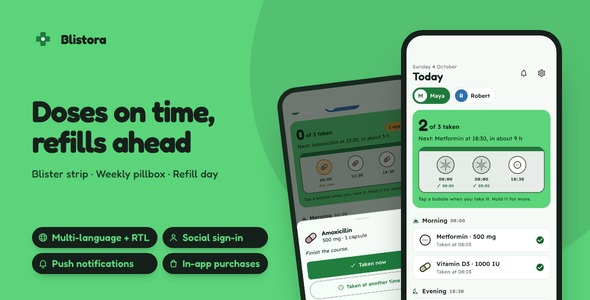
Blistora | Flutter Medication Reminder and Refill Tracker App With Laravel Cloud Backup Blistora | Flutter Medication Reminder and Refill Tracker App...
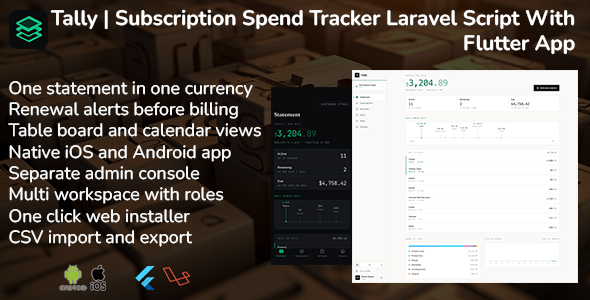
Tally | Subscription Spend Tracker Laravel Script With Flutter App Tally | Subscription Spend Tracker Laravel Script With Flutter App is a...

Yield | Revenue Analytics PHP Script With Flutter App Yield | Revenue Analytics PHP Script With Flutter App is a revenue analytics...
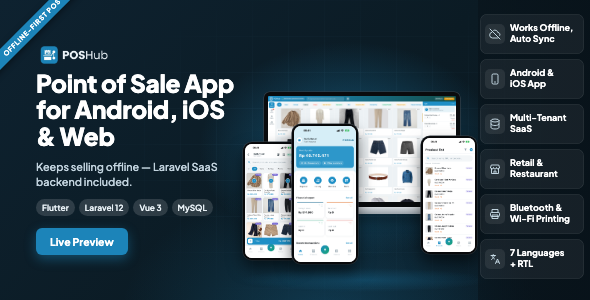
POSHub | Offline-First POS Flutter App for Retail & Restaurant with Laravel SaaS Backend POSHub | Offline-First POS Flutter App for Retail...
