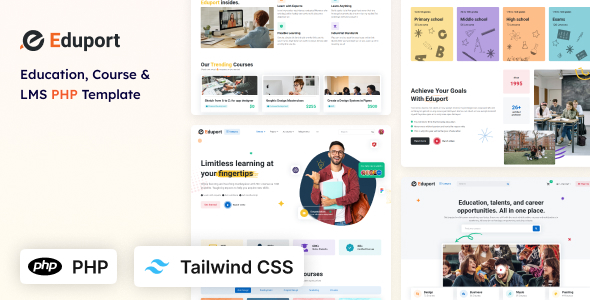
Eduport – LMS, Education and Course PHP Template (Tailwind CSS) is a modern website template designed for online learning platforms, educational institutions, course providers, training academies, and e-learning businesses. Combining a PHP-oriented website structure with Tailwind CSS styling, Eduport provides a starting point for creating an educational website that presents online courses, introduces instructors, organizes learning categories, and helps students discover educational opportunities. Its education-focused design makes it suitable for businesses that want to establish a professional online learning presence, promote digital courses, and build a structured interface for students, teachers, and educational organizations.
Online education has become an important way for students and professionals to develop new skills, access specialized knowledge, and learn at their own pace. Educational websites need to present course information clearly, organize learning resources, and help visitors understand the available programs before enrolling.
Eduport is intended to support these requirements by providing a website foundation tailored to the learning management system (LMS) and online education niche. It can be adapted for online course marketplaces, professional training websites, coaching institutes, educational academies, university-related projects, and independent instructors who want to promote their learning programs.
The combination of PHP-oriented development and Tailwind CSS styling can provide a useful foundation for developers who want to customize educational page layouts and connect the interface to appropriate server-side functionality.
It is important to distinguish an educational website template from a complete LMS application. Features such as student accounts, course progress tracking, instructor dashboards, quizzes, certificates, payment processing, and course administration require working backend functionality unless they are explicitly included in the supplied package.
An educational website should make it easy for visitors to explore courses, understand learning opportunities, and locate important information. Eduport provides an education-focused starting point that can be adapted to different teaching models and institutional identities.
The design can be customized with an organization’s logo, brand colors, typography, course imagery, and written content. A professional training company may emphasize career development and certifications, while an academic institution may focus on structured programs and educational resources.
Developers can organize content around the needs of students, instructors, and prospective customers, creating a more consistent experience throughout the website.
The exact page layouts, components, and interactive elements should be confirmed by reviewing the official demo and supplied documentation.
A well-organized course catalog helps students discover educational content according to their interests, skill levels, and learning objectives.
Eduport can be adapted to present courses in categories such as web development, programming, business, digital marketing, graphic design, data analytics, personal development, and professional training.
A course listing may display information such as:
These elements can help visitors compare learning opportunities and identify relevant courses.
If the template includes course cards or catalog layouts, they can provide the front-end structure for presenting course information. Dynamic search, filtering, sorting, and database-driven catalog management depend on the implementation supplied with the product or additional development.
A dedicated course page helps prospective learners understand what a program covers before deciding whether to enroll.
Eduport can serve as a starting point for presenting detailed course descriptions, learning objectives, prerequisites, instructor biographies, and curriculum information.
Depending on the actual page structure, course information may include:
Clear course descriptions help students make informed decisions and establish appropriate expectations about the learning experience.
A course information page is not the same as a functioning lesson player. Video delivery, downloadable resources, restricted lesson access, and progress tracking require additional functionality unless already provided.
Instructors play an important role in the credibility of an educational platform. Teacher profiles can introduce the people responsible for creating or delivering courses.
A profile section can be customized to display instructor photographs, biographies, professional qualifications, areas of expertise, and relevant experience.
For example, a programming instructor may highlight software development experience, while a business trainer may focus on management, entrepreneurship, or professional certifications.
A structured instructor directory can help students understand the expertise behind individual courses and identify teachers whose backgrounds match their learning goals.
Dynamic instructor registration, course ownership, earnings management, and instructor dashboards should be verified separately because these capabilities require more than a static profile layout.
Organizing courses into meaningful categories can improve navigation and make large educational catalogs easier to explore.
Eduport can be customized to group courses according to subject, industry, learning level, professional objective, or content format.
Potential categories include technology, business management, creative design, finance, marketing, communication skills, and academic preparation.
A clear category structure helps students browse related subjects and discover additional learning opportunities.
For larger platforms, developers may extend the front end with database-driven categories, filters, keyword search, and recommendation features. These functions require appropriate data handling and application logic if they are not already included.
An educational website may need to guide visitors from course discovery to enrollment. Eduport can provide a starting point for presenting registration and enrollment-related interfaces where supported by the supplied pages.
A registration workflow may collect basic account information, while an enrollment workflow may connect a learner with a selected course.
For a working implementation, developers must consider authentication, form validation, secure password handling, database storage, and appropriate access controls.
If the platform sells paid courses, enrollment may also need to connect with a payment provider and verify successful transactions before granting access.
A visible registration or enrollment form alone does not establish that student accounts or course enrollment are fully functional. Review the supplied code and documentation to determine which workflows are implemented.
Online education often combines video lessons, written explanations, presentations, assignments, and downloadable resources.
An educational website can be adapted to introduce these materials and organize them by course or module.
Potential resource types include:
The ability to display or link to learning resources depends on the supplied implementation. Protected downloads, streaming controls, lesson completion records, and access restrictions require additional functionality where they are not included.
Course content should also be organized with clear labels and accessible navigation so learners can locate the material relevant to their current lesson.
PHP is widely used for server-side web development and can support dynamic educational applications when combined with suitable application logic and a database.
For a PHP-based implementation, developers may be able to connect front-end pages to server-side routes, database records, user authentication, and other application services, depending on the structure of the supplied project.
Possible backend extensions include course administration, student management, instructor records, enrollment processing, and dynamic educational content.
The actual framework, PHP version, database requirements, and architecture must be verified in the official documentation. A product described as a PHP template should not automatically be assumed to be a complete LMS backend.
Tailwind CSS uses utility classes to style interface elements. This approach can make it easier for developers familiar with utility-first CSS to adjust spacing, typography, colors, responsive layouts, and other visual properties.
Possible customization tasks include:
The supplied Tailwind CSS version and build setup should be checked before making changes. If the project requires compiling Tailwind assets, developers may need to install the specified dependencies and configure the build process according to the documentation.
Educational businesses differ in their audiences and teaching models. An academic institution may emphasize formal programs and faculty information, while a skills-training platform may focus on practical courses and career development.
Eduport can be adapted to reflect these differences through customized content, branding, course imagery, category structures, and calls to action.
Consistent design and clear navigation help create a more recognizable educational brand and make the platform easier for students to use.
Eduport may be suitable as a starting point for several types of educational websites.
Online learning platforms: Present a catalog of courses, explain learning opportunities, and guide students toward enrollment.
Professional training companies: Promote career-oriented courses, workplace training, and skill development programs.
Coaching institutes: Introduce instructors, organize subjects, and publish information about available classes.
Independent educators: Create a professional website for promoting educational materials and online courses.
Corporate training providers: Present learning programs for employees, professional teams, and business customers.
Educational startups: Establish an initial website foundation that can later be connected to a more extensive learning management application.
Academic organizations: Organize educational program information and introduce teachers, departments, or learning resources.
The suitability of Eduport for each use case depends on the supplied pages and the amount of additional development required.
Students may access educational websites from desktop computers, tablets, and smartphones. A consistent experience across different screen sizes can make course discovery and learning information more accessible.
When evaluating Eduport, test the supplied implementation for responsive navigation, readable text, well-organized course cards, appropriately sized images, and usable forms.
A clear interface should help learners move between categories, course details, instructor profiles, and enrollment information without unnecessary navigation.
Accessibility should also be considered during customization. Logical heading structures, keyboard-accessible controls, readable contrast, descriptive image alternatives, and clearly labeled forms can improve usability for a wider range of students.
Responsive and accessibility behavior should be confirmed through testing rather than assumed from the product title.
Website performance can affect how quickly students access course listings and educational content. Search engine optimization can also help an educational business reach people searching for relevant subjects and training programs.
Recommended practices include:
Educational businesses may benefit from creating useful subject-specific pages that explain the learning outcomes, intended audience, and prerequisites of their courses.
A template provides a technical and visual starting point, but search rankings depend on content quality, site performance, competition, and ongoing optimization.
Educational platforms may handle personal information, account credentials, enrollment details, and payment-related data. Appropriate security measures are therefore important when turning a template into a working application.
Developers should use HTTPS, validate input on the server, protect database queries, manage sessions securely, and keep dependencies updated.
If student accounts are supported, password storage, authentication, authorization, and account recovery should follow established security practices.
For paid courses, payment credentials should be handled through an appropriate payment provider rather than stored insecurely by the application.
If the platform stores student progress or other sensitive information, access controls and data protection practices should be designed around the actual requirements of the service.
These capabilities must be evaluated against the supplied codebase; they should not be assumed to be included solely because the product is education-oriented.
The installation process depends on the PHP implementation, Tailwind CSS build configuration, dependencies, and project structure supplied with Eduport.
A typical setup process may involve:
A static or primarily front-end implementation may have different requirements from a complete PHP application connected to a database. Confirm the exact setup process before selecting hosting or planning a production deployment.
Always follow the supplied documentation for supported versions, configuration settings, and deployment commands.
Eduport may be suitable for:
E-learning businesses: Establish an online presence for digital courses and educational programs.
Training academies: Present training options, course details, instructors, and enrollment information.
Coaching institutes: Organize academic subjects and introduce teaching staff.
Professional educators: Promote specialized courses and learning resources.
Educational startups: Build an initial website foundation for a learning-focused business.
Web developers and digital agencies: Use a PHP and Tailwind CSS-based starting point for customized educational projects.
Before choosing the template, review the included pages, available functionality, licensing conditions, technical requirements, and any required backend development.
Eduport – LMS, Education and Course PHP Template (Tailwind CSS) provides an education-focused website foundation for online learning businesses, training providers, coaching institutes, and educational organizations.
Its intended purpose is to help present courses, organize learning categories, introduce instructors, communicate educational opportunities, and guide students toward enrollment. The combination of PHP-oriented development and Tailwind CSS styling can provide a useful starting point for developers who want to customize the interface and connect it to suitable application services.
However, a complete LMS involves more than educational website pages. Features such as student accounts, protected lessons, course progress tracking, quizzes, certificates, instructor dashboards, and payment processing should be verified in the supplied package or implemented separately.
For educational businesses and developers seeking a customizable learning website foundation, Eduport is worth evaluating against the project’s functional requirements, technology stack, and design goals. Reviewing the official demo, documentation, included files, and licensing terms will help determine whether it is the right choice for the intended educational platform.
1. All digital products are the most recent version, with no possibility of free updates. After payment, you can request an update to the most recent version for 5 days if a new version is released. We free support within 5 days.
2. If a license is required (Excludes WHMCS license , we provide only method not license), please contact us via email or ticket for assistance with activation. Our license is only valid for activation and does not include support.
3. We provide Mobile, PHP script installation services for $19.90 / ₹1700. Please create a backup after installation as we do not support re-installation. For mobile app source code, we do not offer installation services.
4. If you have any questions, please contact us by email [email protected] or create a ticket on this page
5. Please note that any digital products presented on the website do not contain malicious code, viruses or advertising. You will receive the original files from the developers. We do not sell any products that have been downloaded from other websites.
6. The response time can last up to 6 hours.
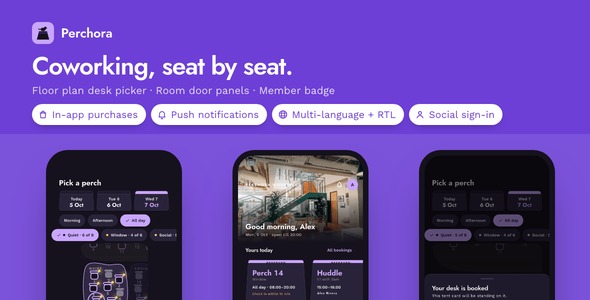
Perchora | Flutter Coworking Space Member App With Laravel Admin Perchora | Flutter Coworking Space Member App With Laravel Admin is a...
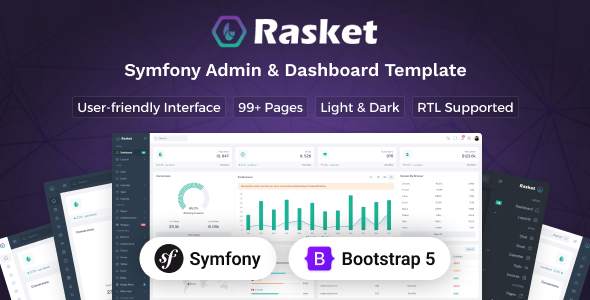
Rasket - Symfony Admin Dashboard Template Rasket - Symfony Admin Dashboard Template is a modern administrative dashboard template designed for developers, businesses,...
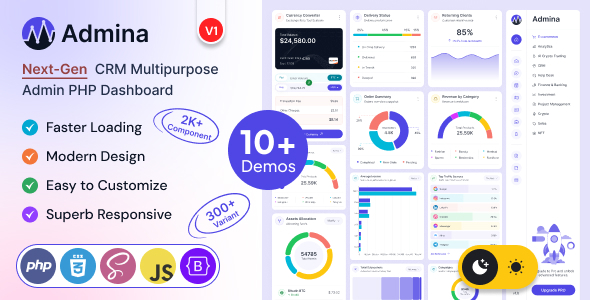
Admina – Php Admin Dashboard Template Multipurpose Admina – Php Admin Dashboard Template Multipurpose is a versatile administrative dashboard template designed for...
Sudsora | Flutter Laundry and Dry Cleaning App with Laravel Admin Simplify laundry services, streamline pickup requests, and manage cleaning orders with...
