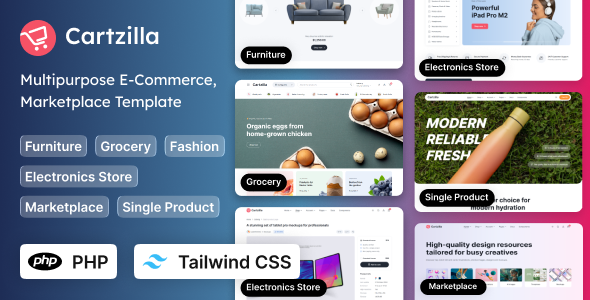
Cartzilla – Multipurpose E-Commerce Tailwind CSS PHP Template is a modern e-commerce website template designed for developers, online retailers, digital entrepreneurs, and businesses looking to create a professional online shopping experience. Combining a PHP-oriented development approach with the utility-first styling capabilities of Tailwind CSS, Cartzilla provides a foundation for building customized storefronts that showcase products, organize shopping categories, and present essential information throughout the customer journey. Its multipurpose nature makes it suitable for a wide range of online retail concepts, from fashion and electronics stores to grocery marketplaces, lifestyle shops, and general merchandise websites.
Whether you are developing a new e-commerce business, creating a storefront for a client, or building a customized shopping interface for an existing PHP application, Cartzilla can help streamline the frontend development process. Developers can adapt the available layouts, navigation structures, product presentation elements, and visual styling to match their business requirements. By starting with an existing template rather than creating every interface from scratch, teams can focus more of their development effort on product management, order processing, payment integration, and other essential e-commerce functionality.
A successful online store needs more than an attractive homepage. Customers should be able to understand the product offering, browse relevant categories, compare items, and locate important shopping information without unnecessary complexity. Cartzilla is intended to provide a starting point for creating an organized and visually consistent retail website.
A customized storefront may include promotional banners, featured product sections, category navigation, special offers, product collections, and shopping-related calls to action. These elements can help businesses communicate their brand identity while directing visitors toward relevant products.
The multipurpose approach makes the template adaptable to different retail industries. A fashion retailer may emphasize product photography and seasonal collections, while an electronics store may prioritize product specifications and comparison information. A grocery business might organize its homepage around essential categories, frequently purchased items, and promotional offers.
The final appearance and available page structures depend on the source files and layouts included in the purchased package.
Tailwind CSS is a utility-first CSS framework that allows developers to style interfaces by composing utility classes directly within their markup. This approach can make it easier to control spacing, typography, colors, layout behavior, and responsive styling without creating a separate CSS rule for every individual design decision.
Cartzilla uses a Tailwind CSS-oriented approach, making it a potential choice for developers who prefer utility-based styling and reusable frontend structures.
With Tailwind CSS, developers can customize storefront elements to match their brand guidelines. They can adjust color palettes, button styles, typography, spacing, product card layouts, and other visual details according to the project’s needs.
For example, a premium fashion brand could use a restrained visual palette and spacious product grids, while a discount retail store might use stronger promotional colors and more compact product sections.
Developers should check the included Tailwind CSS version, build configuration, and dependency requirements before making significant changes. The exact customization workflow depends on the package implementation.
PHP remains a widely used technology for developing dynamic websites and server-side web applications. A PHP e-commerce template can provide a useful foundation for projects that need a storefront interface capable of being integrated into a broader PHP-based system.
Cartzilla can be evaluated for use in PHP projects where developers want to customize the presentation layer and connect it to their own application logic. Depending on the included architecture, integration may involve PHP templates, shared layout files, asset configuration, routing, and dynamic data rendering.
A developer could adapt the storefront to work with a custom PHP application, an existing product database, or an appropriate backend service. If the project uses a framework such as Laravel or CodeIgniter, additional integration work may be needed to align the template with that framework’s view system, routes, controllers, and asset pipeline.
It is important to note that a PHP template does not automatically provide a complete e-commerce backend. Product administration, database operations, authentication, order management, and payment processing must be included in the package or implemented separately.
Product discovery is one of the most important parts of an online shopping experience. Customers need a clear way to explore the available inventory and identify products that match their needs.
Cartzilla can serve as a foundation for creating product listing pages and organized category sections, depending on the layouts provided. A customized store can arrange products into meaningful groups and display essential information in a consistent format.
Product listings may be adapted to show:
For stores with large catalogs, developers may also implement category filtering, sorting, pagination, and search functionality.
These features can improve navigation, but their actual behavior depends on whether they are included in the template or require additional programming.
A well-structured product page helps customers understand what they are buying before making a purchase. It should present product information clearly and provide an obvious path toward the next shopping action.
Cartzilla can be customized to support product detail pages that present product photography, descriptions, prices, and other relevant information. Depending on the project, additional content may include technical specifications, available sizes, color options, product variations, shipping information, and customer reviews.
For example, an electronics retailer may require specification tables, while a clothing store may need size options and material information. A home décor shop may prioritize large product images and detailed descriptions of dimensions and materials.
The product page should also provide a clear purchase interface. If the template does not include functional cart operations, developers will need to connect the relevant controls to backend cart logic or an e-commerce platform.
The shopping cart and checkout process are central to an online store’s ability to convert visitors into customers. A well-organized purchasing flow helps users review selected items, understand their order totals, and complete the necessary checkout steps.
Cartzilla can be evaluated as a frontend foundation for shopping-related pages, depending on the included package. Developers may adapt cart layouts to present product names, quantities, prices, selected variations, and order summaries.
A customized checkout experience may require customer information forms, delivery details, shipping options, tax calculations, payment selection, and an order confirmation page.
However, visual cart and checkout layouts should not be confused with working transaction functionality. A complete implementation requires backend processing for cart persistence, inventory validation, order creation, payment verification, and order status updates.
Payment integrations should use supported provider APIs or trusted payment gateway integrations. Sensitive card details should not be collected or stored directly unless the implementation complies with the applicable security requirements.
One advantage of a multipurpose e-commerce template is the ability to adapt its design to different product categories. Rather than requiring a completely new interface for every business type, developers can customize the same foundation to suit different branding and merchandising strategies.
Fashion and apparel stores: Present clothing, footwear, accessories, seasonal collections, and promotional campaigns.
Electronics stores: Organize gadgets, computers, mobile devices, accessories, and other technology products.
Grocery and food shops: Create product categories for groceries, packaged foods, beverages, and household essentials.
Home and furniture stores: Showcase furniture, lighting, interior accessories, and home improvement products.
Beauty and personal care stores: Display cosmetics, skincare products, fragrances, and personal care essentials.
Sports and fitness stores: Organize sporting equipment, workout accessories, fitness products, and outdoor gear.
General merchandise stores: Build flexible storefronts for businesses that sell products across multiple categories.
These examples describe possible applications. The final store functionality depends on the selected design, the available components, and the backend implementation.
Customers may visit an online store from desktop computers, laptops, tablets, and smartphones. A responsive storefront helps ensure that product information remains accessible across different screen sizes.
Cartzilla’s responsive behavior should be evaluated through the product demo and source package. Developers can customize the layout to support different viewport sizes and ensure that important shopping elements remain usable.
On smaller screens, product grids may need fewer columns, navigation may require a compact menu, and product images or checkout forms may need adjusted spacing. Buttons should remain easy to interact with, and important product information should be readable without excessive horizontal scrolling.
Responsive testing is especially important for product listing pages, product detail pages, cart interfaces, and checkout forms. Developers should verify that their customizations preserve a consistent shopping experience across common browsers and devices.
Every e-commerce business needs a storefront that reflects its brand and appeals to its target audience. Cartzilla can provide a starting point for customizing the visual identity of a shopping website.
Possible customization tasks include changing the logo, updating colors and typography, replacing product imagery, modifying promotional banners, reorganizing navigation, and adjusting the layout of product collections.
A premium retail brand may prefer understated colors and spacious layouts, while a high-volume discount store may need more prominent promotional messaging. A niche online shop may benefit from focused category navigation and product content tailored to a specific audience.
Using Tailwind CSS can help developers make detailed styling adjustments through utility classes and reusable components. The amount of customization required will depend on the original implementation and the desired storefront design.
A dynamic online store needs a reliable way to retrieve product information and process customer actions. Cartzilla can be adapted to connect its frontend to a suitable PHP backend, database, API, or e-commerce platform where supported by the project’s architecture.
Product information may include names, descriptions, prices, images, categories, stock quantities, and product variations. A backend can provide the data needed to populate storefront pages and keep displayed information aligned with the application’s records.
Developers may also integrate additional services for search, product recommendations, analytics, shipping calculations, and customer communications.
For an existing e-commerce platform, integration should follow that platform’s supported development practices. For a custom PHP application, the team must implement the required data models, endpoints, validation, and business rules.
Before selecting Cartzilla for a particular project, review its documentation to determine which integrations, source structures, and example pages are included.
Search engine visibility can help e-commerce businesses attract potential customers who are searching for relevant products. A well-organized storefront supports a better user experience and provides a foundation for implementing technical SEO.
Cartzilla can be customized with descriptive page titles, meta descriptions, meaningful headings, readable URLs, descriptive image alternative text, and appropriate internal links.
Product and category pages should contain useful information rather than relying exclusively on images or short promotional labels. Product descriptions, specifications, category introductions, and helpful buying information can make pages more informative for both visitors and search engines.
Depending on the application, developers may also implement canonical URLs, XML sitemaps, structured product data, optimized images, and appropriate indexing rules.
SEO results are not guaranteed by a template alone. They depend on the quality of the final implementation, product content, technical configuration, site performance, and ongoing optimization.
An efficient storefront helps customers browse products and complete shopping tasks with less friction. Developers should consider image optimization, asset delivery, stylesheet configuration, JavaScript usage, and backend response times when adapting Cartzilla.
Tailwind CSS can support a maintainable styling workflow when the project uses a properly configured build process. Developers should follow the supplied instructions and verify that the final production assets include the styles required by the customized interface.
Reusable layout components can also help maintain consistency across the homepage, category pages, product detail pages, and account interfaces. Shared components reduce duplicated work and make future design changes easier to manage.
Before launching a customized store, developers should test navigation, forms, product links, responsive layouts, page loading behavior, and all connected shopping workflows.
E-commerce applications handle information that may include customer details, addresses, order records, and payment-related data. Security should therefore be considered an essential part of the development process.
A production implementation should include appropriate server-side input validation, secure session handling, authorization checks, protection against common web vulnerabilities, and safe database query practices.
Checkout workflows must validate prices, quantities, discounts, and stock availability on the server rather than trusting values submitted by the browser. Payment status should be verified through the relevant gateway integration before an order is marked as paid.
Developers should also review third-party dependencies, configure production error handling, protect administrative routes, and test important workflows before deployment.
These safeguards must be implemented in the complete application and should not be assumed to be provided by a frontend template alone.
Cartzilla – Multipurpose E-Commerce Tailwind CSS PHP Template may be suitable for PHP developers, freelance web designers, digital agencies, startups, and businesses that want a customizable foundation for an online shopping website.
It can be considered for projects ranging from small niche storefronts to more extensive retail interfaces, provided the included layouts and source structure match the intended use case.
Developers familiar with PHP and Tailwind CSS may find it useful for accelerating interface development while retaining control over branding and backend integration. Agencies may also evaluate it as a reusable starting point for client e-commerce projects.
Before purchasing, review the live demo, included pages, documentation, framework and dependency versions, responsive behavior, license terms, and any stated browser compatibility requirements.
Cartzilla – Multipurpose E-Commerce Tailwind CSS PHP Template offers a starting point for building customized online shopping interfaces with a PHP-oriented development approach and Tailwind CSS styling. Its multipurpose design makes it a potential fit for fashion retailers, electronics stores, grocery businesses, lifestyle brands, and other online commerce projects.
By adapting the available layouts, integrating product data, and connecting the interface to appropriate backend services, developers can create a storefront aligned with their business requirements. Additional implementation may be necessary for working shopping carts, checkout processing, inventory management, user accounts, payment gateways, and order administration.
For developers and businesses seeking a flexible foundation for a PHP-based e-commerce website, Cartzilla is worth evaluating against the project’s design goals, technical requirements, and required shopping functionality.
1. All digital products are the most recent version, with no possibility of free updates. After payment, you can request an update to the most recent version for 5 days if a new version is released. We free support within 5 days.
2. If a license is required (Excludes WHMCS license , we provide only method not license), please contact us via email or ticket for assistance with activation. Our license is only valid for activation and does not include support.
3. We provide Mobile, PHP script installation services for $19.90 / ₹1700. Please create a backup after installation as we do not support re-installation. For mobile app source code, we do not offer installation services.
4. If you have any questions, please contact us by email [email protected] or create a ticket on this page
5. Please note that any digital products presented on the website do not contain malicious code, viruses or advertising. You will receive the original files from the developers. We do not sell any products that have been downloaded from other websites.
6. The response time can last up to 6 hours.
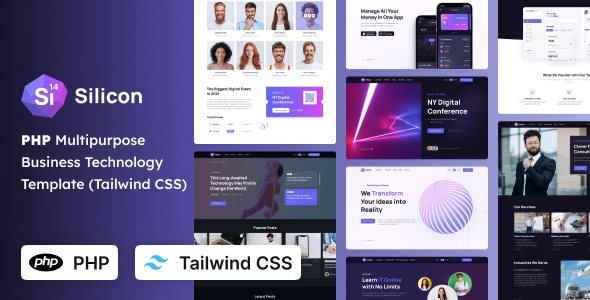
Silicon - Multipurpose Business, SaaS & Technology Tailwind CSS PHP Template Silicon - Multipurpose Business, SaaS & Technology Tailwind CSS PHP Template...
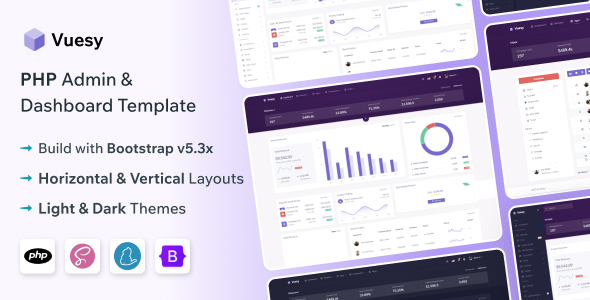
Vuesy - PHP Admin & Dashboard Template Vuesy - PHP Admin & Dashboard Template is a modern administration interface designed to help...

Nativa Theme - Landing & Client Portal Design for RedFamosa SMM Panel Nativa Theme is a modern and professionally designed landing page...
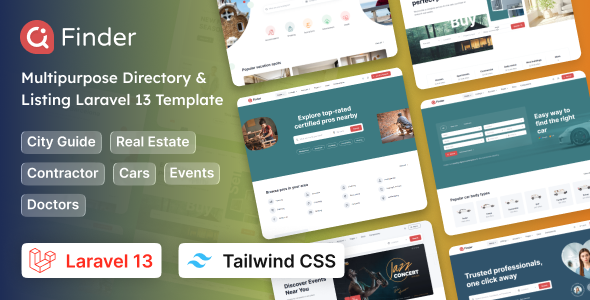
Finder - Multipurpose Tailwind CSS 4 Directory & Listing Laravel 13 Template Finder - Multipurpose Tailwind CSS 4 Directory & Listing Laravel...
