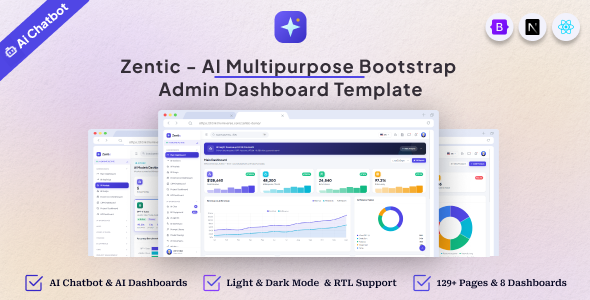
Zentic — AI Multipurpose Bootstrap 5 Admin Dashboard Template + RTL is a modern admin dashboard template designed for developers, businesses, and software teams that need a professional interface for managing data, monitoring application activity, and organizing administrative workflows. With its AI-oriented and multipurpose positioning, Bootstrap 5 foundation, and RTL support, Zentic provides a starting point for building dashboards, SaaS administration panels, analytics interfaces, business management systems, and other web application interfaces.
Whether you are developing an AI-powered platform, a CRM dashboard, a project management application, an analytics portal, or an internal business tool, Zentic can help streamline the initial frontend development process. Developers can customize the supplied layouts and interface elements to match their application’s requirements, branding, and information architecture.
Its combination of a responsive Bootstrap-based design and right-to-left layout support makes it relevant to projects serving users across different devices and language directions. The exact dashboards, page layouts, charts, components, and AI-related interface elements included should be verified against the product documentation.
An effective admin dashboard helps users understand important information quickly and perform routine tasks efficiently. It should organize complex data into readable sections, provide clear navigation, and maintain a consistent visual hierarchy.
Zentic is positioned for administrative interfaces where structured information, reusable components, and a professional appearance are important. Depending on the supplied layouts, developers may adapt the dashboard to display summary cards, data tables, charts, activity information, forms, navigation menus, and other application elements.
A well-designed dashboard can help users move between different sections without losing track of important tasks. Consistent spacing, typography, colors, and component styles also make the interface easier to understand.
The multipurpose approach allows developers to customize the interface for different applications instead of building every page structure from scratch.
Bootstrap 5 is a widely used frontend framework that provides a responsive grid system, reusable interface components, utility classes, and styling conventions for web development.
A Bootstrap-based dashboard template can simplify the creation of consistent administrative interfaces. Developers can work with familiar layout patterns and customize them according to the requirements of the application.
Depending on the package, Zentic may include layouts and components that can be adapted for navigation, cards, forms, tables, alerts, modals, and other common dashboard elements. The exact component selection depends on the files included in the template.
Bootstrap’s responsive utilities can help developers adjust page layouts for desktops, tablets, and mobile devices. Developers should still test the supplied implementation to ensure that navigation, tables, forms, and data visualizations remain usable on smaller screens.
Before installation, review the package documentation for its Bootstrap version, JavaScript dependencies, icon libraries, build requirements, and supported browsers.
AI-powered applications often need administrative interfaces for presenting model information, managing workflows, monitoring usage, and reviewing generated results. A dashboard template can provide a useful visual foundation for these experiences.
Zentic’s AI-oriented positioning makes it relevant to developers creating interfaces for AI tools, automation platforms, machine learning services, and related software products.
Potential interface concepts include:
These are possible implementation ideas rather than a guarantee that every component or AI workflow is included in the package.
A dashboard interface alone does not provide an AI model, API connection, or automated processing capability. Functional AI features require suitable backend services, model integrations, data handling, and application logic.
Zentic can serve as a starting point for a range of administrative interfaces, depending on the layouts and components available in the package.
SaaS Administration Panels: Organize application settings, user records, usage information, and administrative tools.
CRM Dashboards: Present customer records, sales activity, lead information, and workflow summaries when the required business logic is implemented.
Analytics Dashboards: Display key performance indicators, charts, reports, and data summaries connected to an appropriate data source.
Project Management Interfaces: Organize project information, task records, activity summaries, and status indicators.
AI and Automation Platforms: Provide an interface for reviewing tasks, managing configurations, and presenting results from integrated services.
Business Management Systems: Create administrative screens for records, reports, forms, and internal workflows.
Customer Support Applications: Organize support records, status information, and operational metrics.
These examples illustrate potential applications and do not indicate that dedicated demos or complete business modules are necessarily included.
Administrative users often need to review large amounts of information quickly. Well-organized dashboard components can help present important metrics and records in a readable format.
Depending on the available layouts, Zentic may provide a foundation for creating summary cards, data tables, charts, progress indicators, and activity sections. Developers can customize these elements to display the information relevant to their application.
Summary cards can highlight important metrics, while charts can communicate trends and comparisons. Tables are useful for reviewing detailed records, and filters or pagination can help users navigate larger datasets when implemented.
For a production dashboard, displayed values should come from reliable application data rather than permanent placeholder content. Dynamic charts, sorting, filtering, export functions, and real-time updates require appropriate JavaScript logic and, where necessary, backend integration.
The actual chart libraries and data interaction capabilities should be verified in the supplied source files.
Right-to-left support is important for applications serving users who read languages such as Arabic, Hebrew, Persian, or Urdu. An RTL interface changes the directional presentation of text and layout elements so the interface aligns naturally with the language.
Zentic’s RTL positioning makes it relevant to projects that require right-to-left layouts alongside standard left-to-right interfaces.
When implementing RTL support, developers should check navigation alignment, text direction, icons, forms, tables, spacing, breadcrumbs, dropdowns, and responsive behavior. Some icons or visual elements may need special treatment to maintain their intended meaning.
A complete multilingual experience may also require translated labels, appropriate font choices, locale-aware date and number formatting, and language selection controls.
RTL styling does not automatically provide translations or complete localization. Developers should verify which RTL assets and language-related features are included in the package.
Modern dashboards are frequently accessed from different screen sizes. Although complex administrative tasks may be easier on a desktop, users may still need to review information or perform simple actions on tablets and smartphones.
Zentic’s Bootstrap-based foundation can support responsive layout customization. Developers should test sidebar behavior, navigation menus, tables, cards, charts, and forms across common viewport sizes.
Wide data tables may require horizontal scrolling or alternative mobile layouts. Navigation should remain easy to open and close, and interactive controls should be sufficiently large for touch input.
Responsive behavior depends on the actual implementation. Testing on real devices and multiple browsers helps identify issues that may not appear in a desktop preview.
A dashboard should reflect the product’s identity while keeping information easy to understand. Zentic can be customized to suit different software products, business environments, and user requirements.
Common customization tasks include:
A consistent design system helps maintain a professional appearance across the application. Developers should also ensure that color choices provide sufficient contrast and that important status information is not communicated through color alone.
The degree of customization depends on the supplied files, component structure, and developer familiarity with Bootstrap, CSS, and JavaScript.
Most administrative applications require users to create, review, update, and organize records. Forms and tables provide the interface for these common operations.
Depending on the available components, Zentic can be adapted to present user records, application settings, configuration forms, status fields, and administrative data.
A complete workflow may require form validation, confirmation dialogs, sorting, filtering, pagination, file uploads, or export options. These features should be implemented and tested according to the application’s requirements rather than assumed to work automatically because the template contains a visual control.
When connecting forms to a backend, developers should implement server-side validation, appropriate authorization checks, safe error handling, and clear success or failure messages.
Administrative interfaces should also prevent unauthorized users from accessing restricted records or performing privileged actions.
An admin dashboard generally needs a connection to the application it manages. Depending on the project, this may involve a REST API, GraphQL service, database-backed backend, authentication provider, or external software platform.
Zentic can provide a frontend foundation for these integrations where its architecture supports the required approach.
Potential integrations include authentication, analytics services, CRM systems, payment platforms, AI APIs, notification services, and reporting tools. Each integration requires appropriate configuration and testing.
Developers should distinguish between frontend presentation and actual business functionality. For example, a dashboard card displaying a usage total needs a reliable data source, while an AI generation interface requires a backend or service integration that performs the requested operation.
API credentials and sensitive secrets should never be exposed in publicly accessible frontend code. Access controls and data validation should be enforced by the appropriate backend services.
A well-performing dashboard should load efficiently and remain responsive during common interactions. Excessive scripts, large dependencies, and unnecessary visual effects can affect the user experience.
Developers can improve performance by optimizing assets, reducing unused code, loading nonessential modules when needed, and limiting unnecessary network requests. Dashboard pages should also avoid rendering large datasets without suitable pagination or virtualization where appropriate.
Accessibility is equally important. Forms should have meaningful labels, interactive elements should support keyboard navigation, and text should maintain adequate contrast. Status messages and validation errors should be clear to users relying on assistive technologies.
For long-term maintenance, developers should review dependencies, follow compatible update procedures, and test changes before deploying them to production.
A template does not automatically guarantee accessibility compliance, optimal performance, or secure application behavior. These outcomes depend on implementation and ongoing maintenance.
Zentic may be suitable for frontend developers, SaaS founders, software companies, digital agencies, and development teams building administrative interfaces.
It can be a useful starting point for projects involving business analytics, AI applications, CRM tools, automation platforms, internal dashboards, and multilingual administrative systems.
Developers who are familiar with Bootstrap 5, HTML, CSS, and JavaScript will generally find it easier to customize the frontend and connect it to the appropriate backend services.
Before purchasing or deploying the template, review its documentation, included pages, source code, supported dependencies, licensing terms, RTL implementation, and technical requirements. Confirm which dashboard components are supplied and which features require additional development.
Zentic — AI Multipurpose Bootstrap 5 Admin Dashboard Template + RTL provides a potential foundation for building modern administrative interfaces for AI-oriented products, SaaS platforms, business applications, and data management systems. Its Bootstrap 5 foundation and RTL positioning make it relevant to developers who need a customizable dashboard interface for different users and language directions.
With appropriate branding, responsive layouts, reliable data integrations, secure backend functionality, and careful RTL testing, developers can adapt Zentic to a wide range of dashboard projects. Reviewing the included components and verifying the actual implementation before deployment will help ensure that the final application meets its technical, usability, and business requirements.
1. All digital products are the most recent version, with no possibility of free updates. After payment, you can request an update to the most recent version for 5 days if a new version is released. We free support within 5 days.
2. If a license is required (Excludes WHMCS license , we provide only method not license), please contact us via email or ticket for assistance with activation. Our license is only valid for activation and does not include support.
3. We provide Mobile, PHP script installation services for $19.90 / ₹1700. Please create a backup after installation as we do not support re-installation. For mobile app source code, we do not offer installation services.
4. If you have any questions, please contact us by email [email protected] or create a ticket on this page
5. Please note that any digital products presented on the website do not contain malicious code, viruses or advertising. You will receive the original files from the developers. We do not sell any products that have been downloaded from other websites.
6. The response time can last up to 6 hours.
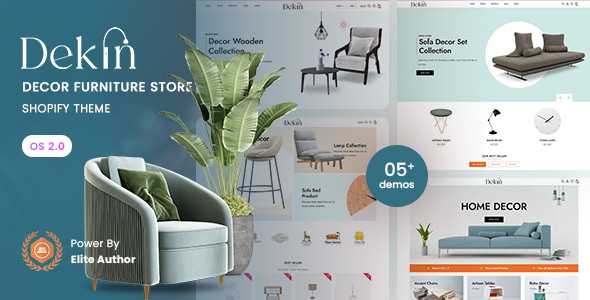
Dekin - Decor Furniture Store Shopify 2.0 Theme Dekin is a modern and elegant Shopify 2.0 theme designed specifically for furniture stores,...
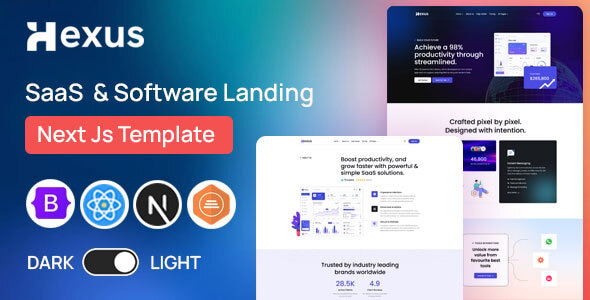
Hexus – SaaS Landing Page Next JS Template Hexus – SaaS Landing Page Next JS Template is a modern website template designed...
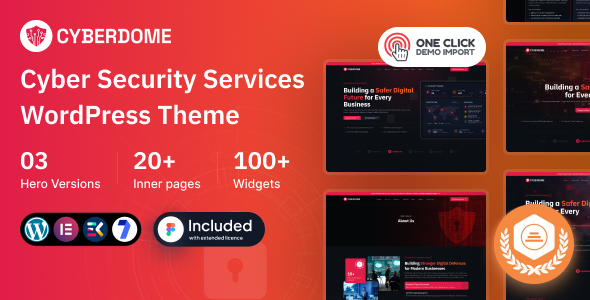
CyberDome - Cyber Security Services WordPress Theme CyberDome - Cyber Security Services WordPress Theme is a modern and professional website theme designed...
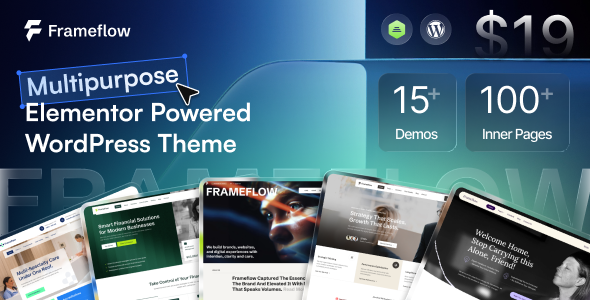
Frameflow - Multipurpose WordPress Theme Frameflow is a versatile, modern, and feature-rich Multipurpose WordPress Theme designed to meet the needs of businesses,...
