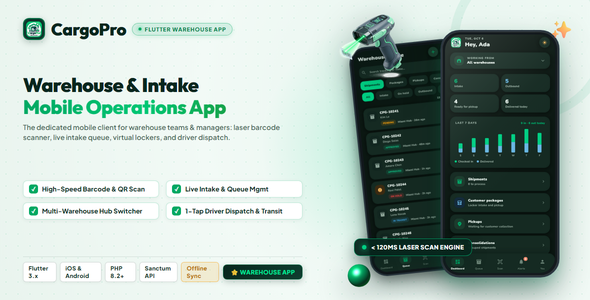
Warehouse App for Cargopro | Courier and Delivery Management System is a logistics-focused application template designed to support warehouse operations, courier management, and delivery workflows. Created for businesses seeking to improve their logistics processes, this solution provides a starting point for building a more organized approach to managing shipments, warehouse activities, and delivery operations. It is suitable for courier companies, logistics providers, warehouse operators, eCommerce businesses, and developers building digital solutions for the transportation and supply chain industry.
With a focus on warehouse and courier operations, Warehouse App for Cargopro can help developers explore interfaces and workflows for shipment handling, inventory coordination, delivery tracking, and operational management. Its actual capabilities depend on the included application screens, integrations, and source files.
Courier management involves coordinating shipments from the point of collection through sorting, transportation, and final delivery. A dedicated application can help businesses organize these activities and make shipment information easier to access.
Warehouse App for Cargopro provides a starting point for developing logistics-focused workflows that connect warehouse operations with courier and delivery processes.
Depending on the included functionality, developers can customize shipment records, delivery information, operational screens, and other components to suit a company’s requirements.
Efficient warehouse operations require organized handling of incoming goods, stored items, and outgoing shipments. A warehouse management interface can help teams structure daily activities and reduce reliance on disconnected records.
Potential areas for customization include receiving goods, organizing shipment details, managing dispatch workflows, and reviewing warehouse activity.
Businesses can adapt the application concept to their operating procedures, whether they manage a small distribution center or coordinate shipments across multiple locations.
Advanced inventory management, barcode scanning, and warehouse automation may require additional development if they are not included in the original application.
Shipment visibility is an important part of modern logistics. Businesses and customers benefit from clear information about shipment progress and delivery status.
Depending on the original implementation, developers can explore workflows for displaying shipment details, updating delivery statuses, and reviewing shipment histories.
Potential enhancements include tracking references, estimated delivery information, status notifications, and integration with courier APIs. Live GPS tracking and real-time carrier updates require suitable integrations and should not be assumed to be included by default.
A structured delivery workflow can help logistics teams coordinate dispatch, transportation, and delivery confirmation.
Warehouse App for Cargopro can serve as a foundation for customizing delivery-related screens and operational processes. Potential workflow stages may include shipment preparation, dispatch assignment, in-transit updates, delivery attempts, and completion records.
The exact stages should reflect the business’s operating model and the features supported by the supplied application.
A clear interface can make logistics applications easier for warehouse personnel, administrators, and delivery teams to use throughout the working day.
Developers can review the included screens and customize navigation, forms, shipment information, status indicators, and other interface elements.
Potential improvements include simplified task flows, searchable shipment records, clearer delivery status displays, and layouts adapted for mobile use.
The availability of specific interface components depends on the original template.
Warehouse and courier operations often depend on accurate coordination between stored goods and outgoing shipments.
Developers can explore ways to connect inventory records with shipment preparation and dispatch workflows. Potential enhancements include product references, quantity records, storage locations, and shipment-item associations.
More advanced inventory functionality, such as stock reservations, automated replenishment, batch tracking, and warehouse synchronization, may require backend development and database integration.
Delivery operations may involve assigning shipments to drivers, riders, or courier personnel. A digital workflow can help businesses organize these assignments and review their progress.
Depending on the original application’s structure, developers can consider adding personnel records, delivery task lists, assignment screens, and delivery completion details.
Driver accounts, route optimization, GPS tracking, and automated assignment logic may require additional services or custom development.
Accurate shipment records help businesses review logistics activity and identify operational issues.
Potential enhancements include shipment histories, dispatch summaries, delivery completion reports, and date-based activity filters.
Administrators may also benefit from reports covering shipment volumes, delayed deliveries, warehouse activity, and delivery performance. Actual reporting capabilities depend on the supplied application, and advanced analytics may require additional implementation.
Logistics applications often need to work with existing business systems. Depending on the source code and architecture, developers can explore integrations with inventory platforms, order management systems, courier services, and notification providers.
Potential integrations include:
These integrations may require API credentials, backend development, suitable permissions, and ongoing maintenance.
Warehouse and delivery personnel may need to access operational information from different devices. A responsive interface can improve usability across desktop computers, tablets, and smartphones.
Developers should evaluate the original application’s supported screen sizes and customize the layout where necessary.
For mobile-focused workflows, useful considerations include readable shipment details, accessible buttons, efficient data entry, and reliable behavior under varying network conditions.
Logistics systems can contain operational records, delivery addresses, customer information, and business data. Security should therefore be considered throughout implementation and deployment.
Potential requirements include authenticated access, role-based permissions, secure API communication, input validation, protected credentials, and appropriate data-retention practices.
The security capabilities of the original template should be reviewed before production use. Additional controls may be necessary to meet the business’s operational and compliance requirements.
Warehouse App for Cargopro may be considered for projects involving:
The suitability of each use case depends on the actual features, supported integrations, and licensing conditions.
A well-designed warehouse and courier management application can help businesses organize workflows, improve information visibility, and reduce dependence on fragmented manual processes.
By structuring shipment records and operational tasks, a customized solution may help teams coordinate warehouse activities and delivery operations more consistently.
The actual business benefits depend on implementation quality, data accuracy, staff adoption, and integration with existing systems.
This application template is suitable for developers building logistics software, businesses exploring digital warehouse workflows, and technology teams creating courier management solutions.
It may also serve as a starting point for agencies developing customized logistics applications for clients. Before choosing the template, review its supported platforms, technical stack, source-code availability, and included functionality.
Warehouse App for Cargopro | Courier and Delivery Management System provides a logistics-focused foundation for developers and businesses exploring warehouse organization, shipment coordination, and delivery management solutions.
Its application concept can be adapted to different logistics workflows, with opportunities to extend shipment visibility, operational reporting, inventory coordination, and courier integrations where supported.
Whether you are developing a courier application, streamlining warehouse processes, or creating a customized logistics solution, review the included features, technical requirements, integrations, and licensing terms to determine whether this template meets your project goals.
1. All digital products are the most recent version, with no possibility of free updates. After payment, you can request an update to the most recent version for 5 days if a new version is released. We free support within 5 days.
2. If a license is required (Excludes WHMCS license , we provide only method not license), please contact us via email or ticket for assistance with activation. Our license is only valid for activation and does not include support.
3. We provide Mobile, PHP script installation services for $19.90 / ₹1700. Please create a backup after installation as we do not support re-installation. For mobile app source code, we do not offer installation services.
4. If you have any questions, please contact us by email [email protected] or create a ticket on this page
5. Please note that any digital products presented on the website do not contain malicious code, viruses or advertising. You will receive the original files from the developers. We do not sell any products that have been downloaded from other websites.
6. The response time can last up to 6 hours.

Adaptix Meditation | Flutter app Template Adaptix Meditation | Flutter app Template is a modern mobile application design solution created for meditation...

Seed Drop | Unity Complete Puzzle Game Template Seed Drop is a complete puzzle game template developed with Unity, designed for game...
FinanceAI | Flutter Personal Finance and Expense Tracker App FinanceAI is a modern and intelligent personal finance management application built with Flutter,...