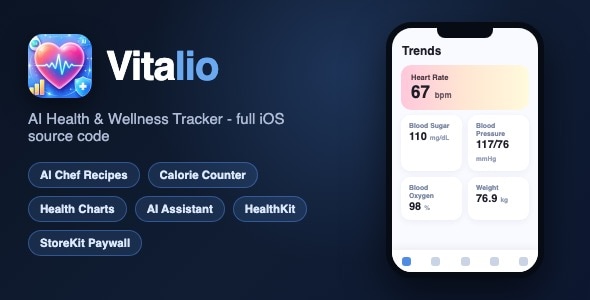
Vitalio | Health and Wellness Tracker Template With AI Recipes and Charts – SwiftUI is a modern iOS application template designed for health-conscious users who want to organize their wellness routines, explore personalized meal ideas, and visualize lifestyle-related progress through interactive charts. Built with SwiftUI, Vitalio provides a foundation for developing a health and wellness tracking application that brings nutrition inspiration, progress monitoring, and everyday wellness information into a single mobile experience.
Maintaining a balanced lifestyle often involves paying attention to nutrition, physical activity, hydration, personal goals, and daily habits. However, tracking these activities across different applications or manually maintained records can become inconvenient. A dedicated wellness application can make this process more organized by presenting relevant information through a unified interface.
Vitalio combines the concept of wellness tracking with AI-assisted recipe discovery and visual data presentation. Its intended experience can help users explore food ideas, review wellness-related information, and understand their progress through charts and structured summaries. The SwiftUI foundation also makes the project a useful starting point for developers who want to build or customize a native iOS wellness application.
Whether you are an independent app developer, a startup founder exploring the digital wellness market, or a business planning to launch a lifestyle and nutrition application, Vitalio offers a foundation for creating an engaging mobile experience. The exact capabilities depend on the supplied implementation, available integrations, and configuration of any AI-powered features.
A wellness tracker helps users organize lifestyle information and review personal habits over time. Rather than focusing on a single activity, a broader wellness application can bring different aspects of daily well-being into one convenient interface.
Vitalio is designed around this integrated approach, providing a foundation for displaying wellness-related information in an organized mobile environment. Depending on the supplied implementation, users may be able to record selected activities, review personal goals, and view summaries of their progress.
Potential tracking categories include nutrition, water intake, exercise, daily routines, and other lifestyle indicators. The exact categories and data-entry workflows should be verified against the original application demo and documentation.
A centralized wellness interface can make it easier for users to review their records and establish more consistent habits. For developers, it also provides an opportunity to customize the application for specific audiences, such as fitness enthusiasts, busy professionals, or people interested in improving their everyday routines.
Nutrition plays an important role in many people’s wellness goals, and finding suitable meal ideas can sometimes be challenging. Vitalio emphasizes AI-assisted recipe functionality as part of its intended user experience.
An AI-powered recipe feature can help users explore meal suggestions based on preferences, available ingredients, dietary requirements, or other relevant inputs, depending on how the feature is implemented.
For example, a wellness application could help a user discover breakfast ideas, quick lunches, balanced dinner options, or simple snacks. It could also be extended to support vegetarian meal ideas, high-protein recipes, or other dietary preferences when the underlying AI service and application logic support those requests.
Potential recipe information may include ingredients, preparation instructions, serving sizes, and nutritional estimates. These details should be confirmed in the supplied version rather than assumed to be available.
AI-generated recipes should be reviewed for ingredient accuracy, food safety, and nutritional suitability. Users with allergies, medical dietary restrictions, or specific nutritional requirements should verify recommendations carefully.
Meal planning can help people organize their grocery shopping and make more intentional food choices throughout the week. When connected with recipe discovery, it can become a useful part of a broader wellness workflow.
Vitalio’s AI recipe concept offers a foundation for developing meal-planning experiences that align with individual preferences and goals.
Depending on the included features, the application may provide recipe browsing or other nutrition-related interactions. Additional development could introduce weekly meal schedules, saved recipes, grocery lists, meal categories, and recipe recommendations based on user preferences.
For example, users could potentially organize breakfast, lunch, dinner, and snacks into a structured plan. A more advanced implementation could connect recipes with estimated calories, protein, carbohydrates, and fats.
These capabilities depend on the availability of the relevant screens, data models, and AI integration. Buyers should confirm whether meal planning and saved recipes are included or would require customization.
Charts help transform individual records into information that users can understand at a glance. For a wellness application, visual summaries can make changes in daily habits easier to recognize over time.
Vitalio includes a focus on charts, making data visualization an important part of its intended experience.
Depending on the supplied implementation, charts may present recorded wellness metrics, progress toward goals, historical activity, or nutrition-related information. The specific chart types, available date ranges, and underlying calculations should be checked in the original product documentation.
Visual analytics can help users compare recent activity with previous periods and identify patterns in their recorded habits. They can also provide a more engaging way to review progress than a long list of numbers.
Potential enhancements include weekly summaries, monthly trends, goal-completion charts, and comparisons between planned and recorded activities. These should be treated as possible extensions unless explicitly included in the product.
Vitalio is built using SwiftUI, Apple’s declarative framework for developing user interfaces across supported Apple platforms.
SwiftUI allows developers to build interface components using a state-driven approach. This can simplify the organization of screens, controls, layouts, and visual feedback in applications that display frequently changing information.
For a wellness tracker, SwiftUI can be used to create interfaces for dashboards, data-entry screens, recipe details, user preferences, and chart-based progress summaries, depending on the structure of the supplied project.
The native iOS-oriented approach can help developers customize the application’s visual design while following familiar Apple interface conventions.
Possible customization areas include typography, spacing, navigation, color themes, card layouts, icons, animations, and interactive chart presentation.
Developers should review the actual project structure, Swift language version, deployment target, dependencies, and supported iOS versions before beginning customization.
A clear dashboard can help users understand their current activity without navigating through multiple screens.
Vitalio’s wellness-focused concept provides a foundation for presenting relevant information in a structured overview. Depending on the included implementation, a dashboard may display selected metrics, goal summaries, recent activity, recipe suggestions, or links to other parts of the application.
A well-organized dashboard can help users identify which areas of their routine need attention and access frequently used features more conveniently.
For example, a customized version could place hydration progress, meal information, activity summaries, and daily goals within a single view. The actual availability of these metrics depends on the underlying tracking functionality.
Developers can also explore personalized dashboard layouts that prioritize the information most relevant to different user groups.
Understanding food choices is an important aspect of many wellness routines. A nutrition-oriented application can help users organize meal information and become more aware of their eating patterns.
Depending on the supplied functionality, Vitalio may provide a foundation for presenting recipe-related information and nutrition-focused data.
Potential nutrition fields include calories, serving sizes, protein, carbohydrates, fat, and other nutritional estimates. Their availability and accuracy depend on the underlying recipe data, AI service, or nutritional database used by the application.
If nutritional calculations are included or added later, developers should consider portion sizes, ingredient substitutions, data quality, and the limitations of estimated values.
AI-generated nutritional information should not be treated as a substitute for verified food-label data or professional dietary guidance. For users who need medically appropriate nutrition plans, recommendations should be reviewed by a qualified professional.
Setting manageable goals can help users build more consistent routines. A wellness tracker can support this process by allowing users to record activities and review progress over time.
Vitalio’s tracking and chart-oriented concept provides a potential foundation for connecting daily habits with personal objectives.
Depending on the implemented features, users may be able to monitor selected metrics or review progress toward defined targets. Additional development could introduce configurable goals, completion indicators, streaks, and reminders.
For example, a future version could support a daily hydration target, a weekly activity goal, or a regular meal-planning objective. Such functionality would require suitable data tracking and goal-management logic if it is not already included.
The most effective goal-setting experiences allow users to make realistic adjustments and interpret progress without encouraging unhealthy or overly restrictive behavior.
AI can make a wellness application more interactive by helping users explore information through natural-language requests and personalized suggestions.
Vitalio highlights AI-assisted recipes, which may be implemented through an external AI service or another supported mechanism. The exact provider, model, API requirements, and personalization capabilities should be verified in the product documentation.
Depending on the integration, users may be able to request meal ideas, explore ingredient combinations, or receive recipe suggestions based on their preferences.
Additional AI-powered possibilities include meal substitutions, recipe categorization, and suggestions based on previously saved preferences. These are potential extensions rather than guaranteed features of the supplied template.
If an external API is required, deployment may involve API credentials, service configuration, usage limits, and ongoing operating costs. Sensitive user information should not be sent to external AI services without an appropriate privacy design and clear user consent.
AI-generated content should also be reviewed for reliability, especially when it includes nutrition-related claims.
A wellness application should make everyday interactions straightforward, especially when users need to record information quickly or review progress at a glance.
Vitalio provides a SwiftUI-based starting point for designing a structured mobile experience around wellness tracking, recipes, and charts.
Depending on the supplied screens, the interface may include dashboard components, data summaries, recipe views, and other wellness-related sections. The original design and feature set should be reviewed to understand the available layouts.
Developers can adapt the interface to match a brand’s visual identity, target audience, and product strategy. Potential adjustments include color schemes, typography, onboarding, navigation, accessibility, and the arrangement of information.
A consistent visual language can help users understand the application more quickly and create a more polished experience across its different screens.
Some wellness applications connect with device-level health information to reduce manual data entry and provide a broader view of daily activity.
Depending on the intended product direction, Vitalio could potentially be extended with Apple Health or HealthKit integration, where appropriate permissions and technical requirements are met.
Such an integration might support selected health or activity data made available by the user, depending on the implementation and applicable platform rules.
However, HealthKit connectivity, automatic step tracking, sleep data, heart-rate information, and device synchronization should not be assumed to be included simply because the application is a wellness tracker.
Any health-data integration requires careful permission handling, privacy disclosures, data minimization, and testing. Developers should clearly explain what information is accessed and how it is used.
Wellness applications may handle personal information about habits, food preferences, activities, and other lifestyle-related data. Protecting this information should be a priority throughout development and deployment.
Before launching Vitalio commercially, developers should review how information is stored, whether it is transmitted to external services, and what controls users have over their data.
If AI-powered recipes use a third-party provider, the application should be configured to handle API credentials securely and avoid unnecessary disclosure of personal information.
Depending on the product’s functionality, useful privacy measures may include secure network communication, appropriate access controls, clear privacy disclosures, and suitable data deletion procedures.
Wellness information should be presented responsibly. General lifestyle suggestions should not be represented as medical diagnoses or personalized medical treatment unless the product has been specifically designed, validated, and authorized for such a purpose.
Vitalio may be suitable for several types of users and development projects.
The suitability of the template depends on the included features, technical requirements, and intended business model.
Vitalio can serve as a starting point for developers who want to build a more specialized wellness application.
Potential enhancements include user accounts, cloud synchronization, personalized onboarding, expanded recipe filters, saved meal plans, additional charts, push notifications, and more detailed progress reports.
Other possibilities include multilingual support, accessibility improvements, configurable goals, subscription plans, and connections to external nutrition databases.
A production-ready application may also require a backend service for account management, cross-device synchronization, saved data, or AI request processing. These capabilities depend on the original architecture and may require additional development.
Before implementing extensions, review the supplied code, data models, dependencies, API configuration, and licensing permissions to determine the most appropriate approach.
Before using Vitalio, review the supplied documentation to identify the required development environment and supported iOS versions.
A typical SwiftUI development workflow may require a compatible Mac, an appropriate version of Xcode, the necessary iOS SDK, and an Apple development account for certain testing and distribution tasks.
Depending on the supplied package, setup may involve opening the project in Xcode, resolving dependencies, configuring application identifiers, and supplying any required API credentials.
If AI recipes rely on an external service, verify whether the package includes integration code, how the service is configured, and whether a separate paid API account is required.
Before distributing the application, test the main screens, chart calculations, recipe-generation flow, error handling, and privacy-related behavior. Also confirm whether the package includes source code, setup documentation, updates, and technical support.
Before purchasing Vitalio, review the original demo, screenshots, documentation, and feature list to confirm which capabilities are included in the current version.
In particular, verify the supported tracking metrics, AI recipe integration, chart types, data persistence, account functionality, and any third-party service dependencies.
Do not assume that advanced sleep tracking, automatic activity collection, HealthKit integration, cloud backup, medical recommendations, or complete meal-planning functionality is available unless explicitly documented.
If you intend to launch the application commercially, review the license, privacy requirements, API operating costs, and Apple’s current app distribution policies. A template provides a development foundation, but production deployment may require additional configuration, testing, and customization.
Vitalio | Health and Wellness Tracker Template With AI Recipes and Charts – SwiftUI offers a modern starting point for building an iOS wellness application that brings nutrition inspiration, lifestyle tracking, and visual progress monitoring into a single mobile experience.
With its SwiftUI foundation, AI-assisted recipe concept, and emphasis on charts, Vitalio can help developers explore a more engaging approach to everyday wellness management. It may be suitable for independent developers, digital health and lifestyle startups, and businesses interested in creating a branded wellness application.
Review the included features, AI service requirements, supported iOS versions, data-handling approach, and licensing terms to determine whether Vitalio matches your development goals and intended user experience.
1. All digital products are the most recent version, with no possibility of free updates. After payment, you can request an update to the most recent version for 5 days if a new version is released. We free support within 5 days.
2. If a license is required (Excludes WHMCS license , we provide only method not license), please contact us via email or ticket for assistance with activation. Our license is only valid for activation and does not include support.
3. We provide Mobile, PHP script installation services for $19.90 / ₹1700. Please create a backup after installation as we do not support re-installation. For mobile app source code, we do not offer installation services.
4. If you have any questions, please contact us by email [email protected] or create a ticket on this page
5. Please note that any digital products presented on the website do not contain malicious code, viruses or advertising. You will receive the original files from the developers. We do not sell any products that have been downloaded from other websites.
6. The response time can last up to 6 hours.

TallySeller | Third-Party eBay-Compatible Profit Tracker and Analytics SaaS | Laravel and Flutter TallySeller | Third-Party eBay-Compatible Profit Tracker and Analytics SaaS...
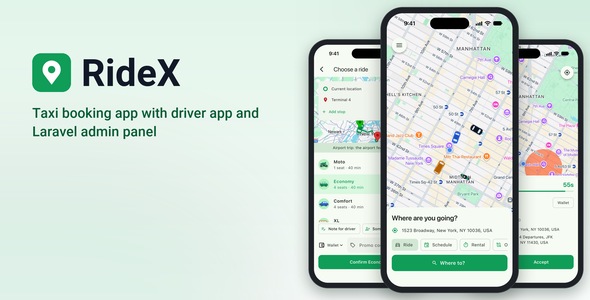
RideX | Flutter Taxi Booking App With Laravel Admin Panel RideX | Flutter Taxi Booking App With Laravel Admin Panel is a...
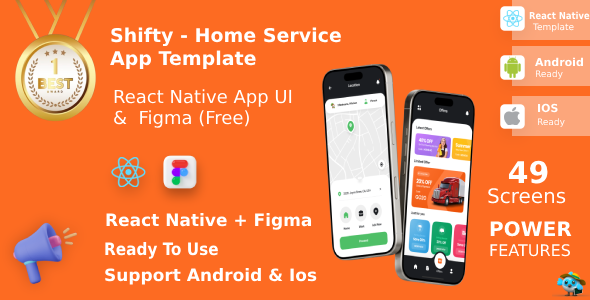
Shifty | Multi-Service Booking App UI Kit for React Shifty | Multi-Service Booking App UI Kit for React is a modern user...
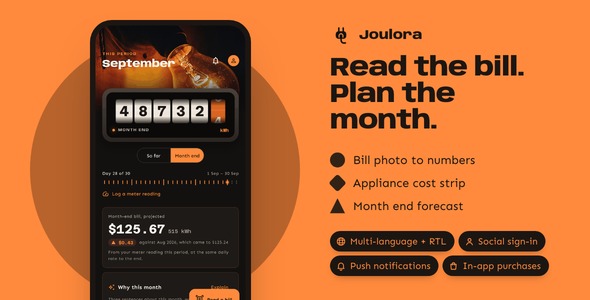
Joulora | Flutter AI Electricity Bill and Appliance Cost App With Laravel Key Proxy Joulora is an advanced AI-powered electricity bill and...
