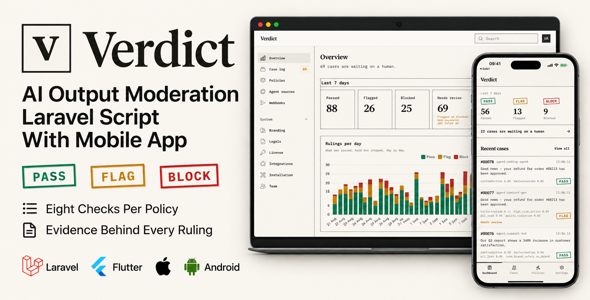
Verdict | AI Output Moderation Laravel Script With Mobile App is a software solution designed to help developers and businesses build an AI content moderation platform for reviewing, analyzing, and managing AI-generated or user-submitted content. Combining a Laravel-based backend with a mobile application component, Verdict provides a foundation for creating moderation workflows that help identify potentially harmful, inappropriate, or policy-violating content before it reaches an intended audience.
As AI-powered applications become increasingly common, businesses need practical ways to evaluate the content generated by language models, chatbots, and other automated systems. An AI moderation solution can help organizations apply content policies, review potentially unsafe responses, and improve the reliability of digital experiences.
Verdict is suited to projects exploring automated content screening, moderation management, and AI-assisted safety workflows. Developers can adapt the platform to their requirements, integrate compatible AI moderation services, and configure rules for different use cases. The exact moderation capabilities, supported AI providers, and mobile application features depend on the original script’s implementation and documentation.
The primary concept behind Verdict is to provide a framework for evaluating content and identifying material that may violate defined safety or usage policies.
AI output moderation can be used to review generated text, chatbot responses, submitted messages, and other content before it is displayed to users. Depending on the included implementation and connected moderation services, Verdict may be adaptable to classify content, flag potential violations, and return structured moderation results.
Potential moderation categories include:
The actual categories and detection methods depend on the moderation model, configured rules, and integrations supported by the script. These capabilities should be verified against the original product documentation rather than assumed to be included in full.
Laravel is a PHP framework commonly used to build web applications, REST APIs, authentication systems, and backend business logic. Verdict uses Laravel as its server-side foundation, providing a starting point for organizing moderation requests, application settings, and communication with supported services.
Depending on the supplied implementation, the backend may be adaptable to receive content, validate requests, call a moderation provider, process the result, and return a structured response to the connected application.
Potential backend responsibilities include:
The availability of these functions depends on the original codebase. Developers should verify the supplied API endpoints, database schema, authentication method, and supported integrations before extending the system.
The mobile application component can provide a convenient interface for accessing moderation functionality from supported devices. Depending on the supplied package, it may allow users or administrators to submit content, review analysis results, or manage supported moderation workflows.
Potential mobile application use cases include testing chatbot responses, reviewing submitted text, checking moderation outcomes, and accessing moderation-related information.
Developers should confirm which mobile platforms are supported, how the app communicates with the Laravel backend, and whether the included interface is fully functional or requires additional configuration.
For production deployment, the mobile app should use secure API communication and avoid storing sensitive credentials directly in the client application.
External AI services can provide specialized models for classifying content and identifying potentially unsafe material. Verdict can be evaluated as a foundation for integrating compatible moderation APIs, depending on the providers supported by the supplied implementation.
A typical integration may follow this process:
This workflow is illustrative; the actual implementation may differ.
Developers should verify the supported providers, API credentials, request formats, response fields, and usage requirements. AI moderation services may also impose separate pricing, rate limits, and data-processing conditions.
A moderation system becomes more useful when its output is aligned with the rules of the application using it. Different businesses may have different requirements for acceptable content, prohibited material, and escalation procedures.
Depending on the available implementation, Verdict may be adaptable to apply configurable moderation rules or interpret classifications returned by a connected AI service.
Potential policy settings include category-specific thresholds, restricted terms, severity levels, and rules for deciding when content should be allowed, flagged, or blocked.
For example, a customer support chatbot may require a different moderation policy from a public social platform or an educational application.
The actual configuration options should be confirmed in the original script. Custom rules, threshold controls, and advanced policy management may require additional development.
In applications where AI-generated responses are delivered directly to users, moderation may need to occur before the content is displayed.
Verdict can serve as a starting point for building a moderation layer between an AI service and the end user, provided the necessary integration is implemented.
Potential use cases include screening chatbot responses, reviewing automated customer support messages, validating user-generated content, and applying policy checks to AI-assisted workflows.
A production implementation should account for network latency, API timeouts, provider errors, and situations where a moderation result cannot be obtained. The application should have a clearly defined fallback policy for these cases rather than silently treating failed moderation as approval.
Clear moderation results can help developers understand why content was flagged and decide what action to take. Depending on the supplied implementation, Verdict may be extended to present moderation outcomes in a structured format.
Potential result fields include a classification, severity indicator, moderation status, policy category, or explanation based on available provider data.
Developers may also implement reporting features that summarize moderation activity, such as the number of requests reviewed, the frequency of flagged content, or common policy categories.
These reporting features require appropriate data collection and should be treated as potential extensions unless included in the original package.
Moderation scores should be interpreted carefully. A confidence score or classification is not necessarily proof that a piece of content violates a policy, and results should be evaluated within the application’s context.
A centralized administration interface can help authorized staff manage the moderation system and review its operational status.
Depending on the supplied Laravel script, Verdict may include or support an administrative interface for configuring settings and managing relevant platform data.
Potential administrative capabilities include:
The exact dashboard functionality should be verified in the original feature list. If a full moderation queue, reviewer assignment system, or detailed analytics dashboard is not included, these functions may need to be developed separately.
Administrative access should be restricted through appropriate authentication and role-based permissions.
AI moderation systems often rely on private credentials to access external providers. Protecting these credentials is important because unauthorized use can result in data exposure, unexpected charges, or service disruption.
Verdict’s Laravel backend can provide a suitable place to manage protected API credentials if the implementation supports server-side configuration.
Recommended practices include:
A Laravel backend does not automatically guarantee secure credential handling. Developers should inspect the configuration and verify that sensitive values remain protected throughout the request lifecycle.
Moderation systems may process private messages, customer support conversations, personal information, or other sensitive material. Businesses should carefully evaluate what data is collected and how it is handled.
A production implementation should minimize unnecessary data retention, limit access to moderation records, and establish clear rules for deleting stored content when it is no longer required.
When external AI providers are used, developers should review their data-processing terms, retention policies, and applicable privacy obligations.
Where possible, the system should retain only the information needed for moderation, auditing, or legitimate operational requirements. Sensitive content should not be exposed unnecessarily through analytics, logs, notifications, or administrative interfaces.
Automated moderation systems can make mistakes. They may flag harmless content incorrectly or fail to identify material that violates a policy.
Verdict can be evaluated as a foundation for moderation workflows that account for uncertainty and allow additional review where necessary.
Potential enhancements include confidence thresholds, manual review queues, reviewer decisions, appeals, and policy-specific escalation procedures.
For high-impact decisions, it is important to avoid relying solely on a single automated classification. Human review can help resolve ambiguous cases, identify systematic errors, and improve moderation policies over time.
The appropriate balance between automated screening and manual review depends on the application, audience, and consequences of a moderation decision.
Different applications need different moderation workflows. Verdict may be adapted to support specific content types, AI providers, business rules, and application environments.
Potential integration scenarios include:
Integration may require changes to the backend, data structures, provider configuration, and mobile interface. Developers should confirm the script’s supported content formats and API capabilities before selecting an integration strategy.
Moderation adds an additional processing step to an application’s content workflow. Its impact on performance depends on the AI provider, content size, network conditions, and backend implementation.
Developers should test request latency, provider timeouts, rate limits, malformed responses, and temporary service outages.
Where appropriate, background jobs or asynchronous processing may be used for large moderation tasks, while interactive use cases may require a faster request-response workflow.
Caching should be used carefully because moderation decisions can depend on the policy configuration, model version, and context in which content is evaluated.
The reliability of the final system depends on the supplied implementation, server configuration, AI provider, and any additional integrations.
Verdict may be suitable for:
Before selecting the script, review the supplied source code, supported AI providers, mobile application compatibility, API requirements, licensing terms, and included administrative features.
Verdict | AI Output Moderation Laravel Script With Mobile App provides a foundation for developing an AI content moderation solution that combines a Laravel backend with a mobile application component. Its intended use includes evaluating content, integrating moderation services, and creating workflows for identifying potentially inappropriate or policy-violating material.
The actual capabilities depend on the original implementation and the AI services connected to it. Developers should verify supported moderation categories, API integrations, administrative tools, and mobile functionality before beginning production deployment.
With secure API configuration, carefully designed moderation policies, appropriate privacy controls, and a clear process for reviewing uncertain results, Verdict can serve as a starting point for building safer AI-powered applications and content management workflows.
1. All digital products are the most recent version, with no possibility of free updates. After payment, you can request an update to the most recent version for 5 days if a new version is released. We free support within 5 days.
2. If a license is required (Excludes WHMCS license , we provide only method not license), please contact us via email or ticket for assistance with activation. Our license is only valid for activation and does not include support.
3. We provide Mobile, PHP script installation services for $19.90 / ₹1700. Please create a backup after installation as we do not support re-installation. For mobile app source code, we do not offer installation services.
4. If you have any questions, please contact us by email [email protected] or create a ticket on this page
5. Please note that any digital products presented on the website do not contain malicious code, viruses or advertising. You will receive the original files from the developers. We do not sell any products that have been downloaded from other websites.
6. The response time can last up to 6 hours.

Yield | Revenue Analytics PHP Script With Flutter App Yield | Revenue Analytics PHP Script With Flutter App is a revenue analytics...

Joulora | Flutter AI Electricity Bill and Appliance Cost App With Laravel Key Proxy Joulora is an advanced AI-powered electricity bill and...
ParkFlow | Parking Reservation and Operations Management System Laravel and React Native Simplify parking operations and deliver a convenient reservation experience with...
Drillora | Flutter Tool and Equipment Hire App with Laravel Admin Simplify equipment rentals, manage tool bookings, and connect customers with the...
