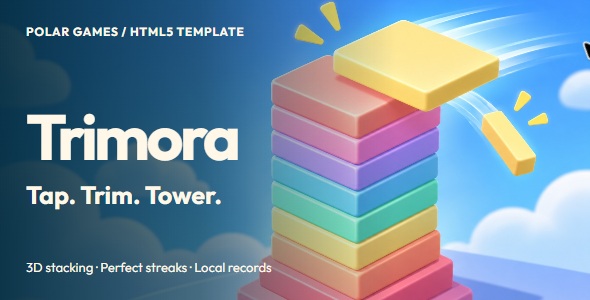
Trimora | HTML5 3D Stacking Arcade With Local Records is an engaging HTML5 arcade game template designed for developers, game creators, and digital entrepreneurs who want to explore the exciting world of browser-based gaming. Featuring a 3D stacking arcade concept, Trimora offers a foundation for creating an entertaining experience built around precision, timing, and progressively challenging gameplay. Its arcade-style format makes it suitable for casual gaming websites, browser game collections, interactive entertainment platforms, and personal game development projects.
Designed around the familiar appeal of stacking games, this template can serve as a starting point for a lightweight gaming experience that encourages players to improve their performance and beat their previous records. The inclusion of local records, as indicated by its product title, adds a competitive element by allowing gameplay achievements to be tracked locally. This can help encourage repeat play and give users a reason to return to the game to improve their scores.
Whether you are developing a standalone arcade game, expanding an existing HTML5 game portfolio, or experimenting with browser-based 3D entertainment, Trimora provides a game-oriented starting point for your project.
The central concept of Trimora is a three-dimensional stacking arcade experience. Stacking games generally challenge players to position moving or falling blocks accurately, rewarding good timing and careful placement. As the game progresses, maintaining precision becomes increasingly important, creating a simple concept with an engaging skill-based challenge.
A 3D presentation can give the gameplay a stronger visual sense of depth compared with a traditional flat arcade interface. Depending on the included implementation, blocks, stacking surfaces, movement, and camera perspectives may contribute to the overall experience.
This gameplay format is suitable for casual audiences because it is easy to understand while leaving room for players to improve their timing and consistency. Developers can also use the concept as inspiration for new levels, alternative stacking mechanics, scoring systems, and additional arcade challenges.
Trimora is identified as an HTML5 game, making it relevant to developers interested in browser-based entertainment. HTML5 games can be delivered through compatible web browsers without requiring players to install a traditional desktop application.
This approach can simplify distribution for projects that are intended to run on a website. Developers can host the game on a compatible web server and provide access through a browser-based page, subject to the template’s technical requirements.
An HTML5 game template may also be useful for learning about game presentation, user interaction, scoring logic, and browser delivery. Before integrating it into a larger project, developers should review the included source files, dependencies, supported browsers, and any setup instructions supplied with the package.
One of the notable elements highlighted in the product title is local record tracking. Local records can provide a way to preserve a player’s best performance on the same browser or device, depending on how the game implements storage.
A record system can make a simple arcade game more engaging by giving players a personal goal beyond completing an individual round. Players can attempt to beat their previous results, improve their timing, and develop more consistent strategies.
Local record functionality should be distinguished from an online leaderboard. Records stored locally are not automatically shared across devices or accounts. A global ranking system, online profiles, cloud synchronization, or multiplayer competition would generally require additional implementation and appropriate backend infrastructure unless these capabilities are explicitly included in the package.
Arcade games often succeed through a combination of simple controls, immediate feedback, and a clear objective. A stacking game can use these principles to provide a short, repeatable gameplay loop that suits quick gaming sessions.
Players can focus on improving accuracy, achieving a higher score, and setting a new personal record. This format can work well for casual game portals, entertainment blogs, interactive promotional websites, and collections of lightweight browser games.
For developers, the stacking concept can also serve as a foundation for experimenting with difficulty progression, bonus scoring, visual effects, and alternative game modes. Any such additions would depend on the flexibility of the supplied source code and the developer’s customization work.
HTML5 delivery makes Trimora a potential fit for websites that want to offer games directly through a browser. Visitors may be able to access a deployed version without downloading a separate game installer, provided their browser and device meet the game’s requirements.
Browser-based distribution can help reduce the number of steps between discovering a game and starting to play. It can also make the game easier to share through a website link or incorporate into an existing gaming portal.
Actual device compatibility, however, depends on the game engine, rendering approach, input controls, and browser support. Developers should test the supplied project on their intended desktop and mobile browsers before publishing it as a cross-device experience.
Trimora can be considered by developers who want a starting point for customizing an arcade game rather than creating every component from scratch. Depending on the included source code and license, possible areas for modification may include:
These are potential customization directions rather than a guarantee that every feature is included or configurable out of the box.
Trimora may be useful for several types of digital projects.
Browser Game Websites: Add a stacking arcade experience to a website that publishes casual games and interactive entertainment.
HTML5 Game Portfolios: Use the project as part of a collection that demonstrates browser-game development skills and interactive design.
Learning and Prototyping: Explore the structure of an HTML5 arcade game and experiment with gameplay logic, scoring, and visual presentation.
Personal Gaming Projects: Build a customized stacking game concept for a personal website or a small independent game project, subject to the package license.
Promotional Experiences: Consider a customized version for a campaign or branded entertainment page, provided the license permits the intended commercial use and the game can be adapted appropriately.
Game Development Experiments: Use the project as a foundation for testing new mechanics, visual effects, or interface improvements.
Before using Trimora in a production environment, review the documentation and source files included with the download. Confirm the required development tools, any third-party libraries, the recommended hosting setup, and the process for configuring or launching the game.
It is also important to establish how local records are stored and whether those records persist after the browser is closed. Local storage behavior can vary depending on the implementation and browser settings. If the project is intended for mobile users, test touch input, viewport scaling, performance, and interface readability on real devices.
If you plan to publish the game on a commercial website, check the license terms for redistribution, modification, advertising, and use within a larger product. Additional integrations, such as analytics, advertising networks, account systems, or server-side score storage, may require separate development.
Trimora offers a focused starting point for projects built around 3D stacking arcade gameplay and local record tracking. Its HTML5 format makes browser-based distribution a practical direction, while its arcade concept provides a clear objective that casual players can understand.
For developers, the value of a game template lies in the opportunity to begin with an existing project structure and then adapt it to specific creative or technical goals. Reviewing the included source code and documentation will help determine how easily the gameplay, visuals, and record system can be customized.
Trimora | HTML5 3D Stacking Arcade With Local Records is a potential choice for developers, game enthusiasts, and digital publishers looking for an HTML5 arcade game project centered on 3D stacking gameplay. Its local-record concept supports personal score improvement, while its browser-based format makes it suitable for exploration as a web gaming experience.
Whether you want to study an arcade game implementation, develop a customized browser game, or expand a casual gaming collection, Trimora provides a starting point worth evaluating. Check the included documentation, technical requirements, supported devices, and license terms to confirm that the package meets your project’s needs before deployment.
1. All digital products are the most recent version, with no possibility of free updates. After payment, you can request an update to the most recent version for 5 days if a new version is released. We free support within 5 days.
2. If a license is required (Excludes WHMCS license , we provide only method not license), please contact us via email or ticket for assistance with activation. Our license is only valid for activation and does not include support.
3. We provide Mobile, PHP script installation services for $19.90 / ₹1700. Please create a backup after installation as we do not support re-installation. For mobile app source code, we do not offer installation services.
4. If you have any questions, please contact us by email [email protected] or create a ticket on this page
5. Please note that any digital products presented on the website do not contain malicious code, viruses or advertising. You will receive the original files from the developers. We do not sell any products that have been downloaded from other websites.
6. The response time can last up to 6 hours.

Candy Tube Sort | HTML5 Sort Puzzle Game Candy Tube Sort | HTML5 Sort Puzzle Game is a colorful browser-based puzzle game...

Maple Lake: Merge Resort | HTML5 Game Maple Lake: Merge Resort | HTML5 Game is a relaxing, resort-themed casual game concept that...

Cherry Spoon: Merge Diner | HTML5 Game Bring a delightful restaurant experience to life with Cherry Spoon: Merge Diner | HTML5 Game,...

Iza Product Designer WordPress & WooCommerce Plugin Iza Product Designer WordPress & WooCommerce Plugin is a powerful online product customization solution that...
