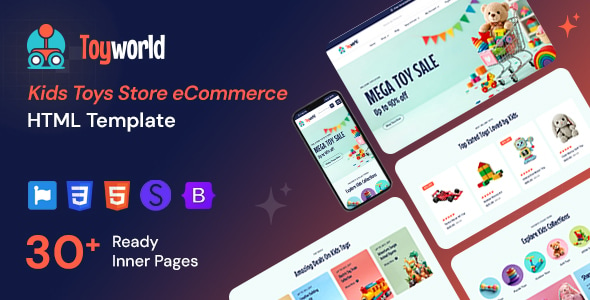
Toyworld – Kids Toys Store eCommerce HTML Template is a cheerful and modern website template designed for toy shops, children’s product retailers, online toy stores, and businesses specializing in games, educational toys, and kids’ accessories. Created for the eCommerce industry, Toyworld provides a frontend foundation for presenting toy collections, organizing product categories, highlighting popular items, and creating an engaging online shopping experience for parents, gift buyers, and families.
Whether you are launching a new online toy store, expanding an existing retail business, or developing an eCommerce website for a client, Toyworld can help simplify the initial website design process. Its store-focused structure can be customized with colorful product imagery, age-based categories, promotional content, and brand-specific styling to suit different toy retail businesses.
Built around HTML-based website development, the template is relevant to developers who want direct control over the frontend structure and presentation. With suitable customization and integration, it can serve as a starting point for a professional online toy store.
A toy store website should create a welcoming atmosphere while making it easy for customers to discover products. Bright colors, engaging product photographs, clear categories, and readable descriptions can help communicate the fun and creativity associated with children’s products.
Toyworld is positioned for toy retail websites where visual appeal and organized product presentation are important. Its design can be adapted to reflect a playful brand identity while maintaining a structured shopping experience.
Developers can customize the color palette, typography, banners, product images, and page layouts to match the store’s personality. A premium educational toy business may prefer a clean, informative presentation, while a general toy retailer may choose a more colorful and energetic visual style.
The exact layouts, page variations, and included design elements should be verified against the supplied template package.
HTML templates provide a foundation for building websites using standard frontend technologies. HTML defines the page structure, CSS controls the visual presentation, and JavaScript can add interactive behavior where required.
Toyworld is suitable for developers who want to customize the storefront directly without relying on a specific content management system by default. The supplied files can be adapted to update product layouts, navigation, promotional sections, category pages, and other frontend elements.
This approach may be useful for businesses that need a customized storefront design or developers who want to connect the interface to an existing commerce platform.
However, an HTML template does not automatically provide a complete eCommerce backend. Features such as product inventory, customer accounts, order processing, payment gateways, and database-driven catalog management require suitable integrations or additional development unless explicitly included.
A well-organized product catalog helps customers find suitable toys based on interests, age groups, product types, and purchasing requirements.
Toyworld can provide a foundation for presenting different toy collections in a structured format. Depending on the available layouts, product cards may be adapted to display product images, names, prices, short descriptions, and other relevant details.
Potential product categories for a toy store include:
These categories are suggested applications for a toy store and are not a guarantee that individual category pages are included in the template.
The homepage is often the first page customers see when visiting an online toy store. It should communicate the store’s identity, highlight relevant products, and provide straightforward paths to the main shopping categories.
Toyworld can be customized to present featured collections and promotional content according to the retailer’s priorities. Depending on the supplied layouts, suitable homepage sections may include promotional banners, category highlights, popular products, new arrivals, seasonal collections, and special offers.
For example, a store may highlight educational toys during the back-to-school season or promote gift collections during holidays and birthdays.
Clear calls to action can help customers navigate from promotional content to the relevant product collection. Promotional messages should remain accurate, and limited-time offers should clearly communicate their applicable conditions.
Product detail pages help customers understand what a toy offers and determine whether it is suitable for their needs.
Depending on the included layouts, Toyworld can be adapted to present product photographs, product names, descriptions, pricing, specifications, and other relevant information.
A well-prepared product page may include:
For children’s products, accurate age recommendations and safety information are particularly important. Retailers should use verified manufacturer information rather than making unsupported claims about product suitability or safety.
Interactive functions such as image galleries, variant selection, live stock updates, and add-to-cart behavior depend on the supplied implementation or additional development.
Parents and gift buyers often need to evaluate several details before choosing a toy. Clear product information, easy navigation, and an organized shopping experience can help them make informed purchasing decisions.
Toyworld can be customized to make product discovery straightforward through category links, featured collections, and clearly presented product details.
Where appropriate, developers may add age-based navigation, interest-based categories, brand filters, price filters, or search functionality. These features can help visitors narrow their choices when a store carries a large number of products.
However, visual search fields and filter controls do not automatically provide functional filtering. Dynamic search, sorting, and category results require appropriate JavaScript logic, product data, or backend integration.
Customers may browse a toy store from desktop computers, tablets, and smartphones. A responsive website helps maintain a convenient experience across different screen sizes.
When implementing Toyworld, developers should verify that the product grids, navigation menus, promotional banners, product images, and purchase-related controls adapt appropriately to smaller viewports.
Mobile layouts should keep product names and prices readable, make navigation easy to access, and provide touch-friendly controls. Product photographs should retain suitable proportions without making pages unnecessarily difficult to scroll.
Responsive behavior depends on the actual CSS and JavaScript supplied with the template and any subsequent customizations. Testing on different devices and browsers is essential before launching the store.
Every toy retailer has a distinct identity and target audience. Some stores specialize in premium wooden toys, while others focus on affordable toys, educational products, collectibles, or licensed character merchandise.
Toyworld can be customized to reflect these different retail concepts through changes to the color palette, typography, imagery, content, and page structure.
Common customization tasks include:
A consistent visual identity can help make the store more recognizable and create a more cohesive experience for returning customers.
The level of customization depends on the source files, existing layout structure, and developer familiarity with HTML, CSS, and JavaScript.
A complete online toy store needs a reliable process for selecting products, reviewing orders, entering delivery details, and completing payments.
Toyworld can serve as a frontend foundation for shopping-related interfaces, but a visual cart or checkout layout does not automatically provide a functioning commerce system.
Developers should confirm whether the supplied package includes interactive shopping features or whether these require additional implementation. A complete store may need integration with a commerce backend, a headless eCommerce platform, or a custom API.
These systems may manage product records, stock levels, customer accounts, cart contents, order processing, shipping options, discounts, and payment transactions.
Payment gateways should be implemented using approved integration methods, and sensitive credentials must not be exposed in public frontend code. Checkout workflows should be tested carefully before accepting real customer orders.
Website performance is important for online stores because customers may browse many products and images during a shopping session. Slow pages or difficult navigation can create unnecessary friction.
Developers can improve performance by optimizing product photographs, using appropriate image formats, reducing unnecessary scripts, minimizing unused CSS, and avoiding excessive animations. Efficient hosting and caching can also contribute to a smoother browsing experience.
Search engine optimization helps potential customers discover toy products through relevant searches. Important implementation tasks include creating descriptive page titles and meta descriptions, organizing headings logically, adding meaningful image alternative text, and maintaining clear URLs.
Toy product pages should contain accurate, original descriptions rather than relying exclusively on generic manufacturer text. Where appropriate, developers may also configure product structured data, canonical URLs, and accurate availability information.
An HTML template does not automatically guarantee search rankings, optimal loading speed, or complete SEO readiness. These outcomes depend on the implementation, product content, hosting, and ongoing maintenance.
As a toy retail business grows, the website may require additional functionality such as customer accounts, wishlists, product reviews, inventory synchronization, order tracking, analytics, email marketing, and customer support tools.
Toyworld can provide a frontend foundation for these enhancements, depending on the supplied code and the integrations selected.
For example, a retailer may connect the website to an eCommerce platform to manage stock and orders, integrate analytics to understand shopping behavior, or connect an email marketing service for customer communications.
Advanced features such as personalized recommendations, loyalty programs, subscriptions, and marketplace seller management require suitable backend functionality or third-party services. These capabilities should not be assumed to be included in the original template unless confirmed by its documentation.
Toyworld may be suitable for toy retailers, children’s product businesses, eCommerce entrepreneurs, web developers, freelancers, and digital agencies.
It can be a useful starting point for businesses selling educational toys, plush toys, games, building sets, baby products, and other children’s merchandise, provided the available layouts match the intended project.
Developers familiar with HTML, CSS, and JavaScript can adapt the frontend and connect it to the required commerce services.
Before purchasing or deploying the template, review the included pages, source code, documentation, dependencies, licensing terms, and technical requirements. Confirm which eCommerce functions are already implemented and which will require additional development.
Toyworld – Kids Toys Store eCommerce HTML Template provides a starting point for building a colorful and professional online toy store. Its eCommerce-focused presentation can be adapted to showcase children’s toys, educational products, games, creative activities, and other related merchandise.
With consistent branding, organized product categories, accurate product information, responsive layouts, optimized images, and integration with a suitable commerce backend, Toyworld can support a wide range of online toy retail projects. Reviewing the supplied features and testing the completed website before launch will help ensure that the final store meets its technical, usability, and business requirements.
1. All digital products are the most recent version, with no possibility of free updates. After payment, you can request an update to the most recent version for 5 days if a new version is released. We free support within 5 days.
2. If a license is required (Excludes WHMCS license , we provide only method not license), please contact us via email or ticket for assistance with activation. Our license is only valid for activation and does not include support.
3. We provide Mobile, PHP script installation services for $19.90 / ₹1700. Please create a backup after installation as we do not support re-installation. For mobile app source code, we do not offer installation services.
4. If you have any questions, please contact us by email [email protected] or create a ticket on this page
5. Please note that any digital products presented on the website do not contain malicious code, viruses or advertising. You will receive the original files from the developers. We do not sell any products that have been downloaded from other websites.
6. The response time can last up to 6 hours.
Zentic - AI SaaS & LLM Platform HTML Template Zentic - AI SaaS & LLM Platform HTML Template is a modern website...

Diligent - Creative Agency & Portfolio React Template Diligent - Creative Agency & Portfolio React Template is a modern website template designed...

Larix - PHP Landing Page Template Larix is a modern and highly versatile PHP landing page template designed for startups, SaaS businesses,...
Admina – Php Admin Dashboard Template Multipurpose Admina – Php Admin Dashboard Template Multipurpose is a versatile administrative dashboard template designed for...
