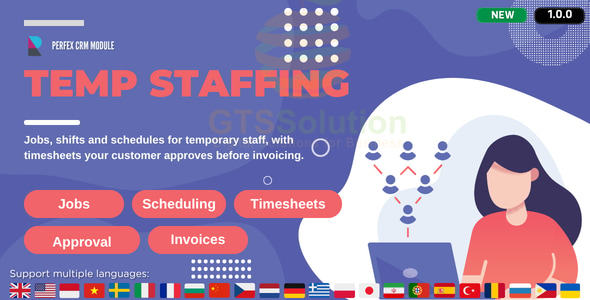
Temp Staffing for Perfex CRM – Jobs, Shifts and Timesheet Billing is a workforce management extension designed to help temporary staffing agencies, recruitment companies, labor suppliers, and workforce service providers organize job assignments, manage employee shifts, track working hours, and support timesheet-based billing within their Perfex CRM environment.
Temporary staffing businesses often coordinate multiple clients, workers, job locations, shift schedules, and billing arrangements at the same time. Managing these activities through disconnected spreadsheets and manual records can make it difficult to maintain accurate information and monitor assignment progress. A specialized staffing module can provide a more structured approach to organizing these operational activities.
With its focus on jobs, shifts, and timesheet billing, this Perfex CRM extension is intended to support important stages of temporary workforce coordination. It can be relevant to agencies supplying temporary workers to warehouses, offices, hospitality businesses, manufacturing facilities, retail stores, construction projects, and other organizations that need flexible staffing arrangements.
The exact workflows, automation features, permissions, and billing capabilities available should be confirmed in the official module documentation before implementation.
Temporary staffing involves matching workers with client requirements for a defined period, shift, project, or assignment. Unlike permanent recruitment, staffing operations may require continuous coordination of schedules, worker availability, attendance records, and timesheet approvals.
Temp Staffing for Perfex CRM provides a starting point for organizing these activities within an existing CRM-based business environment.
A staffing agency may need to maintain information about client companies, job requirements, assigned workers, scheduled shifts, completed hours, and billing records. Keeping these records organized helps teams understand which assignments are active, which shifts require attention, and which timesheets are ready for review.
Depending on the implementation, the module may complement existing Perfex CRM workflows by keeping staffing-related information associated with the broader business operation. The availability of direct connections to clients, projects, invoices, or other CRM records should be verified against the supplied documentation.
Job management is a central part of temporary workforce coordination. Staffing agencies receive requests from clients who need workers with particular skills, availability, experience, or qualifications.
A structured job management process helps agencies record these requirements and track assignments from initial planning through completion.
Depending on the fields and workflows supported by the module, a job record may contain information such as:
These are common staffing management fields rather than a guarantee that every field is included in the extension.
Organized job records can help staffing coordinators compare client requirements with available workers and maintain visibility into upcoming assignments.
For example, a warehouse may require additional workers for evening shifts during a seasonal increase in demand. A staffing agency can use a structured job record to document the requirement, coordinate suitable personnel, and monitor the assignment as it progresses.
Temporary staffing agencies frequently maintain a pool of workers who can be assigned to different clients and job locations.
A structured worker management process helps coordinators maintain relevant information about personnel and determine which workers may be suitable for particular assignments.
Depending on the module’s actual capabilities and its relationship with existing Perfex CRM records, worker information may include names, contact details, skills, availability, employment status, assignment history, and relevant administrative notes.
Staffing teams can use organized worker records to reduce repetitive data entry and improve visibility into the workforce they coordinate.
For example, a hospitality staffing agency may need workers with experience in food service, event setup, or customer-facing roles. A manufacturing staffing provider may focus on different skills, safety requirements, and shift availability.
Sensitive personnel information should be collected and stored only when necessary and handled according to applicable privacy and employment requirements.
A worker database, candidate matching engine, document verification system, or automated availability checker should not be assumed to be included unless explicitly documented.
Shift scheduling is particularly important for staffing businesses because workers may be required at different times, locations, and client sites.
The module’s stated focus on shifts makes shift-related coordination an important part of its intended use. Depending on the available functionality, staffing teams may be able to organize scheduled work periods and associate them with jobs or workers.
A shift record commonly includes the work date, start time, end time, assigned location, required personnel, and relevant job reference. Break periods and special instructions may also need to be considered where supported.
Effective shift planning can help agencies coordinate staffing requirements across multiple clients while reducing confusion about when and where workers should report.
Typical scheduling scenarios include:
The actual scheduling tools, recurring shift options, conflict detection, and calendar views depend on the module’s implementation.
A shift schedule should also be reviewed against applicable labor laws, contractual requirements, rest periods, and overtime rules.
Timesheets are essential for staffing agencies because they provide a record of the hours worked during an assignment. These records can help the agency review attendance, calculate billable time, and prepare information for payroll or client invoicing.
Temp Staffing for Perfex CRM specifically highlights timesheet billing, making the relationship between working-hour records and billing an important consideration.
Depending on the available fields and workflows, timesheets may record the worker, job assignment, shift date, start and end times, breaks, total hours, and approval status.
A consistent timesheet process helps reduce discrepancies between scheduled hours and reported working hours. It can also provide a documented basis for reviewing overtime, missed shifts, or differences between worker submissions and client records.
For example, a worker scheduled for an eight-hour shift may submit a timesheet reflecting actual working hours and any eligible overtime. The staffing coordinator or authorized client representative can review the information before it is used for billing.
The availability of electronic timesheet submission, automated hour calculations, approval workflows, or attendance integrations should be verified in the official product specifications.
Timesheet approval is an important control in temporary staffing operations. Before working hours are used for billing, the agency may need to verify that the reported time is accurate and consistent with the assignment requirements.
A typical process may involve a worker submitting hours, a supervisor or client representative reviewing the record, and an authorized person approving it for billing.
Depending on the module’s implemented workflow, timesheets may support status tracking or other review-related fields. The exact approval roles, notification options, and audit history should be confirmed from the supplied documentation.
A well-defined approval process can help identify discrepancies such as missing hours, incorrect shift dates, duplicate entries, or unapproved overtime.
Staffing agencies should establish clear rules about who can submit, edit, review, and approve timesheets. Changes to approved records should be handled carefully so that billing remains traceable and accurate.
Where required, organizations may need to implement additional approval controls or integrate with a separate attendance management system.
Billing is one of the most important operational requirements for temporary staffing agencies. Many agencies charge clients based on approved working hours, agreed hourly rates, shift premiums, or other contractual terms.
The module’s emphasis on timesheet billing indicates that it is intended to support a workflow connecting recorded working hours with billing-related activities.
Depending on the implementation, billable time may be used to calculate charges based on an agreed rate. For example, if a worker completes 40 billable hours at a contractual client rate of ₹500 per hour, the base service charge would be ₹20,000 before any applicable taxes, adjustments, or additional charges.
A staffing agency may need to manage different rates for different jobs, workers, clients, shift types, or overtime arrangements. The actual supported rate structures and calculation rules should be verified in the official documentation.
Potential billing considerations include:
These represent common staffing billing requirements rather than a guarantee that every feature is built into the module.
The extension should not be assumed to automatically generate invoices, process payments, calculate all statutory deductions, or synchronize with accounting systems unless those functions are explicitly documented.
Staffing agencies typically serve multiple clients, each with different staffing requirements, work locations, shift patterns, and commercial agreements.
Maintaining a clear relationship between client records and staffing assignments can help agencies understand which jobs belong to which organizations and track operational responsibilities.
Within a Perfex CRM environment, staffing workflows may complement client management activities. The actual links between staffing records and Perfex CRM client profiles should be confirmed before deployment.
A coordinated process can help staff review client requirements, record assignment details, follow up on timesheets, and prepare billing information for the relevant organization.
For example, an event staffing provider may coordinate several workers for one client during a conference. Another client may require recurring warehouse shifts throughout the month. Structured records help distinguish these assignments and reduce the risk of mixing information between customers.
Client-specific billing rates, service terms, or approval arrangements may require additional configuration or customization depending on the extension’s capabilities.
A staffing agency needs to understand the status of its jobs, scheduled shifts, worker assignments, and outstanding timesheets.
A structured workflow can help coordinators identify tasks that require attention, such as unfilled shifts, incomplete time records, pending approvals, or assignments approaching their end dates.
Depending on the module’s included views and reporting tools, staffing teams may be able to review assignment information and monitor the progress of related operational activities.
Useful management questions include:
The actual dashboard widgets, automated reminders, reports, and filtering capabilities should be verified against the module documentation.
If these views are not included, they may be developed or integrated separately according to the agency’s operational requirements.
Perfex CRM provides a broader business management environment, and a staffing extension can be valuable when its workflows fit into the agency’s existing processes.
Depending on the supported integration points, Temp Staffing for Perfex CRM may be used alongside relevant CRM information to help coordinate client-facing staffing operations.
Potential integration scenarios include linking staffing activities with client records, using existing business contact information, or connecting billing-related workflows with other administrative processes.
However, the exact integration behavior depends on the extension’s implementation. Developers should verify whether the module connects directly to Perfex CRM clients, staff, projects, invoices, or other components.
Compatibility with the installed Perfex CRM version is also important. Before installation, review the extension’s requirements, installation instructions, permissions, database changes, and supported update process.
If the agency uses other systems for payroll, accounting, attendance, or recruitment, additional API integration or custom development may be necessary.
Temporary staffing is used across many industries, and each sector has its own scheduling and billing requirements.
Warehouse and logistics staffing: Coordinate workers across receiving, packing, dispatch, and inventory-related assignments.
Hospitality staffing: Organize personnel for restaurants, hotels, conferences, and special events.
Manufacturing staffing: Track temporary workforce assignments for production lines, packaging, and operational support.
Retail staffing: Coordinate additional personnel during seasonal sales, promotions, and busy trading periods.
Construction support staffing: Organize temporary assignments for eligible support roles, subject to relevant safety and qualification requirements.
Office and administrative staffing: Coordinate receptionists, data-entry workers, temporary administrative assistants, and related roles.
Event staffing: Manage short-term assignments for event setup, guest services, registration, and venue operations.
These are potential use cases. The module’s actual fit depends on its supported job fields, scheduling model, worker records, and billing rules.
Staffing agencies benefit from understanding how effectively they coordinate assignments and process timesheets.
Depending on the reporting capabilities included, a staffing management workflow may support analysis of completed shifts, approved working hours, billing totals, outstanding records, and assignment status.
Such information can help management identify operational bottlenecks and improve internal processes.
For example, a large number of unapproved timesheets may indicate that client verification procedures need improvement. Repeated shift gaps may suggest a need for better workforce planning or more accurate availability records.
Useful staffing performance measures may include assignment completion rates, timesheet approval turnaround, billable hours, unfilled shifts, and average time taken to resolve discrepancies.
The actual availability of reports, export functions, and automated summaries should be confirmed in the official documentation. Additional reporting may require configuration, data integration, or custom development.
Staffing systems can contain personal information, employment-related records, work schedules, and commercially sensitive billing details. Proper access controls are important for protecting this information.
Organizations should ensure that users have access only to the records required for their responsibilities. For example, a staffing coordinator may need to manage assignments, while a billing employee may primarily need access to approved timesheets and relevant rate information.
If the extension supports role-based permissions, administrators should configure and test them carefully. The available permission controls and their level of detail depend on the implementation.
Other good practices include regular backups, secure server configuration, updated dependencies, and appropriate handling of personal data.
Agencies should also establish procedures for correcting records, reviewing changes, and retaining timesheet information according to applicable legal and contractual requirements.
This extension may be useful for businesses that already use Perfex CRM and need a more organized approach to temporary workforce operations.
Potential users include:
Its suitability depends on the agency’s operational workflow, the module’s documented capabilities, and compatibility with the existing Perfex CRM installation.
Temp Staffing for Perfex CRM – Jobs, Shifts and Timesheet Billing provides a staffing-focused extension concept for businesses that need to coordinate temporary jobs, scheduled shifts, working-hour records, and client billing activities within their Perfex CRM environment.
Its focus on job management, shift coordination, and timesheet-based billing addresses important operational areas for temporary staffing agencies. A structured workflow can help improve record organization, make assignment status easier to review, and provide a clearer basis for calculating client charges from approved working hours.
Before installing the extension, review the official documentation to confirm supported Perfex CRM versions, job and worker management fields, shift scheduling features, timesheet approval workflows, billing calculations, and integrations with existing CRM records.
With clearly defined staffing procedures, accurate time records, suitable approval controls, and appropriate billing configuration, this module can serve as a useful component of a more organized temporary workforce management process.
1. All digital products are the most recent version, with no possibility of free updates. After payment, you can request an update to the most recent version for 5 days if a new version is released. We free support within 5 days.
2. If a license is required (Excludes WHMCS license , we provide only method not license), please contact us via email or ticket for assistance with activation. Our license is only valid for activation and does not include support.
3. We provide Mobile, PHP script installation services for $19.90 / ₹1700. Please create a backup after installation as we do not support re-installation. For mobile app source code, we do not offer installation services.
4. If you have any questions, please contact us by email [email protected] or create a ticket on this page
5. Please note that any digital products presented on the website do not contain malicious code, viruses or advertising. You will receive the original files from the developers. We do not sell any products that have been downloaded from other websites.
6. The response time can last up to 6 hours.
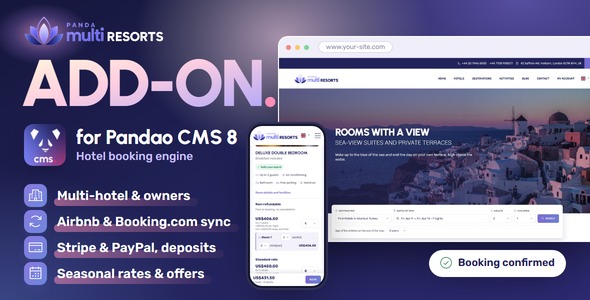
Multi Resorts – Hotel Booking Add-on for Pandao CMS Multi Resorts is a comprehensive hotel booking add-on developed for Pandao CMS, designed...
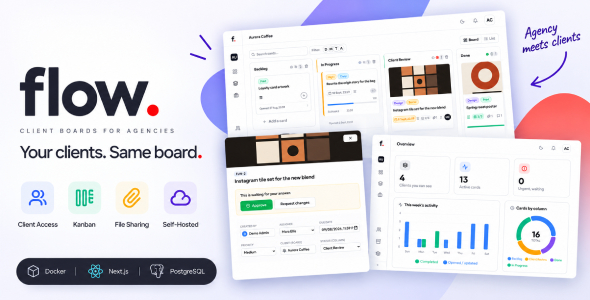
Flow | Client Portal and Kanban Project Management for Agencies Flow | Client Portal and Kanban Project Management for Agencies is a...
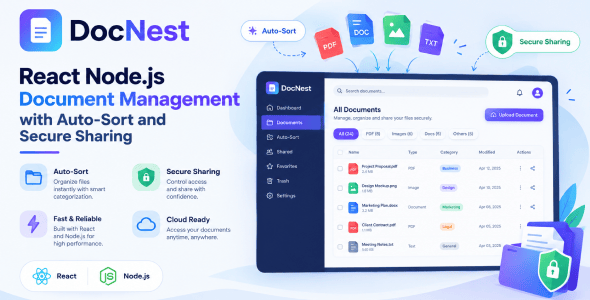
DocNest | React Node.js Document Management with Auto-Sort and Secure Sharing DocNest is a modern and intelligent document management platform built with...
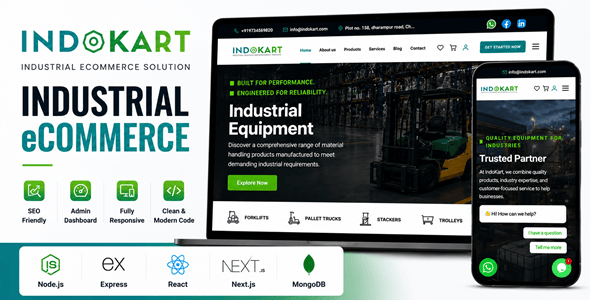
IndoKart | React Node.js eCommerce Platform With Admin Panel IndoKart is a modern and scalable eCommerce platform built with React and Node.js,...
