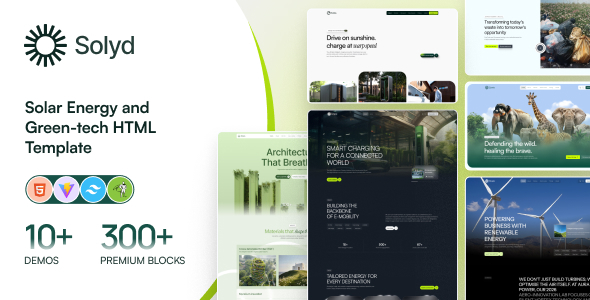
Solyd | Solar Energy & Green-tech HTML Template is a modern website template designed for solar energy companies, renewable energy providers, green technology businesses, and sustainability-focused organizations. Created for businesses operating in the clean energy sector, Solyd provides a frontend foundation for presenting renewable energy solutions, showcasing company services, explaining sustainable technologies, and connecting with potential customers. Its industry-focused positioning makes it suitable for businesses that want to communicate their commitment to energy efficiency, environmental responsibility, and a cleaner future through a professional online presence.
Whether you operate a solar panel installation company, provide renewable energy consulting, distribute solar equipment, or offer green technology solutions, Solyd can serve as a starting point for developing a business website tailored to your services. Developers can customize the supplied HTML structure, styling, and visual assets to reflect a company’s brand identity, service offerings, and target audience.
A solar energy website should communicate the value of renewable power while helping visitors understand the available products and services. Customers may be researching solar panel installation, comparing energy solutions, exploring commercial solar systems, or looking for information about sustainable technologies.
Solyd is positioned for renewable energy businesses that need a clear and professional way to communicate these offerings. Its design can be adapted to present company information, service descriptions, project highlights, energy solutions, and customer inquiry options.
A consistent visual identity helps build recognition and supports the company’s professional image. Developers can customize colors, typography, imagery, spacing, and page content to reflect the business’s brand. Solar installations, renewable energy systems, and environmental imagery can also help communicate the company’s industry focus.
The exact layouts, page variations, and included visual components should be verified against the product package.
Solyd is an HTML website template intended for developers who want direct control over the structure and presentation of their website. HTML defines the page structure, CSS manages visual styling, and JavaScript can be used to implement interactive behavior where required.
This approach can be useful for developers building corporate websites, service pages, landing pages, and other frontend experiences without relying on a particular content management system.
Developers can adapt the existing markup, modify styles, replace images, and extend the website according to project requirements. A static HTML website may be sufficient for a business that primarily needs to publish company information and receive customer inquiries.
However, dynamic features such as customer portals, automated quotation systems, database-driven project galleries, or account management require additional backend development or third-party integrations unless explicitly included in the package.
Before installation, review the documentation for the source file structure, dependencies, required libraries, browser compatibility, and recommended setup process.
Solar panel installation businesses need to explain their services clearly so customers can understand how a solar system may fit their property and energy requirements.
Solyd can be customized to present residential, commercial, and industrial solar services, depending on the needs of the business and the available layouts. Relevant content may include system installation, solar equipment selection, project planning, maintenance, inspections, and energy consultation.
A service page should explain what the company offers, who the service is intended for, and what customers can expect from the process. Supporting photographs, installation examples, and clear inquiry options can help visitors understand the business’s capabilities.
Businesses should provide accurate descriptions of their services, qualifications, and service areas. Any claims about expected energy production, financial savings, or environmental benefits should be supported by appropriate evidence and clearly explained assumptions.
The renewable energy industry includes a range of technologies and services beyond residential solar panels. Businesses may specialize in commercial solar installations, energy efficiency, equipment distribution, renewable energy consulting, or integrated sustainable energy systems.
Solyd can serve as a foundation for presenting these different offerings through organized service sections and informative content pages.
Potential applications include:
These are possible content applications rather than a guarantee that separate pages for every service are included in the template.
Customers considering renewable energy services often want to understand the company’s experience, technical capabilities, and approach to project delivery.
An informative company profile can introduce the organization, its mission, its service areas, and the expertise of its team. Solyd can be adapted to communicate this information in a structured and professional format.
Depending on the business, the about section may include company milestones, team profiles, relevant certifications, project experience, and information about its approach to sustainability.
Use genuine company details and authorized photographs wherever possible. Accurate information helps establish credibility and gives prospective customers a better understanding of the organization they may choose to work with.
A project portfolio can help renewable energy companies demonstrate their experience and show prospective customers the types of installations they handle.
Solyd can be customized to present completed solar installations, commercial projects, industrial systems, or other renewable energy work. Depending on the included layouts, developers may organize projects into visual galleries, project cards, or dedicated case study pages.
Useful project information can include the project location at an appropriate level of detail, system capacity, installation type, project scope, and relevant technical information. Where performance figures are available, clearly explain the measurement period and source of the data.
Case studies can also describe the customer’s requirements, the proposed solution, and the completed installation. This gives visitors more context than photographs alone and helps communicate the company’s technical capabilities.
Any claims about energy generation, reduced electricity bills, or emissions avoided should be accurate and appropriately qualified.
Businesses in the solar and green technology sectors often need to explain technical subjects to customers with different levels of knowledge. A well-organized website can help make this information easier to understand.
Solyd can be adapted to communicate topics such as solar installation processes, system components, maintenance requirements, and general energy efficiency considerations.
Clear explanations can help customers understand the differences between available solutions and identify the questions they should ask before making a purchase decision.
For example, a solar company might explain how roof suitability, energy consumption, system size, local regulations, and installation requirements influence a project. Providing practical information can make the website more useful while setting realistic expectations.
Technical and financial claims should be based on reliable information rather than unsupported promises.
Customers may research solar services from desktop computers, tablets, and smartphones. A responsive website helps ensure that important information remains accessible across these devices.
When implementing Solyd, developers should verify that navigation menus, service cards, project galleries, headings, images, and contact information adapt appropriately to different screen sizes.
Mobile usability is especially important for visitors who want to call a business, request an estimate, or send an inquiry directly from their phone.
Developers should test navigation, image scaling, button sizes, form fields, spacing, and text readability across different viewports. The final responsive experience depends on the supplied CSS implementation and any customizations made during development.
Every renewable energy business has different branding requirements. A residential solar installer may want to emphasize approachable service and household energy solutions, while an industrial provider may prioritize technical expertise, project capacity, and commercial capabilities.
Solyd can be customized to reflect these differences through changes to colors, typography, imagery, content, and page structure.
Common customization tasks include:
Maintaining consistent branding across the website helps communicate professionalism and makes the company easier to recognize.
The level of customization depends on the supplied source files and the developer’s familiarity with HTML, CSS, and JavaScript.
A solar energy website should make it easy for interested customers to request information or discuss a potential project.
Depending on the available layouts, Solyd can be adapted to include contact details, consultation calls to action, and inquiry forms. Businesses may also choose to display service areas, telephone numbers, business email addresses, and other communication channels.
A functional inquiry form may collect relevant details such as property type, location, approximate energy requirements, and preferred contact method. Only request information that is necessary for the inquiry process.
A visible form does not automatically process or deliver submissions. Developers may need to connect it to a backend endpoint, email service, or third-party form provider. Input validation, spam protection, error handling, and privacy considerations should be addressed before the website goes live.
Website performance matters because visitors may leave a page that loads slowly or is difficult to navigate. Solar websites often use large project photographs and promotional banners, so image optimization can be especially important.
Developers can improve performance by resizing images appropriately, using suitable modern formats, reducing unnecessary scripts, minimizing unused CSS, and avoiding excessive animation effects. Hosting configuration and caching can also influence page loading speed.
Search engine optimization helps potential customers discover solar services through relevant searches. Important implementation tasks include writing descriptive page titles and meta descriptions, organizing headings logically, adding meaningful image alternative text, and creating readable URLs.
Businesses should also create useful, original content about their actual services, project experience, and service locations. Local business information should remain consistent wherever it is published.
An HTML template does not automatically guarantee search rankings, high performance, or complete SEO readiness. Results depend on content quality, implementation, hosting, and ongoing maintenance.
As a renewable energy business grows, its website may need additional capabilities such as analytics, customer relationship management integration, appointment scheduling, quotation workflows, newsletter subscriptions, or a content management system.
Solyd can provide a frontend foundation for these enhancements, depending on the structure of the supplied code and the integrations selected.
For example, a business may connect inquiry forms to a CRM system, use analytics to understand visitor behavior, or add a content management system so staff can publish project updates without editing HTML directly.
More advanced features, such as solar system estimation tools, customer dashboards, and online equipment sales, require additional implementation or compatible third-party services. These capabilities should not be assumed to be included in the original template unless confirmed by the documentation.
Solyd may be suitable for solar installation companies, renewable energy consultants, green technology businesses, equipment suppliers, web developers, freelancers, and digital agencies.
It can be a useful starting point for projects where the primary goal is to communicate services, showcase completed work, establish a professional brand, and encourage customer inquiries.
Before purchasing or deploying the template, review the included pages, source code, documentation, dependencies, licensing terms, and technical requirements. Confirm that the available layouts match the intended website and identify any additional functionality that needs to be developed.
Solyd | Solar Energy & Green-tech HTML Template provides a starting point for building professional websites for solar energy companies, renewable energy providers, and sustainability-focused businesses. Its HTML-based structure allows developers to customize the website’s presentation and adapt its content to different clean energy services and audiences.
With consistent branding, informative service pages, genuine project examples, responsive implementation, optimized imagery, and suitable integrations, Solyd can be adapted to a wide range of renewable energy website projects. Reviewing the supplied features and testing the finished implementation before launch will help ensure that the website meets the business’s technical, usability, and communication requirements.
1. All digital products are the most recent version, with no possibility of free updates. After payment, you can request an update to the most recent version for 5 days if a new version is released. We free support within 5 days.
2. If a license is required (Excludes WHMCS license , we provide only method not license), please contact us via email or ticket for assistance with activation. Our license is only valid for activation and does not include support.
3. We provide Mobile, PHP script installation services for $19.90 / ₹1700. Please create a backup after installation as we do not support re-installation. For mobile app source code, we do not offer installation services.
4. If you have any questions, please contact us by email [email protected] or create a ticket on this page
5. Please note that any digital products presented on the website do not contain malicious code, viruses or advertising. You will receive the original files from the developers. We do not sell any products that have been downloaded from other websites.
6. The response time can last up to 6 hours.
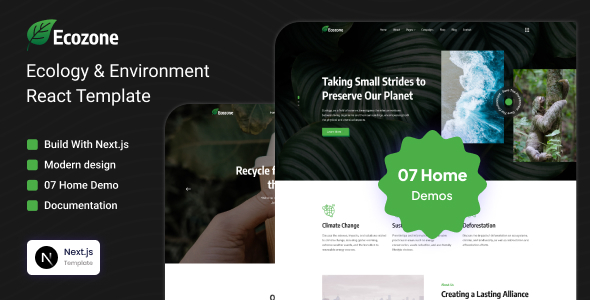
Ecozone – Ecology & Environment Next.js Template Ecozone is a modern, clean, and nature-inspired Ecology & Environment Next.js Template designed for environmental...
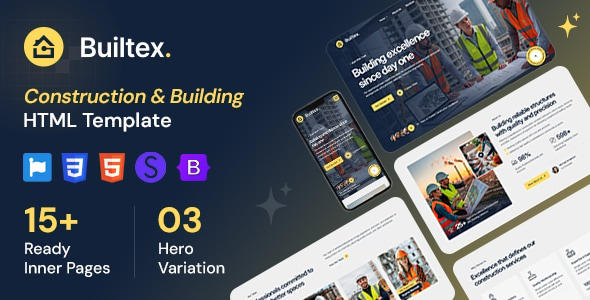
Builtex - Construction HTML Template Builtex is a modern and professionally designed HTML template created specifically for construction companies, building contractors, engineering...
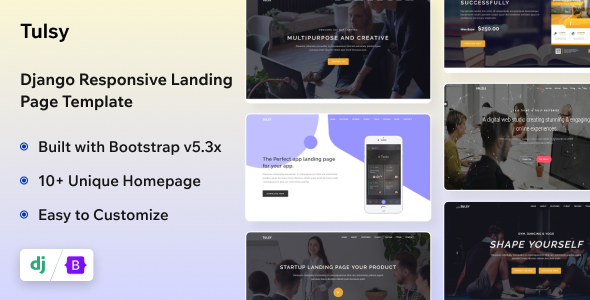
Tulsy - Django Multipurpose Landing Page Template Tulsy is a modern and versatile Django landing page template designed for startups, SaaS companies,...
Mihrab – Islamic Centre, Mosque, Charity & Online Courses React Template Mihrab is a modern, elegant, and purpose-driven Islamic Centre, Mosque, Charity...
