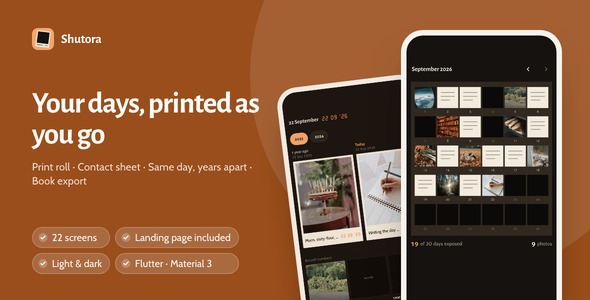
Shutora | Flutter Photo Diary App with Laravel Cloud Backup is a mobile application template designed for creating a personal photo diary where users can capture, organize, and preserve meaningful moments through photographs and written memories. Built with Flutter and paired with a Laravel-based cloud backup component, Shutora provides a foundation for developing a digital journaling experience that combines visual storytelling with centralized data storage.
Photographs often capture important experiences, everyday activities, travel memories, celebrations, and personal milestones. A photo diary gives users a dedicated space to organize these moments and associate them with dates, descriptions, and personal reflections. With cloud backup functionality, a compatible application can also provide a way to preserve selected diary data beyond a single device.
Shutora is suitable for developers and entrepreneurs interested in personal journaling, memory-keeping applications, and photo-focused mobile utilities. Its Flutter-based interface and Laravel backend can be customized to suit different user experiences, storage requirements, and privacy expectations. The exact features, synchronization workflows, and backup capabilities depend on the original implementation and should be verified in the supplied documentation.
Shutora is designed around the concept of maintaining a personal diary through photographs and written entries. Rather than storing images without context, users can organize memories into a more meaningful collection.
Depending on the included implementation, the application may be adaptable to display photo entries, dates, captions, and other diary-related information. This structure can help users revisit important moments and understand the stories behind their photographs.
Potential diary entry types include:
These are possible use cases rather than a guarantee that every entry type is supported by default. Developers should check the original product demonstration and feature list to confirm the available screens and data fields.
Flutter provides a cross-platform development framework that allows developers to create applications for supported platforms using a shared codebase. Shutora uses Flutter as its mobile development foundation, offering a starting point for building a consistent photo diary experience.
Using an existing application template can reduce repetitive UI development and allow developers to focus on customizing the diary workflow, connecting the backend, and configuring photo storage.
Potential benefits include:
Supported operating systems, Flutter versions, and device compatibility should be confirmed in the supplied technical documentation.
A photo diary needs a convenient way for users to add photographs to their personal collections. Depending on the existing implementation, Shutora may be adaptable to support image selection from a device gallery or direct capture using the camera.
A streamlined image workflow can make it easier to document everyday experiences without navigating through complicated screens.
Potential image-related features include:
These capabilities should be verified against the included source code. Camera access, gallery permissions, supported image formats, and upload behavior may vary depending on the implementation and operating system.
Photographs can become more meaningful when accompanied by personal notes. A diary application can provide a space for users to describe an event, record how they felt, or preserve details they might otherwise forget.
Depending on the supplied functionality, Shutora may be customized to support written captions, dated entries, and additional personal information associated with each photograph.
Potential journal enhancements include longer text entries, daily notes, entry editing, and optional tags for organizing memories.
A useful implementation should preserve the relationship between photographs and their associated text so that entries remain understandable when users revisit them later.
Additional formatting options or advanced journaling features may require further development if they are not included in the original package.
A timeline can make it easier to explore memories chronologically. By organizing entries around dates, users can move through their personal history and locate photographs from particular periods.
Shutora can be evaluated as a foundation for a timeline-oriented photo diary, depending on the available screens and data model.
Potential extensions include daily groupings, monthly collections, yearly memory summaries, and date-based navigation.
Chronological organization can be especially useful for users who regularly document their experiences or maintain a long-term personal journal.
The exact timeline functionality should be verified in the original product documentation.
Cloud backup is an important part of the Shutora product concept. A Laravel backend can provide server-side functionality for handling application requests, managing stored records, and coordinating communication between the mobile application and cloud infrastructure.
Depending on the supplied implementation, the Laravel component may support backup-related workflows for diary information and associated media.
Potential backup responsibilities include:
The precise backup behavior depends on the supplied backend and storage configuration. Developers should verify whether image storage, automatic backup, restore functionality, and multi-device synchronization are included or require additional implementation.
A Laravel backend alone does not automatically provide unlimited cloud storage or a complete backup service. Appropriate storage infrastructure, server configuration, and data management policies are still required.
Cloud storage can help users preserve diary information beyond the local device. When properly implemented, synchronization can also help keep selected records consistent across supported application sessions or devices.
Depending on the architecture included with Shutora, developers may integrate suitable file storage and database services to manage photographs, entry metadata, and user preferences.
Potential synchronization enhancements include upload progress indicators, backup status information, retry mechanisms, and conflict handling when the same entry is modified in multiple places.
Developers should also define how the application behaves when a device loses its internet connection, an upload fails, or the available storage quota is exceeded.
These capabilities should not be assumed to be fully implemented without reviewing the original source code.
A personal photo diary may contain private photographs, locations, and personal reflections. If the application uses user accounts, access management becomes an important part of protecting each person’s collection.
Depending on the included implementation, Shutora may be adaptable to support account authentication and user-specific diary storage.
Potential account-related features include registration, login, profile management, account recovery, and synchronization across supported devices.
Developers should verify which authentication methods are already available and whether the Laravel backend enforces access controls for diary records and uploaded media.
A production application should ensure that one user’s private photographs and journal entries cannot be accessed by another user without explicit authorization.
Privacy is particularly important for applications that store personal photographs and diary entries. Users should understand how their information is stored, backed up, accessed, and deleted.
Recommended implementation considerations include:
If photographs contain location metadata or other personal information, developers should decide whether that information is necessary and how it should be handled.
Cloud backups should be protected by appropriate access controls, and any third-party storage services should be configured according to the application’s privacy requirements.
As a photo diary grows, users may need convenient ways to find older entries. Search and filtering can help them revisit memories without scrolling through an entire collection.
Depending on the available implementation, Shutora may be extended with date-based browsing, text search, tags, or category filters.
Potential search options include finding entries by caption, filtering by month or year, and organizing photographs around selected topics.
Advanced search may require additional database queries, indexing, or changes to the backend API if these features are not included.
A photo diary application can be customized to reflect a particular visual identity or target audience. Shutora provides a Flutter-based foundation that developers can evaluate for branding and interface adjustments.
Potential customization areas include the application name, logo, color palette, typography, icons, navigation, diary layouts, and photo presentation.
For example, a developer could adapt the interface for travel journaling, family memories, creative photography, or everyday personal documentation.
The extent of customization depends on the source code and UI components supplied with the template. Developers should also test their changes across supported devices and screen sizes.
Photo-heavy applications require careful handling of image sizes, storage operations, and network requests. Large image uploads can consume bandwidth and may fail on unstable connections if the application does not handle interruptions appropriately.
Developers should test image loading, upload progress, retry behavior, storage limits, and recovery from failed backup operations.
Depending on the project requirements, image compression, thumbnail generation, background uploads, and storage lifecycle policies may improve performance and control costs.
A reliable backup system should clearly distinguish between locally saved entries and successfully backed-up information. Users should not be led to believe that a memory is safely backed up when an upload has failed or remains incomplete.
The final reliability of Shutora depends on the supplied implementation, backend configuration, and selected storage infrastructure.
Shutora may be suitable for:
Before selecting the template, review its included features, backend requirements, source code, licensing terms, storage configuration, and supported mobile platforms.
Shutora | Flutter Photo Diary App with Laravel Cloud Backup provides a foundation for developing a personal photo diary that combines mobile photography, written memories, and a Laravel-based backend for cloud-related functionality.
Its Flutter architecture can be customized to support photo entries, chronological organization, personal journaling, and backup workflows, depending on the capabilities included with the original package.
Before production deployment, developers should verify the actual backup and restoration features, configure appropriate cloud storage, test synchronization behavior, and protect users’ private photographs and diary information.
With a thoughtful user experience, secure data handling, and a reliable storage strategy, Shutora can serve as a starting point for a digital diary application that helps users preserve and revisit their personal memories.
1. All digital products are the most recent version, with no possibility of free updates. After payment, you can request an update to the most recent version for 5 days if a new version is released. We free support within 5 days.
2. If a license is required (Excludes WHMCS license , we provide only method not license), please contact us via email or ticket for assistance with activation. Our license is only valid for activation and does not include support.
3. We provide Mobile, PHP script installation services for $19.90 / ₹1700. Please create a backup after installation as we do not support re-installation. For mobile app source code, we do not offer installation services.
4. If you have any questions, please contact us by email [email protected] or create a ticket on this page
5. Please note that any digital products presented on the website do not contain malicious code, viruses or advertising. You will receive the original files from the developers. We do not sell any products that have been downloaded from other websites.
6. The response time can last up to 6 hours.
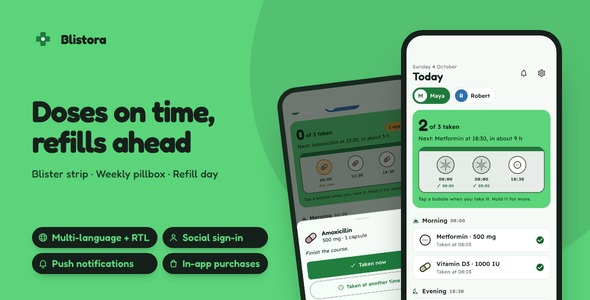
Blistora | Flutter Medication Reminder and Refill Tracker App With Laravel Cloud Backup Blistora | Flutter Medication Reminder and Refill Tracker App...

Yield | Revenue Analytics PHP Script With Flutter App Yield | Revenue Analytics PHP Script With Flutter App is a revenue analytics...

eMart | Multi-Vendor Ecommerce Flutter App eMart | Multi-Vendor Ecommerce Flutter App is a mobile application solution designed for businesses and entrepreneurs...

NextList | Post and Buy - Classified Ads Marketplace React Native App NextList | Post and Buy - Classified Ads Marketplace React...
