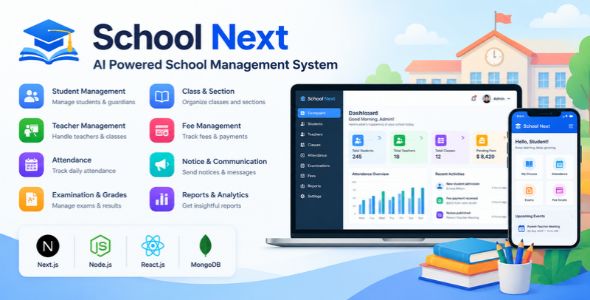
School Next | AI-Powered Education Management and Enterprise ERP System | Next.js | MongoDB is a modern education management software solution designed to help schools, educational institutions, and academic organizations manage their daily administrative and academic operations through a centralized digital platform. Built with Next.js and MongoDB, School Next combines an education-focused ERP concept with AI-powered capabilities to provide a foundation for managing institutional information, organizing workflows, and improving administrative efficiency.
From student admissions and academic records to staff administration, attendance, fee management, and institutional reporting, an education ERP can bring important school operations into one organized environment. School Next is suitable for developers, education technology companies, school administrators, and entrepreneurs planning to build or customize a modern school management platform.
School Next is designed around the needs of modern educational institutions that want to simplify administrative work and improve access to academic information.
Traditional school operations often involve separate systems for student records, staff information, attendance, examinations, and financial management. An integrated education management platform can help bring these activities together, reducing the need for disconnected tools and repetitive manual processes.
The AI-powered positioning also provides opportunities to introduce intelligent automation and data-assisted workflows. Depending on the included AI modules and integrations, these capabilities may support administrative assistance, educational content generation, information analysis, and automated communication.
Student information management is one of the most important parts of a school ERP system. School Next can serve as a foundation for organizing student-related information within a centralized application.
A customized implementation can provide structured student profiles containing personal details, contact information, enrollment information, academic records, and other institution-specific data.
Potential student management capabilities include:
A centralized student database can help authorized school administrators access relevant information more efficiently. The exact fields and management workflows depend on the supplied implementation.
Managing admissions is an important operational requirement for schools and educational institutions. A digital admission workflow can help organize applications, applicant information, and enrollment-related activities.
School Next can be extended to support online admission forms, application tracking, document submissions, and admission status management, depending on the available modules.
An advanced implementation may also include application review workflows, admission approvals, student ID generation, and automatic assignment to classes or academic sessions.
These capabilities can help institutions manage student intake more systematically and reduce manual administrative work.
Attendance tracking helps schools maintain records of student participation and staff availability.
An education ERP can provide a centralized approach to recording, reviewing, and monitoring attendance information. School Next can be customized around attendance workflows for students, teachers, and other staff members.
Potential attendance functionality includes:
Additional functionality such as biometric attendance, RFID integration, QR-based attendance, or automated notifications requires compatible hardware, services, or custom development.
Educational institutions need an organized structure for managing classes, subjects, academic sessions, and student assignments.
School Next can provide a foundation for developing academic management workflows that help administrators organize institutional information.
A customized system may include class creation, section management, subject allocation, academic year configuration, teacher assignments, and student enrollment within classes.
This structure can help teachers and administrators maintain consistent academic information and simplify access to class-related records.
Examinations and academic assessments are essential parts of school administration. A comprehensive ERP platform can help organize examination schedules, assessment records, and student results.
Depending on the included modules, School Next can be extended to support examination management workflows such as:
Advanced grading calculations, automated report generation, and customized assessment rules may require additional configuration based on the institution’s academic policies.
Managing teachers and non-teaching employees is another important requirement for educational institutions.
School Next can be customized to maintain staff information, organize employee records, and support administrative workflows.
Potential staff management functionality includes:
Institutions can use centralized employee records to improve administrative organization. Payroll, leave management, and advanced human resource workflows may require additional modules or integrations.
Fee management is an important operational responsibility for schools, colleges, and other educational organizations.
A school ERP can help organize student fee structures, payment records, outstanding balances, and financial summaries.
Depending on the available functionality, School Next can be extended with features such as:
Automated payments, refunds, recurring billing, and financial reconciliation require suitable backend workflows and payment provider integrations. Actual accounting and taxation requirements should also be configured according to the institution’s location.
Artificial intelligence can help educational institutions improve certain administrative and academic workflows. School Next’s AI-powered positioning provides opportunities to integrate intelligent tools into the broader education management environment.
Depending on the actual AI modules and external integrations, potential enhancements may include:
These are possible AI application areas, not guaranteed built-in features. Their availability depends on the supplied implementation, connected AI models, API credentials, permissions, and data quality. External AI services may also involve separate usage costs.
Communication between schools, students, and parents is an important part of effective educational management.
A customized School Next implementation can provide separate portals or dashboards for different user roles, depending on the available modules.
A student portal may provide access to academic information, attendance records, examination results, schedules, and announcements.
A parent portal can be extended to display relevant information about their children’s attendance, academic progress, fee records, and school notifications.
These portals can help improve communication and reduce the need for repeated manual information requests. Role-based access controls are essential to ensure that users can only access records they are authorized to view.
Schools need to coordinate classes, teachers, subjects, and academic activities throughout the day.
A timetable management module can help administrators organize teaching schedules and reduce scheduling conflicts.
School Next can be customized to support class timetables, teacher assignments, subject schedules, examination calendars, and institutional events.
Additional scheduling capabilities may include automated timetable generation, conflict detection, and calendar synchronization. These advanced features require suitable scheduling logic and implementation.
Educational institutions may also need a centralized way to manage books, learning materials, and library resources.
An extended education ERP can include library management functionality for maintaining book records, catalog information, borrowing history, and return dates.
Potential enhancements include book availability tracking, student borrowing records, overdue notifications, and resource categorization.
Digital learning resources can also be incorporated through additional integrations, depending on the institution’s requirements.
Timely communication helps schools coordinate activities with students, parents, teachers, and administrative staff.
School Next can be extended with communication workflows for sending announcements, academic updates, reminders, and important institutional information.
Possible communication channels include:
Email, SMS, and messaging services require suitable provider integrations and configuration. Automated notifications should also respect user permissions and communication preferences.
Larger educational organizations may require more than basic school administration. They often need centralized management across different departments, academic units, and administrative teams.
School Next’s enterprise ERP positioning makes it relevant to projects that require an expandable institutional management environment.
Depending on the supplied modules and additional development, the platform can be extended to manage academic departments, administrative operations, staff information, student services, financial records, and reporting workflows.
For institutions operating multiple campuses or branches, multi-campus management may also be introduced through suitable database architecture, organization-level permissions, and administrative controls.
Multi-tenant functionality should be verified separately rather than assumed from the enterprise ERP positioning.
A centralized dashboard can help administrators understand important institutional activities without navigating through multiple management sections.
Depending on the included functionality, dashboards may be customized to display student information, attendance summaries, staff records, admission statistics, fee collection data, and other operational indicators.
Reporting functionality can help administrators review institutional information and make more informed decisions.
Potential reporting enhancements include:
The accuracy of these reports depends on the quality of the underlying data and the implementation of the relevant reporting logic.
School Next uses Next.js and MongoDB as its stated technology foundation.
Next.js is a React-based framework for building modern web applications. It provides a structured development environment for creating application interfaces and implementing web-based experiences.
MongoDB is a document-oriented database that can store structured and flexible application data. It can be used to organize information such as student profiles, staff records, academic data, and institutional settings.
Together, these technologies provide a foundation for developing a modern education management application. Developers should review the included architecture, dependencies, API implementation, and database models to understand how the project handles authentication, data operations, and application workflows.
Education management systems handle sensitive information, including student records, parent contact details, staff information, and financial data.
A production deployment should implement appropriate security measures to protect this information.
Important considerations include secure authentication, role-based access control, server-side validation, protected API endpoints, database access restrictions, secure file uploads, and appropriate data backup procedures.
Different user roles, such as administrators, teachers, students, and parents, should receive access only to the information and functions required for their responsibilities.
Institutions should also establish suitable privacy policies and data retention practices according to applicable regulations.
Every school has different academic structures, administrative policies, and operational requirements. School Next can be customized to accommodate different institutional workflows.
Potential extensions include:
The availability of these integrations depends on the supplied source code, supported APIs, and additional development.
School Next can be adapted for several education-related business and institutional requirements.
School Management System: Build a centralized platform for managing student records, attendance, academic information, and administrative operations.
College Management ERP: Customize the system for higher education institutions with departments, academic sessions, student records, and examination workflows.
Multi-Branch Education Organization: Develop an institutional management solution for organizations that operate multiple educational locations, subject to appropriate multi-campus development.
Private Education Institute: Manage admissions, students, teachers, classes, fees, and daily operations for private educational businesses.
Education Technology Startup: Use the platform as a starting point for developing a commercial education management SaaS product.
Enterprise Academic Management: Extend the system to support larger educational organizations with additional administrative and reporting requirements.
School Next is suitable for school owners, college administrators, education entrepreneurs, software development companies, educational institutions, and technology startups.
It can also be useful for developers who want to build customized school management software or create an education ERP product using Next.js and MongoDB.
Its education management and enterprise ERP concept provides a starting point for organizations seeking to digitize academic and administrative workflows.
Using an existing education management project can reduce the initial effort required to develop a school ERP application from the ground up.
Key benefits include:
Before deploying School Next in a live educational environment, review the included source code, documentation, dependencies, database models, and available modules.
Verify which features are fully implemented and which require additional development. In particular, AI functionality, payment processing, biometric attendance, examination automation, parent communication, and multi-campus management should be checked against the actual project package.
A production deployment may require database configuration, secure authentication, role-based permissions, notification services, backup systems, file storage, and institutional data migration.
AI integrations may require separate API credentials and usage fees. Schools should also test the application thoroughly and establish appropriate procedures for protecting student and staff information.
School Next | AI-Powered Education Management and Enterprise ERP System | Next.js | MongoDB offers a modern starting point for developing a centralized education management platform. Its combination of AI-powered positioning, school ERP concepts, Next.js, and MongoDB makes it relevant to educational institutions, software developers, and entrepreneurs building education technology solutions.
Whether you want to digitize school administration, develop a customized education ERP, or establish a scalable school management SaaS business, School Next can provide a foundation for your project. Customize its modules, integrate the required services, and adapt its workflows to create an education management solution that meets your institution’s needs.
1. All digital products are the most recent version, with no possibility of free updates. After payment, you can request an update to the most recent version for 5 days if a new version is released. We free support within 5 days.
2. If a license is required (Excludes WHMCS license , we provide only method not license), please contact us via email or ticket for assistance with activation. Our license is only valid for activation and does not include support.
3. We provide Mobile, PHP script installation services for $19.90 / ₹1700. Please create a backup after installation as we do not support re-installation. For mobile app source code, we do not offer installation services.
4. If you have any questions, please contact us by email [email protected] or create a ticket on this page
5. Please note that any digital products presented on the website do not contain malicious code, viruses or advertising. You will receive the original files from the developers. We do not sell any products that have been downloaded from other websites.
6. The response time can last up to 6 hours.

Frameflow - Multipurpose WordPress Theme Frameflow is a versatile, modern, and feature-rich Multipurpose WordPress Theme designed to meet the needs of businesses,...

Esonix - Business Consulting HTML Template Esonix - Business Consulting HTML Template is a professional website template designed for business consultants, corporate...

Vireon - Business Consulting Elementor Template Kit Vireon - Business Consulting Elementor Template Kit is a professional website template kit designed for...

Finvera — Accounting & Financial Advisory Elementor Template Kit Finvera — Accounting & Financial Advisory Elementor Template Kit is a professional website...
