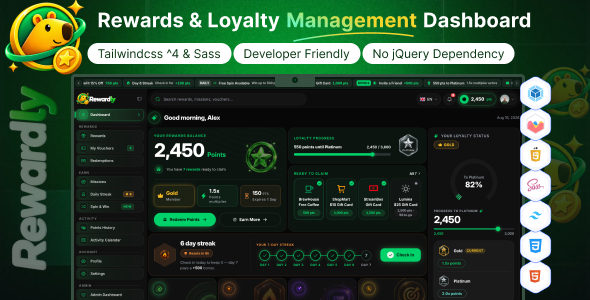
Rewardly – Rewards & Loyalty Management Dashboard Template is a modern administrative dashboard template designed for businesses, startups, e-commerce platforms, and customer engagement teams that want to build interfaces for managing rewards programs and customer loyalty initiatives. Created for loyalty-focused applications, Rewardly provides a foundation for organizing customer information, presenting reward-related data, monitoring program activity, and managing loyalty operations through a centralized dashboard.
Customer loyalty has become an important part of business growth, helping companies encourage repeat purchases, strengthen customer relationships, and improve long-term engagement. A well-organized loyalty management dashboard can help businesses understand program activity, review customer participation, and manage the information needed to deliver a consistent rewards experience.
Rewardly – Rewards & Loyalty Management Dashboard Template can serve as a starting point for developing a customized administration interface for loyalty programs, membership benefits, reward points, customer engagement campaigns, and related business workflows. Depending on the included components and additional development, it can be adapted to the needs of online stores, retail businesses, subscription services, and customer rewards platforms.
An effective loyalty management dashboard should make it easy for administrators to review program information and access frequently used management functions. Rewardly is intended to support a structured administrative experience focused on customer rewards and loyalty-related activities.
A customized dashboard may organize important information into summary cards, customer records, reward categories, transaction histories, and program management sections. This structure can help administrators navigate different aspects of a loyalty program without relying on disconnected spreadsheets or separate interfaces.
Businesses can adapt the dashboard layout to match their internal processes, whether they manage a simple points-based rewards program or a more extensive customer membership system.
The actual pages, visual components, and prebuilt functionality available depend on the original product package and should be verified before purchase.
A loyalty program allows a business to reward customers for qualifying activities, such as purchases, repeat orders, referrals, or participation in promotional campaigns. A centralized administrative interface can make these programs easier to organize and monitor.
Rewardly can provide a foundation for building interfaces that present loyalty program details, customer participation, and reward-related records. Developers can customize the available sections to represent the specific rules and structure of a business’s loyalty system.
Potential management workflows include reviewing program activity, organizing customer membership information, tracking reward eligibility, and presenting available benefits to administrators.
For example, an e-commerce business may use a loyalty dashboard to review customer participation and organize points-based rewards. A retail business could adapt the interface to support membership tiers or promotional incentives.
Program enrollment, reward calculations, eligibility rules, and automated reward distribution require appropriate application logic unless explicitly included in the supplied package.
Customer information is an important part of loyalty management. Businesses need a reliable way to identify members, review their participation, and maintain relevant account details.
Rewardly can be adapted to present customer profiles and membership records through organized administrative views, depending on the components provided. These records may include customer names, membership identifiers, account status, available points, reward history, or other relevant fields.
Developers can customize the displayed information to match the business’s requirements and connect the interface to a suitable customer database or API.
Useful record-management capabilities may include search, filtering, sorting, pagination, and customer detail views where supported or implemented. These features can help administrators work more efficiently when managing a large membership base.
Personal customer information should be handled responsibly, with appropriate access controls, data validation, and privacy practices.
Points-based rewards programs allow customers to accumulate points and redeem them for eligible benefits. An administrative dashboard can help businesses monitor these balances and understand how points move through the program.
Rewardly can serve as a foundation for displaying points-related information when connected to a suitable data source. Depending on the application’s design, administrators may need to review earned points, redeemed points, available balances, expiration information, and transaction histories.
For example, a retailer might award points for eligible purchases and allow members to redeem them for discounts or other benefits. A service business could implement a points system based on qualifying bookings or customer engagement.
The interface should present reward balances clearly and distinguish between available, pending, expired, and redeemed points where those categories apply.
Accurate balance tracking requires a reliable transaction model and server-side calculations. The template itself should not be assumed to calculate, store, or distribute reward points automatically unless those capabilities are explicitly included.
A reward catalog helps customers understand which benefits they can access through a loyalty program. Depending on the business model, rewards may include discounts, promotional codes, vouchers, products, exclusive services, or membership benefits.
Rewardly can be customized to support administrative interfaces for organizing reward information and monitoring redemption activity.
Possible catalog fields include reward names, descriptions, point requirements, availability status, redemption conditions, and expiration dates. Developers can adapt the presentation to reflect the actual reward options offered by the business.
A redemption workflow may also require administrators to review requests, verify eligibility, update redemption statuses, and maintain a record of completed transactions.
The availability of a prebuilt reward catalog, redemption interface, or automated voucher system depends on the original package. Additional backend functionality may be necessary to validate redemptions and prevent duplicate or unauthorized use.
Analytics can help businesses evaluate how customers interact with a rewards program and determine whether its incentives are supporting business objectives.
Rewardly can be adapted to present loyalty-related metrics through dashboard summaries and reporting sections, depending on the components included in the template.
Potential indicators include total enrolled members, active participants, points issued, points redeemed, reward redemption activity, and membership growth. Businesses may also track repeat purchase behavior or other engagement indicators when the required data is available.
These metrics can help teams identify program trends, review customer participation, and evaluate whether particular reward structures are being used as expected.
For meaningful reporting, each metric should have a clear definition and a reliable data source. Real-time analytics, historical comparisons, and automated report generation require suitable integrations and application logic.
Some loyalty programs use membership tiers to recognize customer activity and provide different levels of benefits. Others organize customers into segments based on purchasing patterns, engagement, or membership status.
Rewardly can serve as a foundation for interfaces that present customer groups and membership categories when these workflows are implemented.
A business might introduce basic, silver, gold, and premium membership levels, each with its own eligibility requirements and benefits. Alternatively, customer segments could be organized around participation frequency or other relevant business criteria.
A well-designed administration interface can help staff understand how memberships are categorized and review the information associated with each group.
Automated tier progression, eligibility calculations, and personalized benefit assignment require clearly defined program rules and appropriate backend processing. These capabilities should be confirmed in the included functionality or developed separately.
Loyalty programs often work alongside promotional campaigns that encourage customers to participate, make purchases, or explore additional products and services.
Rewardly can be adapted to support administrative views for organizing campaign information and reviewing related activity, depending on the available components.
Potential campaign categories include seasonal rewards, limited-time point bonuses, referral incentives, birthday benefits, repeat-purchase offers, and membership-exclusive promotions.
Businesses can use the dashboard to organize campaign details such as campaign names, descriptions, eligibility conditions, and active status where those fields are supported by the implementation.
Campaign scheduling, automated customer notifications, email delivery, and promotion activation require additional functionality unless explicitly included in the package. Any promotional rules should be tested carefully to ensure that customers receive the benefits for which they qualify.
A clear activity history helps administrators understand how customer rewards have changed over time. It can also provide a useful record when investigating customer questions or reviewing program operations.
Rewardly can be customized to display loyalty transactions in an organized format. Depending on the application, these records may include points earned, points redeemed, adjustments, reward claims, and related transaction statuses.
Useful interface enhancements may include transaction filters, date ranges, customer identifiers, reference numbers, and detail views. These features can help administrators locate specific activities more efficiently.
A reliable transaction history should be supported by consistent data structures and appropriate server-side processing. Where points have financial or promotional value, businesses should maintain clear rules for adjustments, reversals, and duplicate transaction prevention.
Administrators may need to review loyalty information from different devices and locations. A responsive dashboard can help make important program details accessible across desktop computers, laptops, tablets, and smartphones.
Rewardly should be evaluated across relevant screen sizes to ensure that navigation, customer records, charts, tables, and forms remain usable. During customization, developers can review spacing, typography, mobile navigation, and the presentation of larger datasets.
Tables may need horizontal scrolling or alternative layouts on smaller screens, while important metrics should remain easy to identify.
The exact responsive behavior depends on the implementation supplied with the template. Testing across common devices and browsers helps identify issues before deployment.
Every business has its own branding, customer engagement strategy, and loyalty program structure. A customizable dashboard allows developers to adapt the interface to those requirements.
Rewardly – Rewards & Loyalty Management Dashboard Template can be customized through supported styling options, component changes, content adjustments, and layout modifications.
Potential changes include brand colors, typography, logos, icons, navigation labels, dashboard widgets, and the organization of loyalty-related sections. A retail brand may prefer a visually engaging rewards interface, while a business-focused administration panel may prioritize compact tables and operational data.
Maintaining consistent styling across customer records, reward catalogs, analytics, and program settings can help create a professional user experience.
The available customization options depend on the source files, component structure, and styling system supplied with the product.
A loyalty dashboard generally needs access to customer data, reward transactions, program rules, and other business information to operate as a functional application.
Rewardly can be used as a frontend foundation for an application connected to appropriate backend services. Depending on the architecture, integration may involve REST APIs, customer databases through secure server-side endpoints, e-commerce platforms, or external communication services.
Possible integration tasks include retrieving customer profiles, loading reward balances, submitting administrative changes, displaying transaction histories, and updating program records.
Developers should implement suitable loading indicators, error handling, data validation, and server-side authorization. Sensitive information and private API credentials must be protected rather than exposed in browser-accessible code.
A dashboard template does not automatically provide a complete database, API, reward engine, or integration with a particular e-commerce platform unless those capabilities are explicitly included in the product package.
Loyalty management systems may contain customer information, transaction records, and business-sensitive program settings. Protecting this information should be a core part of the completed application.
Depending on the intended use, developers may need to implement secure authentication, session management, role-based permissions, and protected administrative operations.
For example, a business owner might manage program settings, while support staff may only need access to customer records and redemption histories. Permissions should be enforced on the server or backend, not only by hiding interface elements.
Additional considerations include input validation, secure handling of credentials, controlled API access, and appropriate data-retention practices.
The availability of authentication and security-related functionality should be verified against the original package. Security features should not be assumed to be included solely because a template is designed for administrative use.
Rewardly – Rewards & Loyalty Management Dashboard Template can be adapted to different business models that involve customer rewards, membership benefits, or loyalty-related data.
These are potential implementation scenarios rather than confirmation that every business-specific feature is included in the original download.
Rewardly may be suitable for developers, startups, agencies, e-commerce businesses, and organizations planning to build an administrative interface for a loyalty or rewards application.
It is particularly relevant to projects that need a centralized way to present customer records, loyalty program information, reward balances, transaction activity, and performance metrics.
Developers can use the template as a starting point and extend it according to their application’s business rules, integrations, and reporting needs.
Before purchasing, review the official preview, included layouts, source files, documentation, dependencies, and licensing conditions. Confirm whether the package provides only the dashboard interface or includes any additional application functionality. Plan for backend development if you need automated points calculations, reward redemption, campaign scheduling, or live customer data.
Getting started with Rewardly – Rewards & Loyalty Management Dashboard Template generally involves preparing the development environment and following the instructions provided with the product.
A typical workflow includes:
The exact setup commands, framework requirements, dependencies, and deployment process depend on the supplied project files. Follow the official documentation for accurate instructions.
Rewardly – Rewards & Loyalty Management Dashboard Template is a development resource intended to help users create and customize a rewards or loyalty management dashboard.
Before purchasing, check the official product listing and documentation for the included pages, interface components, supported technologies, dependencies, and license terms.
Do not assume that the template automatically includes a complete loyalty platform, customer-facing rewards portal, automated points engine, payment processing, database, authentication system, or e-commerce integration. These capabilities may require additional development or external services unless they are explicitly included in the package.
Hosting, domain registration, third-party integrations, premium dependencies, and custom development may involve additional costs.
Rewardly – Rewards & Loyalty Management Dashboard Template provides a foundation for building an administrative interface focused on customer rewards, loyalty programs, membership information, and engagement-related data. Its specialized purpose makes it suitable for businesses and developers who want to organize loyalty operations within a centralized dashboard.
From e-commerce rewards and retail memberships to referral programs and customer retention applications, Rewardly can be adapted to a variety of business requirements. By combining the supplied interface with reliable data management, clearly defined reward rules, secure backend services, and appropriate integrations, developers can build a loyalty management application tailored to their organization’s goals.
For anyone planning a rewards administration dashboard or a customized customer loyalty management solution, Rewardly – Rewards & Loyalty Management Dashboard Template is worth evaluating as a starting point for a structured and customizable web application.
1. All digital products are the most recent version, with no possibility of free updates. After payment, you can request an update to the most recent version for 5 days if a new version is released. We free support within 5 days.
2. If a license is required (Excludes WHMCS license , we provide only method not license), please contact us via email or ticket for assistance with activation. Our license is only valid for activation and does not include support.
3. We provide Mobile, PHP script installation services for $19.90 / ₹1700. Please create a backup after installation as we do not support re-installation. For mobile app source code, we do not offer installation services.
4. If you have any questions, please contact us by email [email protected] or create a ticket on this page
5. Please note that any digital products presented on the website do not contain malicious code, viruses or advertising. You will receive the original files from the developers. We do not sell any products that have been downloaded from other websites.
6. The response time can last up to 6 hours.
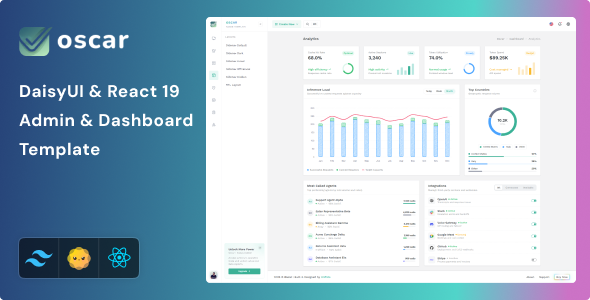
Oscar - React Tailwind CSS DaisyUI Admin & Dashboard Template Oscar is a modern, powerful, and highly customizable React admin dashboard template...
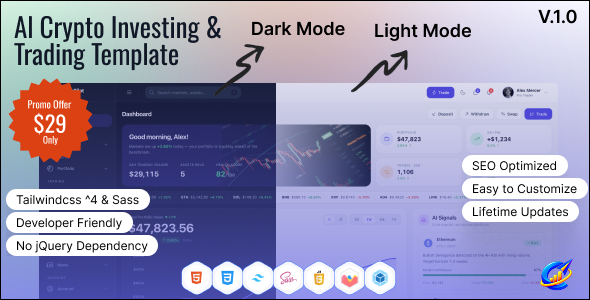
CryptoPilot – AI Crypto Investing & Trading Dashboard HTML Template CryptoPilot – AI Crypto Investing & Trading Dashboard HTML Template is a...
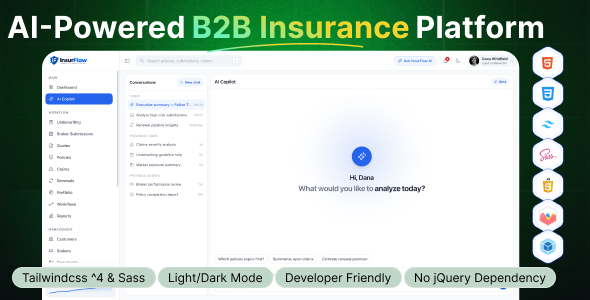
InsurFlow – AI-Powered B2B Insurance Platform HTML Template InsurFlow – AI-Powered B2B Insurance Platform HTML Template is a modern and technology-focused website...

Saal — Tutor Marketplace React & Next.js Template Saal — Tutor Marketplace React & Next.js Template is a modern, professional, and feature-rich...
