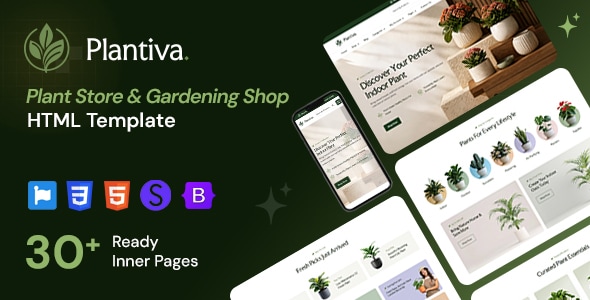
Plantiva – Plant Store & Gardening Shop HTML Template is a professionally oriented website template designed for plant stores, gardening shops, nurseries, indoor plant retailers, landscaping businesses, and businesses specializing in gardening supplies. With a plant-focused design concept and an HTML-based frontend structure, Plantiva provides a starting point for building an attractive online presence where businesses can showcase plants, gardening products, decorative greenery, and related services.
Whether you operate a local plant nursery, sell indoor plants, offer gardening tools, or run a business focused on outdoor landscaping and garden decoration, Plantiva can help you establish a dedicated website for presenting your products and services. Its template-based structure allows developers to customize the layout, colors, typography, imagery, and content to reflect a business’s branding and target audience.
By providing a foundation for a visually organized gardening website, Plantiva can reduce the need to build every frontend component from scratch. Developers can adapt the supplied files to create a website that introduces the business, highlights plant collections, communicates gardening services, and guides visitors toward relevant information.
The exact page layouts, interactive components, included assets, and technical requirements should be confirmed in the original product documentation.
Plantiva – Plant Store & Gardening Shop HTML Template is intended for businesses that want to present plants, gardening products, and related services through a dedicated website. A well-designed online presence can help customers discover available products, learn about a business, and understand its offerings before visiting a store or making an inquiry.
For plant retailers, presentation is especially important because customers often consider plant varieties, appearance, growing environments, maintenance requirements, and decorative possibilities when choosing products.
Plantiva can serve as a starting point for organizing this information into a structured website. A plant nursery might use its design to introduce different plant collections, while a gardening supply store could adapt the layout to highlight tools, pots, soil products, and other gardening essentials.
The HTML-based foundation also provides flexibility for developers who want direct control over the website’s frontend code. The finished website can be customized to suit the business’s content, design preferences, and technical requirements.
A gardening website should create a welcoming atmosphere that reflects the beauty of plants and the benefits of green spaces. Plantiva offers a foundation for developing a visual identity centered on nature, gardening, and plant-inspired products.
Developers can customize the design to suit different business styles, from a modern indoor plant boutique to a traditional garden center or a professional landscaping company.
A carefully selected color palette can help establish the desired atmosphere. Natural greens, neutral backgrounds, earthy shades, and complementary accent colors are potential choices for creating a consistent plant-focused appearance.
High-quality photography can further improve the presentation by allowing customers to appreciate plant varieties, leaf textures, flower colors, pots, and decorative arrangements.
Additionally, consistent typography, balanced spacing, and clear content organization can help visitors navigate the website comfortably. The final appearance depends on the supplied design and any customizations made during development.
Plantiva is identified as an HTML website template, making it suitable for developers who want to work directly with frontend technologies.
HTML provides the structure for page content, CSS controls visual styling and layout, and JavaScript can support interactive behavior where implemented. This familiar development approach allows developers to adapt the website without requiring a particular content management system solely to modify its frontend.
Depending on the included files, customization may involve editing navigation menus, modifying content sections, replacing images, adjusting colors, and changing page layouts.
Developers can also add new sections or adapt existing components to meet the needs of a specific plant store. For example, a nursery could introduce content about plant care, seasonal gardening, or available plant varieties.
However, the template’s actual interactive features and dependencies should be verified in the package. Advanced functionality such as inventory management, customer accounts, live product filtering, and order processing may require additional development.
Product presentation is a central consideration for plant stores and gardening businesses. A structured collection layout helps visitors understand the types of plants available and discover products suited to their preferences.
Plantiva can be adapted to showcase different plant categories using the layouts and components provided in the template.
Potential categories include:
These are examples of possible product categories rather than a guarantee that the original template includes dedicated pages for each one.
Businesses can improve product presentation by adding descriptive names, clear photographs, relevant specifications, and helpful information about plant care or growing conditions.
For instance, an indoor plant shop could organize its products by lighting requirements or plant size, while a garden center could group products by season, outdoor use, or plant type.
A professional gardening website often needs more than a product display. Visitors may also want to learn about the business, understand its services, find store information, and access practical gardening resources.
Depending on the supplied layouts and any additional development, Plantiva can provide a starting point for sections such as the following.
Homepage: Introduce the store, communicate its identity, and highlight selected products, collections, or seasonal offerings.
Plant Collections: Organize different varieties of plants and gardening products into meaningful categories.
Product Details: Present individual products with relevant descriptions, images, and specifications where supported.
About Us: Explain the store’s background, gardening philosophy, and approach to helping customers.
Gardening Services: Describe offerings such as garden maintenance, landscaping, plant installation, or garden consultation when relevant to the business.
Promotional Sections: Highlight seasonal plants, featured collections, new arrivals, or special offers.
Gardening Information: Provide useful guidance about plant care, watering, sunlight, soil, and other relevant topics.
Contact Page: Display business contact information, location details, operating hours, and inquiry options.
The exact availability of these pages depends on the original package. Developers can create additional sections when a project requires content that is not included.
Customers may explore plant collections from smartphones, tablets, laptops, or desktop computers. A responsive website helps provide a consistent browsing experience across these different devices.
Plantiva’s responsive behavior should be evaluated using the included code. Developers can test how the navigation, product images, text, content columns, and buttons adapt to different viewport sizes.
For a gardening shop, mobile usability is particularly valuable because visitors may browse products while planning a garden, shopping in person, or comparing plants for a particular space.
A well-adapted layout should maintain readable text, preserve image proportions, provide comfortable spacing, and make essential navigation elements easy to access.
Developers should also test the website on common mobile screen sizes to identify issues such as horizontal scrolling, overlapping content, or images that load at unsuitable dimensions.
The final mobile experience depends on the template implementation, the quality of its responsive rules, and any changes introduced during customization.
Every plant business has its own target audience and visual identity. Plantiva can be customized to reflect the branding of a plant nursery, online garden shop, landscaping business, or specialist indoor plant retailer.
Potential customization options include:
Color palette: Adjust greens, earthy tones, neutral backgrounds, and accent colors to match the business identity.
Typography: Customize headings, body text, and navigation styles to establish a clear visual hierarchy.
Product imagery: Replace demonstration images with original plant photography, gardening product images, and nursery photographs.
Website content: Add accurate descriptions, business information, product details, and service explanations.
Layout and spacing: Modify existing sections and introduce new components where the supplied code permits.
Brand assets: Add the company logo and maintain consistent branding across the website.
For example, a premium indoor plant store may favor a clean, minimalist design, while a garden center might prioritize seasonal collections and practical product information.
Because the template uses frontend technologies, developers can generally make design changes directly in the relevant source files. The complexity of these changes depends on the existing code structure and the desired result.
Many plant businesses want to move beyond a traditional informational website and allow customers to browse products online. Plantiva can be considered as a frontend starting point for an e-commerce-oriented project, depending on the included layouts and the additional functionality required.
A customized product presentation might include plant photographs, descriptions, prices, product categories, and information about delivery or collection options.
However, an HTML template is not automatically a complete e-commerce platform. Displaying products on a page does not necessarily provide functional shopping carts, checkout, payment processing, stock management, customer accounts, or order tracking.
To support online sales, developers may need to connect the frontend to an e-commerce platform, implement a backend application, or integrate suitable third-party services.
For plant businesses, additional features such as delivery-area restrictions, local pickup, product availability, and special handling instructions may also require custom implementation.
Before purchasing, customers should verify whether any shopping functionality is included or whether Plantiva provides only the frontend design.
A plant store website may benefit from additional tools and services depending on its business model. Plantiva’s HTML structure can serve as a starting point for suitable extensions, subject to the compatibility of the included code.
Potential enhancements include contact forms, newsletter subscriptions, analytics, map integrations, product search, blog functionality, and links to social media profiles.
For example, a landscaping business may want an inquiry form for requesting project estimates. A nursery may prefer to publish educational articles about seasonal planting and plant maintenance.
However, interactive forms may require server-side processing or a third-party form service. Dynamic product search, user accounts, and database-driven inventory require additional functionality unless explicitly provided in the original package.
Developers should review any external libraries, scripts, and dependencies before adding integrations. They should also confirm that the selected services support the intended hosting environment and comply with relevant licensing requirements.
Search engine optimization can help plant stores and gardening businesses reach customers who are looking for particular products, plants, or services. Plantiva provides a frontend foundation that can be customized to support useful content organization and on-page SEO practices.
Developers should create descriptive page titles, relevant meta descriptions, meaningful headings, and informative content for important pages.
For example, a nursery could publish useful content about indoor plants for low-light spaces, seasonal gardening supplies, or plant care for beginners. A local gardening business could develop service pages describing its landscaping work and the areas it serves.
Product pages should use accurate names and original descriptions rather than relying exclusively on generic text. Image alternative text can help describe meaningful photographs to visitors using assistive technologies and provide additional context to search engines.
Performance is also important because plant websites frequently use high-resolution product imagery. Optimizing image dimensions, compressing files, minimizing unnecessary scripts, and avoiding excessive frontend dependencies can help manage loading times.
Where supported by the implementation and hosting environment, developers can also configure caching and compression.
A template alone cannot guarantee high search rankings or specific performance scores. Results depend on content quality, implementation, hosting, competition, and other technical factors.
Plantiva – Plant Store & Gardening Shop HTML Template can be adapted for a variety of businesses connected with plants, gardening, and outdoor spaces.
Plant Nurseries: Present plant varieties, nursery information, and available gardening products.
Indoor Plant Stores: Showcase houseplants, decorative greenery, pots, and indoor gardening accessories.
Garden Centers: Organize outdoor plants, seasonal products, gardening tools, and related merchandise.
Online Gardening Shops: Establish a frontend foundation for a product-focused website that can be extended with appropriate e-commerce functionality.
Landscaping Companies: Introduce landscaping services, garden design projects, and maintenance offerings.
Garden Design Studios: Present completed projects, design approaches, and professional services.
Flower and Ornamental Plant Retailers: Display flowering plants, decorative arrangements, and seasonal collections.
Gardening Supply Businesses: Present soil products, planters, tools, fertilizers, and related supplies where relevant.
Web Design Agencies: Adapt the template for suitable client projects, subject to the applicable license terms.
Its suitability for a particular project depends on the supplied layouts, technical requirements, and amount of customization needed.
Plantiva is suitable for developers, designers, and business owners looking for a starting point for a gardening or plant-focused website.
Small business owners can work with a developer to customize the template for their nursery or retail store. Freelancers may use it as a foundation for client websites, while web design agencies can evaluate it for plant-related commercial projects.
Users with knowledge of HTML and CSS can make basic content and design changes. JavaScript knowledge is helpful when modifying frontend interactions, while backend development experience may be needed for dynamic functionality and online ordering.
Beginners can also benefit from a template-based approach, provided they understand that hosting setup and advanced functionality may require additional technical assistance.
Before choosing Plantiva, consider whether you need an informational website, a product showcase, or a complete online store. This distinction will help determine whether the supplied frontend is sufficient or additional development is necessary.
The installation process depends on the contents of the Plantiva package and the intended hosting environment. A typical workflow includes the following steps.
Step 1: Download and Extract the Files
Extract the package and review the supplied directory structure. Identify the HTML files, CSS stylesheets, JavaScript files, images, fonts, and documentation.
Step 2: Review the Documentation
Check the required dependencies, supported browser expectations, included page layouts, and any installation instructions.
Step 3: Customize Website Content
Replace sample text, images, and demonstration information with the business’s branding, product details, contact information, and service descriptions.
Step 4: Adjust the Design
Customize colors, typography, spacing, and page sections to suit the brand identity and target audience.
Step 5: Configure Interactive Components
Test the navigation, buttons, scripts, and forms. Configure any required external services or server-side processing where applicable.
Step 6: Test Responsive Layouts
Review the website on desktop, tablet, and mobile screens. Verify image scaling, content alignment, navigation behavior, and readability.
Step 7: Deploy the Website
Upload the completed files to a suitable web hosting environment and configure the domain and HTTPS.
Step 8: Perform Final Checks
Review internal links, page titles, image paths, loading behavior, and any implemented interactive features before launching the website.
These steps provide a general frontend setup workflow. The product’s official documentation should be followed for package-specific instructions.
Before purchasing Plantiva – Plant Store & Gardening Shop HTML Template, review the original product listing and documentation to confirm the exact contents and requirements.
Pay attention to the following details:
An HTML template primarily provides a frontend foundation. Additional development may be necessary to create a complete online store or a dynamic gardening business application.
Understanding these limitations before purchase can help you select the right resource for your project and avoid unexpected development requirements.
Plantiva – Plant Store & Gardening Shop HTML Template offers a customizable starting point for creating a professional website for plant nurseries, gardening shops, indoor plant retailers, landscaping companies, and other plant-focused businesses. Its HTML-based foundation provides flexibility for developers who want to customize the website’s appearance, organize product information, and create a digital presence that reflects the natural appeal of plants and gardening.
With thoughtful branding, high-quality photography, informative content, responsive testing, and appropriate SEO practices, Plantiva can be adapted to suit a variety of gardening-related website projects. Businesses that require online ordering or other advanced features can evaluate the additional development or integrations needed to support their operations.
Whether you are creating a website for a local nursery, presenting a collection of indoor plants, or developing a gardening shop website for a client, Plantiva – Plant Store & Gardening Shop HTML Template can provide a useful foundation for your next web development project. Review the included files, documentation, and license terms to ensure that the template meets your technical and business requirements.
1. All digital products are the most recent version, with no possibility of free updates. After payment, you can request an update to the most recent version for 5 days if a new version is released. We free support within 5 days.
2. If a license is required (Excludes WHMCS license , we provide only method not license), please contact us via email or ticket for assistance with activation. Our license is only valid for activation and does not include support.
3. We provide Mobile, PHP script installation services for $19.90 / ₹1700. Please create a backup after installation as we do not support re-installation. For mobile app source code, we do not offer installation services.
4. If you have any questions, please contact us by email [email protected] or create a ticket on this page
5. Please note that any digital products presented on the website do not contain malicious code, viruses or advertising. You will receive the original files from the developers. We do not sell any products that have been downloaded from other websites.
6. The response time can last up to 6 hours.

Industi – Industry & Factory HTML Template Industi – Industry & Factory HTML Template is a professional and modern website template designed...

Builtex - Construction HTML Template Builtex is a modern and professionally designed HTML template created specifically for construction companies, building contractors, engineering...

CyberDome - Cyber Security Services HTML Template CyberDome - Cyber Security Services HTML Template is a modern and professional website template designed...
Farmilk – Dairy Farm & Milk HTML Template Farmilk – Dairy Farm & Milk HTML Template is a professionally designed website template...
