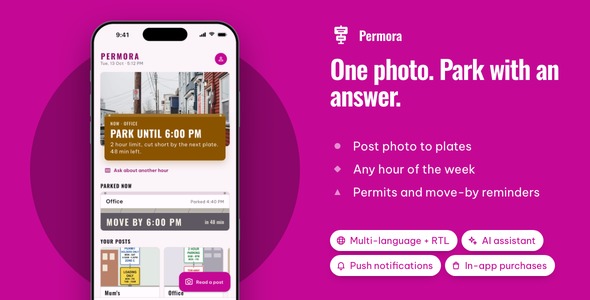
Permora | AI Parking Sign Reader App With Laravel Key Proxy is a mobile application template designed to help developers build an AI-powered parking sign recognition solution. The concept focuses on making parking rules easier to understand by allowing users to capture or upload images of parking signs and use artificial intelligence to interpret the information displayed. With a Laravel-based key proxy component, the solution also provides a foundation for managing communication with supported AI services while keeping sensitive API credentials on the server side.
Parking regulations can be confusing, particularly in unfamiliar cities where signs may contain time restrictions, permit requirements, loading-zone rules, street-cleaning schedules, and other conditions. An AI-assisted parking application can help users interpret this information more conveniently and make more informed parking decisions.
Permora combines a mobile app concept with a Laravel backend component, making it a potential starting point for developers, entrepreneurs, and businesses interested in smart mobility, AI-powered utilities, and location-aware applications.
The central concept behind Permora is to use artificial intelligence to help users interpret parking signs from photographs. Instead of manually searching through lengthy descriptions or trying to understand unfamiliar sign combinations, users can submit an image for automated analysis.
Depending on the included implementation and connected AI provider, the application may be adaptable to identify visible text, extract relevant parking conditions, and present the interpreted information in a more readable format.
Potential information to analyze includes:
Recognition accuracy depends on image quality, the AI model, local signage conventions, and the clarity of the instructions. These capabilities should be verified against the supplied demonstration and documentation.
A convenient image-input workflow is important for a parking sign reader. Permora can serve as a foundation for a mobile experience in which users capture a sign using their device camera or select an existing image, depending on the application’s implemented features.
A practical image workflow should make it easy to photograph the complete sign, including smaller text, arrows, supplementary plates, and time restrictions. Capturing all relevant information can improve the quality of the resulting interpretation.
Potential extensions include image previews, retaking photographs, upload progress indicators, image validation, and helpful guidance for low-quality or incomplete images.
Camera permissions, gallery access, supported image formats, and upload limits should be checked in the original application before planning additional functionality.
Parking signs often communicate multiple conditions through symbols, abbreviated text, time ranges, and exceptions. An AI-powered interpretation layer can help convert this information into a clearer explanation.
Depending on the configured AI service, Permora may be extended to provide a structured response that summarizes the visible rules and highlights important restrictions.
For example, a response could explain that parking is permitted only during specified hours, that a particular period is reserved for street cleaning, or that a permit is required in a designated zone. Such examples describe potential functionality and do not guarantee that every interpretation type is included by default.
A useful implementation should distinguish clearly between information visible on the sign and conclusions inferred by the AI. When the photograph is unclear or a rule cannot be determined confidently, the application should communicate that uncertainty instead of presenting an unsupported answer.
One of the defining elements of Permora is its Laravel key proxy component. A key proxy can act as an intermediary between a mobile application and an external AI service.
Instead of embedding a private AI API key directly in the Flutter or other mobile client code, the application sends an authorized request to the Laravel backend. The backend can validate the request, retrieve the protected credential from server-side configuration, communicate with the relevant provider, and return an appropriate response.
A typical architecture may follow this sequence:
The actual request flow depends on the supplied source code and AI integration.
Protecting API credentials is essential for applications that rely on paid AI services. If private keys are embedded in a distributed mobile application, they may be exposed through reverse engineering, debugging, or other forms of client inspection.
A Laravel key proxy provides an opportunity to centralize credential management on the server. Developers can configure provider keys through environment variables or an appropriate secret-management system rather than hardcoding them into publicly distributed application files.
A production implementation should also consider:
A proxy alone does not guarantee security. The backend must be configured correctly, and access to its endpoints should be controlled according to the application’s requirements.
Laravel provides the server-side foundation for handling API requests, configuration, validation, and communication with external services. In Permora, the key proxy component can help developers organize AI-related requests through a backend they can configure and maintain.
Depending on the supplied implementation, the backend may be adaptable to different AI providers or additional application services. Developers should verify which providers, endpoints, request formats, and response structures are already supported.
Potential backend extensions include request logging, application settings, usage statistics, error tracking, user authentication, and configurable service limits. These features may require additional development if they are not part of the original package.
The backend can also serve as a foundation for integrating future capabilities without requiring sensitive provider credentials to be distributed with the mobile application.
Presenting an AI response in a clear format can make the application more useful than simply displaying raw extracted text.
Depending on the AI integration and user interface, results could be organized into sections such as the main restriction, applicable days, permitted hours, exceptions, and additional conditions. A structured format can help users identify the most important information quickly.
Potential enhancements include highlighting time restrictions, presenting extracted text alongside the interpretation, and identifying missing details that may require another photograph.
The application should avoid treating a simplified summary as a definitive legal determination. If multiple signs apply to the same parking space, users may need to consider all relevant signs, road markings, local regulations, and posted exceptions.
Parking rules can vary significantly between neighborhoods, cities, and countries. A parking sign reader can potentially be extended with location-aware features that help users organize or contextualize their results.
Depending on the intended product scope, possible additions include optional location tagging, saved sign interpretations, parking reminders, favorite locations, and a history of previously analyzed signs.
These are optional extensions rather than guaranteed included features. Location services should be implemented with appropriate permissions and clear user controls, especially when storing or processing location information.
Developers should also avoid using location alone to infer that a parking space is legally available. The actual restrictions must be assessed using current, relevant information.
A focused interface can help users complete a parking sign analysis with minimal effort. Permora can be evaluated as a starting point for creating a mobile utility with an image-input workflow, AI processing states, and readable results.
Possible customization areas include the application’s name, logo, colors, typography, icons, result presentation, and supported navigation structure. The extent of customization depends on the supplied source code and UI components.
Helpful interface states may include image selection, analysis in progress, successful interpretation, unsupported images, network errors, and uncertain results. Clear messages and recovery options can improve usability when the AI provider is temporarily unavailable or the submitted photograph is difficult to read.
AI image analysis typically involves network communication and external processing, so response times can vary according to image size, provider capacity, and connection quality.
A production-ready implementation should handle timeouts, temporary provider failures, invalid requests, rate limits, and incomplete responses. Developers may also need to optimize image dimensions and file sizes to balance upload speed, processing cost, and recognition quality.
Caching may be appropriate for certain non-sensitive results, depending on the application design and the freshness requirements of the information. However, any caching strategy should account for privacy and avoid presenting outdated interpretations as current legal guidance.
Parking sign photographs may accidentally capture vehicle registration plates, pedestrians, nearby buildings, or location-related information. Developers should consider data minimization, secure transmission, retention policies, and clear disclosures about how images are processed.
Where possible, the application should send only the information required for analysis and avoid retaining photographs longer than necessary. If images are transmitted to a third-party AI provider, the application’s privacy policy should explain the relevant processing practices.
AI interpretation should be presented as assistance rather than a guarantee that parking is lawful. Users should be encouraged to verify ambiguous, contradictory, or incomplete signs and consult official local parking guidance when necessary. This is particularly important when restrictions involve penalties, towing, accessibility, or emergency access.
Permora may be suitable for developers and businesses exploring AI-powered mobility utilities, including:
The suitability of the template for a particular project depends on its actual functionality, supported platforms, API integrations, licensing terms, and technical requirements.
Permora | AI Parking Sign Reader App With Laravel Key Proxy offers a foundation for developing an AI-assisted parking sign interpretation application with a server-side component for handling protected API credentials. Its concept combines image-based sign analysis with the potential for clear parking-rule summaries and a backend architecture that can be extended as project requirements evolve.
The Flutter or mobile application layer, AI provider integration, and Laravel proxy should be evaluated together to determine which features are already implemented and which require additional development.
By configuring the backend securely, selecting a suitable AI service, testing the application against real-world signage, and communicating uncertainty clearly, developers can use Permora as a starting point for a practical parking assistance product.
1. All digital products are the most recent version, with no possibility of free updates. After payment, you can request an update to the most recent version for 5 days if a new version is released. We free support within 5 days.
2. If a license is required (Excludes WHMCS license , we provide only method not license), please contact us via email or ticket for assistance with activation. Our license is only valid for activation and does not include support.
3. We provide Mobile, PHP script installation services for $19.90 / ₹1700. Please create a backup after installation as we do not support re-installation. For mobile app source code, we do not offer installation services.
4. If you have any questions, please contact us by email [email protected] or create a ticket on this page
5. Please note that any digital products presented on the website do not contain malicious code, viruses or advertising. You will receive the original files from the developers. We do not sell any products that have been downloaded from other websites.
6. The response time can last up to 6 hours.
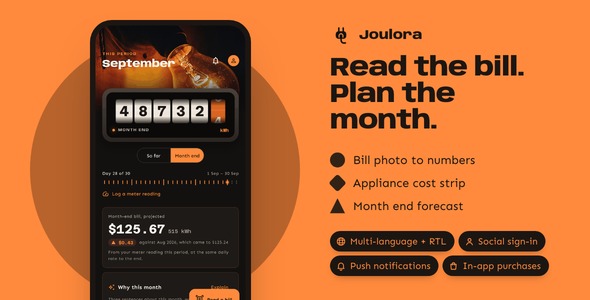
Joulora | Flutter AI Electricity Bill and Appliance Cost App With Laravel Key Proxy Joulora is an advanced AI-powered electricity bill and...
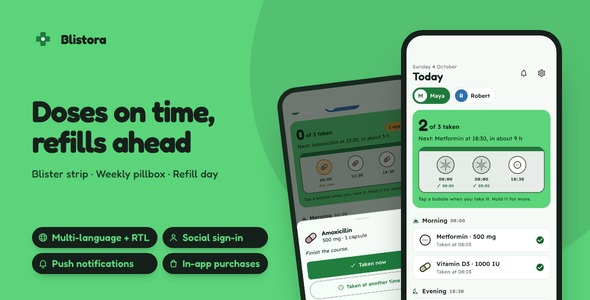
Blistora | Flutter Medication Reminder and Refill Tracker App With Laravel Cloud Backup Blistora | Flutter Medication Reminder and Refill Tracker App...
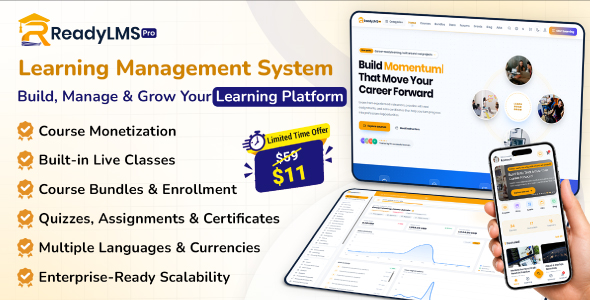
ReadyLMS Pro | Learning Management System With Website, Student App and Admin Dashboard ReadyLMS Pro | Learning Management System With Website, Student...
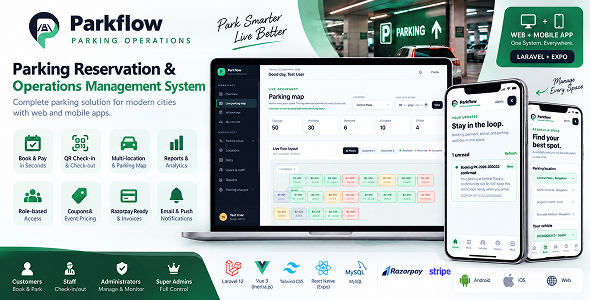
ParkFlow | Parking Reservation and Operations Management System Laravel and React Native Simplify parking operations and deliver a convenient reservation experience with...
