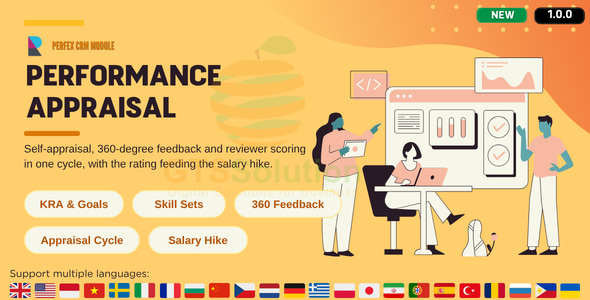
Performance Appraisal for Perfex CRM – Reviews, KRA & Competency is a specialized CRM module designed to help businesses organize employee performance evaluations, track Key Result Areas (KRAs), assess competencies, and establish a more structured approach to performance management within their Perfex CRM environment. By bringing performance appraisal workflows into a centralized business management platform, this solution can help organizations streamline employee reviews, support consistent evaluation practices, and improve visibility into individual and team performance.
Designed for businesses that want to make employee assessments more organized and measurable, the module focuses on important aspects of performance management, including review processes, goal alignment, competency evaluation, and performance documentation. It can be particularly useful for HR departments, team leaders, managers, and business owners who want to establish a systematic process for evaluating employee contributions and identifying opportunities for professional development.
Managing employee performance through spreadsheets, documents, and disconnected communication channels can become difficult as an organization grows. HR teams may need to collect feedback, coordinate evaluation schedules, review employee goals, and maintain historical assessment records. Without a structured workflow, these activities can consume valuable time and make it harder to maintain consistency across departments.
Performance Appraisal for Perfex CRM provides a dedicated approach to organizing appraisal-related activities within the CRM environment. Instead of relying entirely on separate files, businesses can use a centralized module to support their performance evaluation processes, subject to the functionality provided by the installed version.
The module can help organizations establish clearer expectations, document assessment outcomes, and create a more consistent process for reviewing employee progress. This approach is suitable for businesses that want to improve accountability while making performance discussions a more regular part of their management practices.
Key Result Areas define the principal responsibilities and expected outcomes associated with a role. They help employees understand what matters most in their positions and give managers a framework for evaluating results against agreed expectations.
A KRA-oriented appraisal process can help organizations connect daily responsibilities with departmental and business objectives. Depending on the module’s available configuration options, businesses may be able to organize performance evaluations around role-specific goals and measurable outcomes.
Potential benefits of KRA-based performance management include:
For example, a sales employee may be evaluated on revenue generation, lead conversion, customer relationship management, and follow-up consistency. An administrative employee may be assessed on task completion, documentation accuracy, coordination, and process compliance.
These examples illustrate how KRAs can be applied in a business setting; the precise fields, scoring methods, and configuration options available in the module should be verified against its official documentation.
Performance is not determined by results alone. An employee’s professional skills, communication abilities, problem-solving approach, collaboration, and reliability can also influence overall effectiveness.
Competency-based evaluation gives organizations a framework for considering these behavioral and professional qualities alongside measurable outcomes. It can help managers identify strengths, recognize development needs, and make performance discussions more constructive.
Depending on the module’s supported functionality, competency assessments may be organized around criteria relevant to different roles, departments, or levels of responsibility.
Common competency areas that businesses may consider include:
Using a consistent competency framework can help managers conduct more balanced evaluations. It also encourages discussions that focus not only on what employees achieve but also on how they approach their work.
A well-organized appraisal process helps employees and managers understand when reviews take place, what information is expected, and how the results will be used.
Performance Appraisal for Perfex CRM is intended to support a more systematic approach to employee reviews. Organizations can use a defined appraisal process to establish evaluation periods, prepare review criteria, collect relevant observations, and document outcomes according to the module’s available features.
A typical performance review workflow may involve the following stages:
The actual workflow may differ depending on the module version and configuration. Review scheduling, employee self-assessments, approval stages, automated notifications, and other advanced workflow functions should be confirmed in the official product specifications before purchase.
Maintaining accessible and well-organized employee evaluation records can make it easier for authorized managers and HR personnel to review performance history and prepare for future discussions.
A centralized appraisal process can reduce dependence on scattered spreadsheets and individual documents. It may also help organizations maintain more consistent documentation across teams and departments.
Depending on the module’s implementation, appraisal records may support the documentation of evaluation criteria, review outcomes, manager comments, and development objectives.
Organized records can help businesses:
Because performance appraisal data can contain sensitive employee information, organizations should verify the module’s permissions, access controls, data handling practices, and compatibility with their existing Perfex CRM security configuration.
Performance Appraisal for Perfex CRM can be relevant to organizations that want to establish more consistent employee review practices without managing every appraisal activity through separate systems.
Human Resources Departments
HR teams can use a structured appraisal framework to coordinate evaluation policies, support consistent assessment criteria, and organize performance documentation.
Department Managers
Managers can use defined KRAs and competency criteria to prepare employee evaluations, discuss achievements, and identify areas that need improvement.
Team Leaders
Team leaders can use regular performance discussions to clarify expectations, recognize contributions, and encourage employees to develop their professional skills.
Business Owners
Business owners can introduce a more formal performance management process as their workforce grows, helping establish clearer responsibilities and more consistent management practices.
Growing Organizations
Businesses moving away from informal employee reviews can use a dedicated appraisal workflow as part of a broader effort to standardize internal operations.
The module’s suitability for a particular organization depends on its actual functionality, licensing terms, supported Perfex CRM version, and the company’s appraisal requirements.
Performance appraisals are most valuable when they support improvement rather than functioning only as periodic scoring exercises.
By connecting KRAs, competency assessments, and review discussions, organizations can create a framework that encourages employees to understand expectations and work toward specific development objectives.
For example, an employee who consistently meets delivery targets but needs to improve communication may benefit from a development plan focused on collaboration and reporting. Another employee who demonstrates strong technical skills but struggles with deadlines may benefit from clearer task prioritization and time-management goals.
A structured review process can help managers turn these observations into practical next steps. Regular follow-up discussions can then help employees and supervisors evaluate progress and adjust objectives where appropriate.
This approach encourages constructive feedback, professional growth, and a stronger connection between individual performance and organizational priorities.
Unstructured appraisal processes can result in inconsistent ratings, unclear expectations, and evaluations that depend too heavily on individual managerial preferences.
A defined performance framework can help organizations establish common criteria for reviewing employees in comparable roles. KRAs can provide a results-oriented perspective, while competency assessments can offer a broader view of professional effectiveness.
Organizations should establish clear evaluation guidelines, communicate expectations in advance, and encourage managers to support ratings with relevant examples. Where appropriate, employees should have an opportunity to discuss their assessments and clarify any disagreements.
The module can serve as part of this process, but consistent results also depend on internal policies, manager training, fair evaluation criteria, and responsible use of appraisal information.
Perfex CRM is used by businesses to manage customer relationships and coordinate operational activities. A specialized performance appraisal module can extend this environment with employee evaluation capabilities, depending on its implementation and compatibility.
Using an appraisal module within an existing CRM installation may help businesses keep related administrative activities in a familiar environment and reduce the need to introduce an entirely separate application for every internal workflow.
Before implementation, administrators should confirm the module’s installation procedure, supported Perfex CRM versions, PHP requirements, database compatibility, and any dependencies on other modules or extensions.
It is also important to verify whether the module uses existing Perfex CRM user accounts and permission settings, introduces its own roles, or requires additional configuration. These details affect how the module should be integrated into an organization’s existing setup.
Performance Appraisal for Perfex CRM may be useful in a variety of business environments where employee performance needs to be reviewed against defined expectations.
IT and Software Companies: Evaluate project contributions, technical proficiency, communication, delivery consistency, and collaboration.
Digital Marketing Agencies: Assess campaign responsibilities, reporting quality, client coordination, task completion, and goal achievement.
Sales Organizations: Review sales targets, conversion performance, customer engagement, follow-up practices, and professional competencies.
Consulting Businesses: Evaluate client service, analytical thinking, project delivery, communication, and professional development.
Administrative Teams: Assess accuracy, organization, responsiveness, process compliance, and task management.
Service-Based Businesses: Establish review criteria for customer service, operational efficiency, teamwork, and role-specific responsibilities.
These are examples of potential use cases rather than a guarantee that the module contains preconfigured appraisal templates for each industry.
A more structured appraisal process can provide several operational benefits when supported by clear internal policies.
These benefits depend on how the organization configures and uses the module. Software can support a performance management process, but it cannot replace fair policies, thoughtful managerial judgment, or direct communication with employees.
Before installing Performance Appraisal for Perfex CRM, review the product documentation and confirm that your environment meets the developer’s requirements.
Recommended preparation steps include:
The availability of specific settings, installation methods, integrations, and advanced features depends on the product version and its official documentation.
Performance Appraisal for Perfex CRM – Reviews, KRA & Competency offers a focused approach to organizing employee performance management within a Perfex CRM environment. By bringing together the concepts of performance reviews, Key Result Areas, and competency-based assessment, it can help businesses establish clearer expectations, document employee progress, and support more constructive performance discussions.
For HR teams, department managers, and growing organizations, a structured appraisal process can contribute to better accountability, improved employee development, and more consistent evaluation practices. When combined with well-defined goals, fair assessment criteria, and regular feedback, the module can become a useful component of a broader workforce management strategy.
Before purchasing or installing the module, verify the supported Perfex CRM version, included features, licensing terms, dependencies, and official documentation to ensure it matches your organization’s requirements.
1. All digital products are the most recent version, with no possibility of free updates. After payment, you can request an update to the most recent version for 5 days if a new version is released. We free support within 5 days.
2. If a license is required (Excludes WHMCS license , we provide only method not license), please contact us via email or ticket for assistance with activation. Our license is only valid for activation and does not include support.
3. We provide Mobile, PHP script installation services for $19.90 / ₹1700. Please create a backup after installation as we do not support re-installation. For mobile app source code, we do not offer installation services.
4. If you have any questions, please contact us by email [email protected] or create a ticket on this page
5. Please note that any digital products presented on the website do not contain malicious code, viruses or advertising. You will receive the original files from the developers. We do not sell any products that have been downloaded from other websites.
6. The response time can last up to 6 hours.
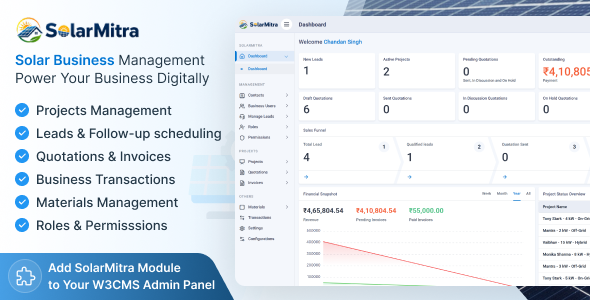
SolarMitra - Solar Business Management Platform | W3CMS Laravel Module SolarMitra is a comprehensive solar business management platform built as a powerful...

Panda Resort – Single Hotel Booking Add-on for Pandao CMS Panda Resort is a powerful hotel booking add-on developed specifically for Pandao...

AMarketPlace – Multi-Vendor Digital Marketplace SaaS | Next.js 16, React 19 and PostgreSQL AMarketPlace is a modern and scalable multi-vendor digital marketplace...

Nativa Theme - Landing & Client Portal Design for RedFamosa SMM Panel Nativa Theme is a modern and professionally designed landing page...
