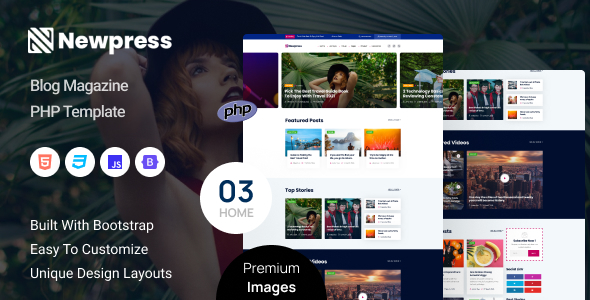
Newpress – Blog Magazine PHP Template is a versatile website template designed for creating professional blogs, online magazines, digital news portals, editorial websites, and content publishing platforms. Built around a PHP-based web development foundation, Newpress provides a starting point for developing a content-focused website where articles, news stories, opinions, reviews, and other editorial materials can be presented in an organized and engaging format. Its blog and magazine-oriented purpose makes it suitable for publishers, content creators, media organizations, and businesses that want to establish a dedicated platform for sharing information online.
In today’s digital publishing environment, readers expect websites that make content easy to discover, navigate, and read across different devices. Whether you are launching a technology blog, a lifestyle magazine, a business news website, or a general-interest publication, an effective layout can help organize articles and create a consistent reading experience. Newpress offers a foundation for building this type of website while allowing developers to customize the presentation according to their branding, publishing requirements, and target audience.
A PHP template can also provide a starting point for connecting website pages with server-side functionality, depending on the implementation included in the original package. Developers can adapt the supplied files and extend the website with suitable backend logic where required. By customizing the design, content structure, and application functionality, Newpress can be adapted to different editorial projects and digital publishing goals.
Newpress is a blog and magazine PHP template intended for websites that publish articles, news, features, and other forms of editorial content. A well-structured publishing website needs to present content in a logical hierarchy so readers can explore topics, discover recent posts, and navigate between related articles.
Newpress provides a starting point for creating this type of content-driven website. Its intended applications include online magazines, independent blogs, news portals, editorial publications, and niche content websites. Depending on the supplied layouts, developers may customize homepage sections, article presentation, category organization, and other interface elements to match their publishing model.
PHP is commonly used to develop server-side web functionality, while HTML, CSS, and JavaScript support the frontend experience. The exact architecture of Newpress depends on the original implementation. Customers should review the supplied source files and documentation to determine whether the package includes a complete PHP application, reusable page templates, database connectivity, or additional dependencies.
The visual presentation of a blog or magazine website plays an important role in attracting readers and making content accessible. A clean layout can help visitors identify featured stories, explore different topics, and focus on the information they want to read.
Newpress is positioned for editorial and publishing websites, making it a useful starting point for creating a content-focused online experience. Developers can adapt the supplied design to highlight important articles, organize stories into categories, and establish a consistent visual identity across the website.
For example, a technology magazine may prioritize product reviews, software news, and industry updates. A lifestyle blog might emphasize photography, personal stories, and practical guides, while a business publication may focus on market developments, entrepreneurship, and professional insights.
Typography, image presentation, spacing, and content hierarchy can all contribute to a more readable experience. The final appearance depends on the actual layouts included in the template and the customization performed during development.
Newpress provides a PHP-oriented starting point for developing a blog or magazine website. Its primary purpose is to support content presentation and customization for editorial projects.
Potential development benefits include:
These capabilities describe common development possibilities for a PHP publishing template. The exact ready-made features, included pages, and working backend modules should be verified in the original product documentation.
The homepage is often the main entry point for an online magazine or blog. It helps readers understand the publication’s focus and discover the latest or most relevant content.
Newpress can be customized to organize available homepage sections around the publication’s editorial priorities. Depending on the supplied components, these areas may be adapted to highlight featured stories, recent articles, popular topics, or selected editorial content.
A news website might place breaking or current stories prominently, while a lifestyle magazine could prioritize visual storytelling and curated articles. A business blog may use the homepage to feature expert commentary, industry analysis, and practical resources.
A clear content hierarchy can help readers navigate the website more efficiently. Developers should ensure that headlines are descriptive, images are relevant, and article summaries communicate the value of each story without unnecessary repetition.
Dynamic content ordering, automated featured-story selection, and editorial scheduling require suitable application logic or a connected content management system unless such functionality is already included.
Article pages are central to any blog or magazine website. They provide the space needed to present complete stories, explain ideas, share opinions, and deliver useful information to readers.
Newpress can serve as a foundation for customizing article layouts around readable typography, appropriate spacing, and structured content. Depending on the included design, developers can adapt areas for article titles, publication details, featured images, body content, and supporting information.
Long-form content benefits from logical headings, short paragraphs, descriptive subheadings, and relevant images. These elements help readers scan an article and locate the information most relevant to them.
For example, a technology publication might use structured sections to explain a software product, while a travel blog may combine descriptive text with photography and destination information.
Features such as automatic reading-time calculations, author profile links, related-article recommendations, comments, and social sharing should be treated as optional additions unless they are confirmed in the supplied package.
An effective publishing website needs a clear way to organize articles. Categories and tags can help readers explore topics and discover additional content that matches their interests.
Newpress can be adapted to support topic-based content organization through the available page structures and, where required, additional backend development. A magazine might organize its articles into technology, business, entertainment, lifestyle, and education categories. A specialized publication could use more focused sections based on its audience and subject matter.
Category pages can provide an overview of articles associated with a particular topic. Individual article pages can also include relevant category information to help readers understand the context of the content.
However, a visual category menu does not automatically provide a functioning content management system. Dynamic category pages, tag relationships, pagination, and database-driven article filtering require suitable data structures and application logic unless already implemented.
Every publication has a distinct identity, editorial tone, and audience. A customizable template helps developers create a website that reflects those differences rather than relying on a generic presentation.
Newpress can be adapted by modifying its available styling, content sections, images, and page structures. Developers may adjust the color palette, typography, logos, navigation labels, article layouts, and other visual elements according to the supplied source files.
For example, a professional business magazine may prefer a restrained design with strong typography, while an entertainment blog may use a more colorful visual style. A technology publication may prioritize concise article cards and structured topic navigation.
Developers can also extend the existing website with new content sections or additional page templates. The degree of customization depends on the code organization, included assets, dependencies, and documentation.
Many readers access blogs and digital magazines through smartphones and tablets. A responsive website helps ensure that headlines, article content, images, and navigation remain usable across different screen sizes.
Newpress can be customized using responsive HTML and CSS techniques, depending on the implementation supplied with the product. Developers can adjust content widths, column arrangements, image dimensions, navigation behavior, and typography for different devices.
For example, a multi-column article grid on a desktop screen may need to become a single-column layout on a smartphone. Article text should remain comfortably readable, while important navigation elements should be easy to access on smaller screens.
Developers should test the completed website across common browsers and screen sizes. Actual responsive behavior depends on the original template and any modifications made during implementation.
PHP provides server-side capabilities that can support dynamic web applications, data processing, and database-driven content. For a publishing website, these capabilities can be used to build features such as article retrieval, category management, and content administration when the necessary functionality is implemented.
Newpress’s PHP-oriented positioning makes it relevant to developers working with PHP-based website projects. However, the exact backend structure must be verified before assuming that database integration, administrator tools, or dynamic publishing workflows are included.
If the supplied package contains only frontend-oriented page templates with PHP files, additional work may be required to connect content to a database or create a complete publishing application. Developers should also review the PHP version requirements, configuration settings, dependencies, and installation instructions.
A clear separation between presentation, data handling, and business logic can help make the customized application easier to maintain as its content and functionality grow.
A blog or magazine website may require additional services to support publishing, audience engagement, and monetization. Depending on the project’s goals, these may include a database, content management system, analytics service, newsletter platform, advertising provider, or social media integration.
Newpress can potentially be extended with suitable integrations where supported by its architecture. For example, a newsletter signup form may connect to an email marketing platform, while a publishing application may use a database to store articles and category information.
However, these services should not be assumed to be included by default. A contact form or newsletter field in a design does not necessarily process submissions or store subscriber details.
Before development, verify the supported PHP version, database requirements, dependencies, browser compatibility, and any third-party licenses documented in the original package.
Search engine optimization is important for publishers who want readers to discover their articles through relevant search queries. A well-organized magazine website can support discoverability by presenting useful content with descriptive titles, clear headings, meaningful internal links, and logical topic structures.
When customizing Newpress, create unique titles and meta descriptions for important pages. Use descriptive article headings, relevant image alternative text, and clear URLs where the application allows them. Content should provide genuine value to readers rather than repeat keywords excessively.
Technical SEO considerations may include XML sitemap generation, canonical URLs, structured data where appropriate, pagination handling, and indexability controls. Dynamic metadata and automated sitemap generation may require additional PHP logic or a suitable content management system.
Performance is equally important for an image-heavy publishing website. Developers should optimize images, reduce unnecessary scripts, minimize avoidable requests, and test loading behavior across devices and network conditions.
A PHP template does not guarantee higher search rankings or specific performance results. Useful content, proper implementation, and ongoing testing remain essential.
Newpress can be adapted for a range of content publishing projects.
Online News Portals: Develop a website for presenting news stories, current affairs, local reporting, or industry updates.
Technology Blogs: Publish articles about software, web development, digital products, gadgets, and emerging technologies.
Lifestyle Magazines: Organize content covering travel, fashion, wellness, home improvement, and everyday interests.
Business Publications: Present entrepreneurship advice, company news, business analysis, and professional insights.
Entertainment Blogs: Publish articles about films, television, gaming, music, and popular culture.
Educational Websites: Share tutorials, learning resources, explainers, and subject-specific articles.
Travel Blogs: Present destination guides, travel experiences, photography, and practical planning information.
Personal Blogs: Establish a professional platform for opinions, personal experiences, and specialist knowledge.
Niche Digital Magazines: Create a focused publication serving a particular industry, hobby, or community.
The suitability of each use case depends on the supplied layouts and the additional functionality required.
Newpress may be useful for individuals and organizations that want to develop a blog or magazine-style website.
Basic familiarity with HTML and CSS is useful for frontend customization. PHP knowledge is helpful when modifying server-side functionality, while database knowledge may be necessary for dynamic content management.
The installation process depends on the files and configuration supplied with Newpress. Review the original documentation before beginning setup.
Step 1: Download and Extract the Package
Download the template files and extract the archive into a suitable project directory.
Step 2: Review the File Structure
Identify the available PHP files, HTML templates, stylesheets, JavaScript assets, images, and documentation. Determine whether the package includes a complete application or primarily provides website page templates.
Step 3: Check the Environment Requirements
Verify the required PHP version, web server configuration, database requirements, and any additional dependencies.
Step 4: Configure the Local Environment
Set up a compatible local development environment or hosting environment. If the application requires a database, configure the connection according to the supplied instructions.
Step 5: Customize the Website
Update the branding, article content, images, navigation, and layout elements to match the publication’s identity.
Step 6: Configure Dynamic Functionality
If required, implement or configure article management, category retrieval, search, pagination, and other backend features that are not already included.
Step 7: Test and Deploy
Check page rendering, navigation, responsive behavior, form processing, database connectivity where applicable, error handling, and performance before deploying the completed website.
Use the commands and configuration instructions provided by the original developer rather than assuming that every PHP template follows the same setup procedure.
Newpress is a PHP blog and magazine template, but the exact functionality included in the original package should be verified before purchase or deployment.
A website template is not necessarily a complete publishing platform. Features such as an administrator dashboard, visual article editor, database-driven content management, user registration, comment moderation, advanced search, newsletter processing, and advertising management may require additional development unless explicitly included.
Customers should review the included pages, source files, database requirements, PHP version compatibility, third-party dependencies, and licensing conditions. For a production publishing website, additional attention should be given to security updates, form validation, access controls, content backups, and privacy requirements.
Newpress – Blog Magazine PHP Template provides a customizable starting point for developing professional blogs, online magazines, digital news portals, and content-focused websites. Its PHP-oriented foundation and editorial purpose make it suitable for publishers, bloggers, developers, and businesses that want to establish an organized online platform for sharing articles and information.
Whether you are launching a technology blog, a lifestyle magazine, a business publication, or a specialized news website, Newpress can be adapted to match your content strategy and visual identity. With appropriate customization, verified backend functionality, quality editorial content, and careful performance and SEO optimization, Newpress can serve as a useful foundation for building a professional digital publishing experience.
1. All digital products are the most recent version, with no possibility of free updates. After payment, you can request an update to the most recent version for 5 days if a new version is released. We free support within 5 days.
2. If a license is required (Excludes WHMCS license , we provide only method not license), please contact us via email or ticket for assistance with activation. Our license is only valid for activation and does not include support.
3. We provide Mobile, PHP script installation services for $19.90 / ₹1700. Please create a backup after installation as we do not support re-installation. For mobile app source code, we do not offer installation services.
4. If you have any questions, please contact us by email [email protected] or create a ticket on this page
5. Please note that any digital products presented on the website do not contain malicious code, viruses or advertising. You will receive the original files from the developers. We do not sell any products that have been downloaded from other websites.
6. The response time can last up to 6 hours.
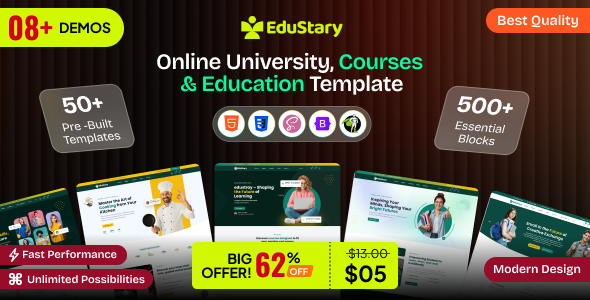
Edustray - University, Online Courses, School & Education HTML Template Edustray is a modern and professionally designed HTML template created for universities,...
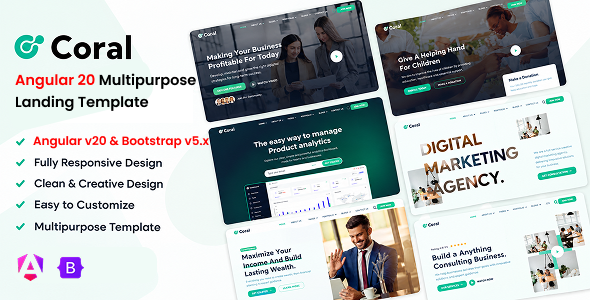
Coral - Angular 20 Multipurpose Landing Template Coral - Angular 20 Multipurpose Landing Template is a modern, responsive, and professionally crafted landing...
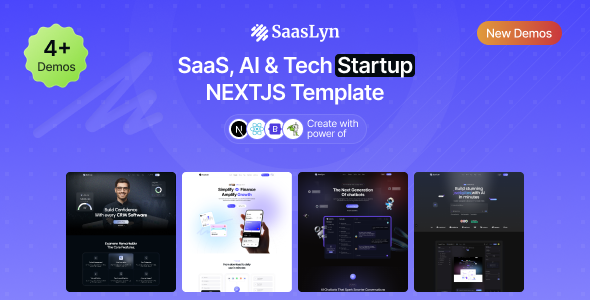
SaasLyn – SaaS, AI & Tech Startup NextJS Template SaasLyn is a modern, professional, and conversion-focused SaaS, AI & Tech Startup NextJS...
Coral - Multipurpose React Js Landing Template Coral - Multipurpose React Js Landing Template is a modern, responsive, and professionally designed landing...
