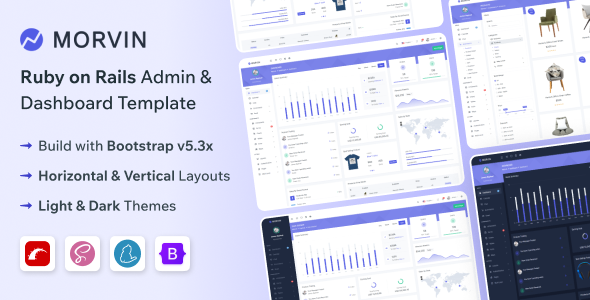
Morvin – Ruby on Rails Admin & Dashboard Template is a professional dashboard template designed for developers building administrative interfaces, business management platforms, analytics dashboards, internal tools, and data-driven web applications. Built for the Ruby on Rails development ecosystem, Morvin provides a customizable foundation for creating structured admin panels with reusable interface elements, organized navigation, and layouts suitable for managing application data and business operations.
Modern web applications often require an administrative interface where authorized users can review information, manage records, monitor activity, and configure application settings. A well-organized dashboard helps simplify these tasks by presenting relevant information through clear layouts, tables, forms, navigation menus, and visual components.
Morvin can serve as a starting point for developers who want to build a consistent administrative experience without designing every interface element from scratch. It can be adapted for CRM systems, project management platforms, ecommerce administration, reporting tools, customer portals, and other Ruby on Rails applications.
Whether you are developing a new SaaS product, an internal business application, a management dashboard, or a custom administration panel, Morvin offers a foundation that can be customized to match your application’s design and functional requirements.
An administrative dashboard is an important part of many web applications. It provides authorized users with a central interface for accessing information, managing records, and performing routine operational tasks.
Morvin is designed to support this type of interface through a customizable dashboard-oriented structure. Depending on the supplied package, the template may include dashboard layouts, navigation components, form elements, tables, charts, interface widgets, and other reusable resources.
Developers can adapt the available layouts to present application-specific information, organize different modules, and establish a consistent visual style across the administrative area.
Potential applications include business management systems, customer relationship management tools, inventory applications, reporting platforms, financial administration interfaces, and SaaS dashboards.
The exact page layouts, bundled libraries, Rails integration approach, and included components should be verified against the supplied product documentation before implementation.
Ruby on Rails is a web application framework based on Ruby that supports structured application development through conventions, routing, controllers, models, views, and database integration.
Morvin is identified as a Ruby on Rails admin and dashboard template, making it relevant to developers working within the Rails ecosystem. The precise implementation may vary depending on the package version and its included dependencies.
Depending on the supplied files, developers may work with Rails view templates, front-end assets, JavaScript resources, stylesheets, configuration files, and supporting components.
Typical customization tasks include:
Developers should follow the installation instructions and confirm the supported Ruby version, Rails version, asset pipeline or bundler requirements, and third-party dependencies before starting development.
A dashboard should help users locate important information quickly without overwhelming them with unnecessary visual elements. Morvin can be customized to create a consistent administrative interface suited to the application’s purpose.
Developers can adapt the color scheme, typography, spacing, icons, navigation, and content sections to establish a distinctive visual identity.
For example, a business management platform may prioritize readable tables and clear operational summaries, while an analytics application may place greater emphasis on charts and reporting sections.
A consistent design system across dashboard pages can reduce visual friction and make the application easier to learn. Shared components can also help developers maintain the same appearance across forms, data tables, navigation elements, and content panels.
The final interface should be designed around the actual tasks users need to complete rather than relying solely on decorative elements.
A dashboard homepage often provides a quick overview of important application information. Morvin can be adapted to present summary cards, status indicators, recent activity, and other relevant metrics where the supplied components support them.
Potential dashboard metrics include total customers, active projects, pending tasks, monthly revenue, new registrations, inventory levels, or service requests.
The selected metrics should reflect the application’s actual business requirements. Each widget should provide meaningful information and, where useful, link to a more detailed view.
A visual chart or summary card does not automatically retrieve live data. Dynamic dashboards require integration with application models, database queries, APIs, or other appropriate data sources.
Developers should also ensure that users only see information they are authorized to access.
Administrative applications frequently rely on tables to display and manage structured records. Morvin can provide a foundation for creating interfaces that organize information into readable rows and columns.
Depending on the included components, developers may adapt table layouts for customer records, project lists, product catalogs, orders, employee details, support tickets, or other application data.
A useful table interface may display record identifiers, names, statuses, creation dates, and relevant actions. Search, sorting, filtering, pagination, and bulk operations can be added where the supplied components and application logic support them.
These behaviors should not be assumed to be fully implemented in every template. Working data management requires the appropriate front-end interactions and backend operations.
For database-backed applications, Rails controllers and models can be used to retrieve records, validate changes, and persist updates according to the application’s requirements.
Forms are essential for creating, editing, and managing records within an admin panel. Morvin can be customized to provide consistent interfaces for entering information and configuring application settings.
Potential form use cases include adding customers, updating project details, editing product information, creating tasks, managing user profiles, and adjusting system preferences.
Depending on the supplied components, forms may include text inputs, selection controls, date fields, checkboxes, text areas, and action buttons.
Functional forms require proper integration with the application’s backend. In a Rails application, developers should implement suitable routes, controller actions, model validations, and error handling.
User input should be validated on the server even when client-side validation is also used. Clear error messages and accessible form labels help users correct mistakes and complete tasks efficiently.
Many business applications require visual summaries of operational data. Morvin may provide a foundation for dashboard layouts that incorporate charting and reporting components, depending on the supplied package.
Possible reporting use cases include sales trends, user activity, project progress, customer growth, operational performance, and inventory changes.
Developers can connect supported chart components to application data and configure appropriate date ranges, labels, and metric definitions.
Charts should communicate meaningful information rather than simply decorate the dashboard. Axis labels, units, time periods, and data sources should be clear enough for users to interpret results correctly.
Live analytics require appropriate data retrieval and aggregation logic. A chart component by itself does not provide a reporting engine or guarantee that data is current.
A well-organized navigation system helps users move between dashboard modules and find relevant features efficiently.
Morvin can be customized to group application pages into logical sections, such as overview, customers, projects, products, reports, settings, and user management.
Developers can adapt the sidebar, top navigation, menus, and page headings to match the structure of the application.
For larger applications, navigation should reflect user roles and common workflows. Administrative features should not be displayed as accessible operations for users who do not have permission to perform them.
The exact navigation components and responsive behavior should be confirmed by reviewing the included template files.
Administrative dashboards often contain sensitive business information, making authentication and authorization important parts of the overall application.
Morvin can serve as the interface foundation for login screens and user-related pages if those layouts are included or created during customization. Functional authentication must be implemented using the Rails application and an appropriate authentication solution.
Role-based access control can be added to define which users may view records, modify data, manage accounts, or access administrative settings.
For example, an application might distinguish administrators, managers, staff members, and read-only users. These roles should be enforced on the server rather than relying only on hiding navigation items in the interface.
Authentication, password recovery, session handling, access policies, and permission checks require appropriate backend implementation unless explicitly included in the package.
Many applications require tools for managing user accounts and configuring operational settings.
Morvin can be adapted to provide interfaces for user lists, account details, profile editing, status indicators, and other administrative controls where supported by the available components.
Settings pages may be used to organize application preferences, business information, notification options, or integration configurations.
The interface should distinguish between general user preferences and sensitive system settings. Access to account management, permission changes, and configuration values should be restricted to authorized users.
Database-backed settings require suitable models, controller logic, validation, and persistence mechanisms.
A CRM or business management platform often needs a centralized dashboard for organizing customers, leads, deals, tasks, and communications.
Morvin can provide a visual foundation for such applications when adapted to the required data model and business workflows.
Potential CRM modules include:
These are possible application modules, not guaranteed built-in features. Each module requires the relevant database structure, business logic, routes, permissions, and user interface implementation.
The template can help establish a consistent administrative presentation while the Rails application provides the underlying functionality.
An administrative dashboard may also be used to manage ecommerce or inventory-related operations.
Morvin can be customized to present product records, stock information, order summaries, customer details, and other relevant data, depending on the requirements of the application.
For an inventory system, the interface might display item identifiers, quantities, stock status, and update actions. An ecommerce administration panel may organize products, categories, orders, and fulfillment information.
These features require suitable database models, validation, business rules, and backend processing. The template itself should not be assumed to include a complete ecommerce platform, payment processing system, or inventory management engine.
Administrators may need to access dashboards from desktop computers, laptops, tablets, and mobile devices. A responsive interface helps make essential information accessible across different screen sizes.
Review the supplied Morvin package to confirm its responsive behavior and supported breakpoints. Test navigation, tables, forms, charts, widgets, and modal interfaces on common devices.
Wide data tables may require horizontal scrolling, column prioritization, or alternative layouts on smaller screens. Buttons and interactive controls should remain easy to use on touchscreens.
Accessibility should also be considered through readable typography, clear focus indicators, keyboard navigation, suitable color contrast, and properly labeled controls.
Responsive behavior should be tested after application-specific components and data have been integrated.
A functional Rails dashboard must connect its interface to the application’s underlying data and business logic.
Developers can use Rails routes to define application endpoints, controllers to process requests, models to represent and validate data, and views or components to present the resulting information.
Depending on the supplied architecture, Morvin’s layouts and components may need to be adapted to Rails view templates and the project’s asset management approach.
Typical integration tasks include displaying database records, submitting forms, handling validation errors, updating records, and managing access to different application sections.
For more complex interfaces, developers may integrate APIs or additional JavaScript components. These integrations should follow the application’s architecture and be tested for compatibility with the selected Rails and dependency versions.
An admin dashboard is usually designed for authenticated users rather than search engine visitors. Consequently, SEO is generally less important for private administrative pages than it is for a public-facing website.
If Morvin is adapted for public-facing pages, developers can implement appropriate page titles, meta descriptions, semantic headings, accessible content, and performance improvements.
Private administrative areas should instead prioritize access control and confidentiality. Sensitive dashboard pages should not be publicly accessible merely to make them discoverable by search engines.
The public and private parts of an application should be separated appropriately according to the project’s architecture.
Dashboard performance is important when users regularly work with large datasets, reports, and multiple application modules.
Developers can improve performance by optimizing images and assets, minimizing unnecessary JavaScript, reducing redundant requests, and using appropriate caching strategies.
For database-backed dashboards, queries should be reviewed for efficiency. Pagination, selective field retrieval, appropriate indexing, and careful data aggregation can help prevent large datasets from slowing down the interface.
Charts and complex widgets should be loaded and updated in a way that does not unnecessarily delay the entire page.
Performance should be tested using realistic data volumes and typical user workflows rather than relying solely on a small demonstration dataset.
Administrative applications often handle confidential business data, so security should be a priority throughout development.
A Rails application using Morvin should implement appropriate authentication, server-side authorization, secure session handling, CSRF protection, input validation, and safe output rendering. Database operations should follow secure Rails practices, and secrets should be managed through appropriate configuration rather than exposed in public files.
Developers should also review third-party dependencies, keep supported packages updated, and apply security patches when necessary.
Administrative actions should be logged where appropriate, and sensitive operations should have suitable authorization checks. Regular backups and tested recovery procedures can help protect application data.
A dashboard template provides a user interface foundation; it does not automatically guarantee that the completed application is secure.
Business applications often need to connect to external services and existing workflows. Morvin can be adapted to present information from compatible APIs or integrated services when suitable development is available.
Potential integrations include email services, analytics platforms, payment providers, customer relationship management tools, reporting systems, notification services, and external data APIs.
The exact integration process depends on the service, authentication method, data requirements, and application architecture.
API credentials should be stored securely, and sensitive integration operations should be handled on the server where appropriate. The template itself does not automatically provide these integrations.
Morvin can be customized for a range of Ruby on Rails application projects.
SaaS Admin Panels: Create an administrative interface for managing application settings, users, and operational information.
CRM Systems: Present customer records, sales opportunities, tasks, and business activity.
Project Management Platforms: Organize projects, task lists, team information, and progress summaries.
Ecommerce Administration: Develop interfaces for product, order, customer, and inventory management.
Analytics Dashboards: Present business metrics and reports using suitable data sources and chart integrations.
Internal Business Tools: Build administrative interfaces for staff workflows, operational records, and company processes.
Financial Reporting Applications: Create dashboards for displaying authorized financial summaries and business reports.
Custom Web Applications: Adapt the interface for other database-driven projects that require a consistent administrative experience.
The suitability of each application depends on the included template components and the backend functionality developed for the project.
Morvin can be a useful starting point for developers seeking a customizable administrative interface for Ruby on Rails applications.
Key potential benefits include:
The exact included pages, chart libraries, component sets, Rails compatibility, dependencies, and functional features should be verified against the official package documentation before purchase or implementation.
Morvin – Ruby on Rails Admin & Dashboard Template provides a customizable foundation for developing administrative interfaces, analytics dashboards, business management tools, and data-driven web applications using the Ruby on Rails ecosystem.
With appropriate integration, developers can adapt the template to present application metrics, manage records, build forms, organize navigation, and provide authorized users with a consistent administrative experience. Its primary value is in establishing the interface foundation, allowing developers to focus on connecting the design to their application’s data and business logic.
For freelancers, software development agencies, SaaS founders, and Ruby on Rails developers, Morvin can help streamline the development of a professional admin interface. Combining the template with well-designed database models, secure authorization, optimized queries, responsive testing, and reliable maintenance can support a robust administrative experience tailored to the needs of a modern web application.
1. All digital products are the most recent version, with no possibility of free updates. After payment, you can request an update to the most recent version for 5 days if a new version is released. We free support within 5 days.
2. If a license is required (Excludes WHMCS license , we provide only method not license), please contact us via email or ticket for assistance with activation. Our license is only valid for activation and does not include support.
3. We provide Mobile, PHP script installation services for $19.90 / ₹1700. Please create a backup after installation as we do not support re-installation. For mobile app source code, we do not offer installation services.
4. If you have any questions, please contact us by email [email protected] or create a ticket on this page
5. Please note that any digital products presented on the website do not contain malicious code, viruses or advertising. You will receive the original files from the developers. We do not sell any products that have been downloaded from other websites.
6. The response time can last up to 6 hours.
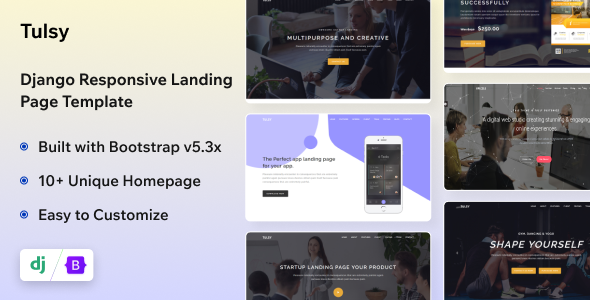
Tulsy - Django Multipurpose Landing Page Template Tulsy is a modern and versatile Django landing page template designed for startups, SaaS companies,...

Befox - Digital Agency & Creative Portfolio HTML Template Befox is a modern and professionally crafted HTML template designed for digital agencies,...
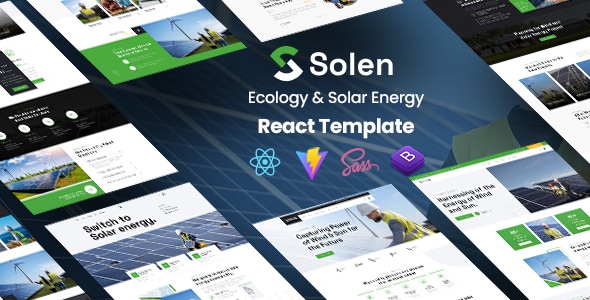
Solen - Ecology & Solar Energy React Template Solen - Ecology & Solar Energy React Template is a modern, eco-friendly, and professionally...
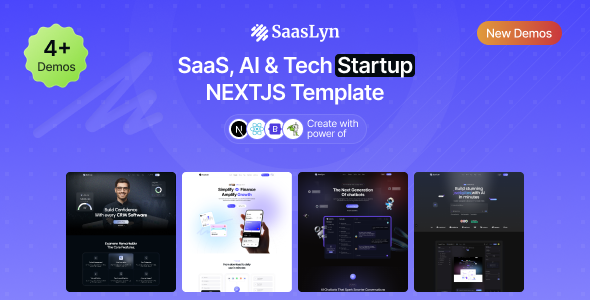
SaasLyn – SaaS, AI & Tech Startup NextJS Template SaasLyn is a modern, professional, and conversion-focused SaaS, AI & Tech Startup NextJS...
