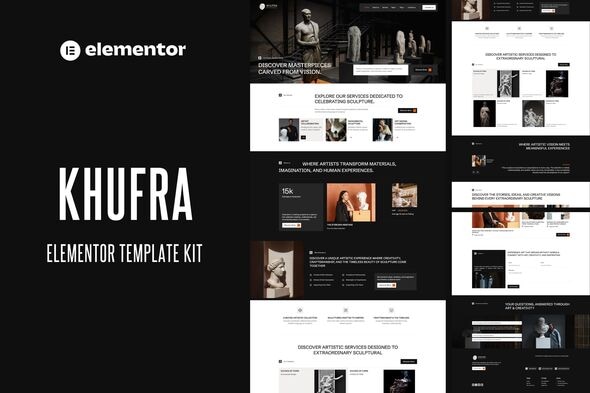
Khufra – Sculpture Exhibition Website Elementor Template Kit is a visually expressive website design solution created for sculptors, contemporary artists, art galleries, sculpture exhibitions, creative studios, museums, and cultural organizations looking to establish a distinctive online presence. Designed for the presentation of visual art and creative projects, Khufra provides a foundation for showcasing sculptures, introducing artists, promoting exhibitions, and sharing artistic stories through a professionally organized website.
In the art world, a website serves as more than a digital portfolio. It provides a space where visitors can explore an artist’s creative vision, discover upcoming exhibitions, learn about individual artworks, and connect with galleries or artists. Khufra offers a starting point for building this experience with a design approach suited to visual storytelling and artistic presentation.
Built for the WordPress and Elementor environment, this template kit supports a visual website customization workflow. Users can adapt supported layouts, update written content, replace images, and refine the overall appearance to reflect their artistic identity or exhibition concept. Whether you are preparing a website for a contemporary sculpture exhibition, developing an artist portfolio, promoting a gallery, or presenting a collection of three-dimensional artworks, Khufra can be customized to suit your creative objectives.
Sculpture is a visual art form that communicates through shape, material, texture, scale, and spatial composition. An effective sculpture website should give these elements room to stand out while making essential information easy to find.
Khufra provides a design foundation for presenting creative work in a structured and visually engaging environment. Its exhibition-oriented concept can be adapted to contemporary art spaces, independent sculpture studios, curated collections, public art projects, and experimental creative practices.
By incorporating high-quality photographs, carefully selected typography, and consistent visual styling, users can develop a website that reflects the atmosphere of their artwork. Artists can emphasize individual pieces, while galleries can organize their online presentation around exhibitions, collections, featured artists, or upcoming cultural events.
The final appearance can be tailored to suit different artistic styles, from minimalist stone sculptures and abstract metal installations to modern decorative objects and experimental mixed-media works.
Khufra can be adapted for a variety of creative and cultural applications, making it a useful starting point for professionals who want to communicate their work online.
Sculpture artists: Create a professional portfolio to showcase completed sculptures, creative experiments, artistic techniques, and selected projects.
Art galleries: Present gallery information, introduce featured artists, highlight collections, and provide visitors with details about current or upcoming exhibitions.
Sculpture exhibitions: Develop an exhibition-focused website to introduce the event concept, display participating artworks, and communicate visitor information.
Contemporary art studios: Build a digital portfolio that reflects the studio’s creative direction and presents its artistic projects in an organized format.
Museums and cultural institutions: Adapt the design for selected sculpture collections, educational content, special exhibitions, or cultural initiatives, subject to the institution’s requirements.
Art curators: Present curated collections, introduce exhibition themes, and communicate the relationship between individual artworks and the overall artistic concept.
Creative agencies: Develop visually distinctive websites for clients in the art, culture, exhibition, and creative industries.
The content, layout, and functionality should be customized according to the needs of the particular artist, gallery, or organization.
Khufra is designed for the Elementor website-building workflow, allowing users to customize supported page layouts through a visual editing interface. This can simplify many common design tasks and reduce the need to build every page section manually.
Depending on the included package and installed Elementor version, customization may include:
This flexibility can be valuable for artists and creative professionals who want greater control over their website’s appearance without managing every design detail through code.
Some elements may require Elementor Pro or additional compatible plugins. Check the product documentation to confirm the required dependencies, included templates, and available customization options.
High-quality artwork presentation is central to an effective sculpture website. Visitors should be able to understand the visual character of a piece and explore the details that make it distinctive.
Khufra can provide a foundation for organizing artwork photography into clear and engaging sections. Artists may use suitable layouts to feature individual sculptures, present a series of related works, or explain how a collection developed over time.
For each artwork, consider including its title, creation year, materials, dimensions, and a concise description where relevant. Additional context can explain the inspiration, creative process, or concept behind the piece. This information helps visitors appreciate the work beyond its visual appearance.
Use photographs that accurately represent the sculpture’s color, proportions, surface, and texture. Where appropriate, include multiple views so visitors can better understand the object’s three-dimensional form. Image galleries, sliders, or other interactive viewing elements should be confirmed against the supplied kit or added through compatible tools when needed.
An exhibition website needs to communicate both the artistic concept and the practical information visitors require. Khufra can be customized to introduce an exhibition through a clear visual hierarchy and carefully organized content.
An exhibition presentation might include the exhibition title, curatorial statement, participating artists, selected artworks, venue details, and visiting dates. Depending on the included layouts, these elements can be arranged to create a coherent journey from the initial introduction to the more detailed information.
For example, an exhibition dedicated to contemporary sculpture could begin with a striking image and a short description of its central theme. Further sections could introduce featured works, explain the artistic context, and provide information about visiting the gallery.
If the exhibition includes ticketing, reservations, guided tours, or special events, these functions may require additional services or integrations. The template itself should not be assumed to include a complete event-management or ticket-booking system.
For individual sculptors, an online portfolio helps establish a recognizable creative identity and gives curators, collectors, collaborators, and potential clients a place to explore their work.
Khufra can be adapted to present a collection of selected projects alongside a biography and information about the artist’s practice. The portfolio may focus on completed sculptures, commissioned work, experimental pieces, installations, or a particular artistic series.
A well-organized portfolio should prioritize the strongest and most representative work. Each project can include a concise description that explains the materials, dimensions, context, and creative intention where relevant.
Artists may also include information about exhibitions, professional collaborations, awards, or published work when applicable. Presenting these details accurately helps visitors understand the artist’s experience and artistic direction.
Sculpture often involves specialized materials, production techniques, and a substantial creative process. Sharing this information can add depth to an online portfolio and help visitors appreciate the work involved in producing each piece.
Depending on the available layouts, Khufra can be customized to include written explanations and supporting images that describe the artist’s process. These might cover clay modeling, stone carving, metalwork, wood carving, casting, installation techniques, or experimental mixed-media practices.
Process photography can be particularly useful for explaining how an artwork evolves from an initial concept to a completed piece. Studio images, material studies, sketches, and installation photographs can provide additional context without distracting from the finished sculpture.
Use this content to communicate your artistic approach in a way that is informative and accessible to both experienced art audiences and visitors discovering your work for the first time.
Art galleries and exhibition organizers often need a website that reflects the character of their space and the artistic work they represent. Khufra can serve as a design foundation for developing a consistent digital identity.
Supported colors, typography, imagery, and layout elements can be adapted to suit the gallery’s branding. A contemporary gallery may prefer restrained styling that emphasizes artwork, while a more experimental art space may use expressive imagery and unconventional content arrangements.
Consistency across exhibition pages, artist introductions, and general gallery information helps create a recognizable experience. Use a coherent visual direction and ensure that visitors can easily find essential information such as opening hours, location, accessibility details, and contact options where relevant.
The final website should reflect the gallery’s actual identity and requirements rather than relying on placeholder content.
Visitors may explore an exhibition website using desktop computers, tablets, or smartphones. A responsive presentation helps ensure that artwork images, descriptive text, and essential event information remain accessible across different screen sizes.
Khufra can provide a starting point for a responsive WordPress website, but the final result depends on the included layouts, Elementor settings, and any custom modifications.
Before publishing, test the website across common device sizes. Review image cropping, heading sizes, gallery spacing, navigation, and the placement of contact or exhibition information. Pay particular attention to large artwork photographs, which should remain visually clear without creating unnecessary horizontal scrolling.
Image optimization is also important. Use appropriately sized files and modern image formats where supported to balance visual quality with loading performance.
An exhibition website can help generate interest before an event, provide useful information during the exhibition period, and preserve a record of the event afterward.
Khufra can be adapted to support these objectives through clear exhibition descriptions, artist introductions, featured artwork sections, and prominent calls to action. Depending on your setup, visitors can be directed to contact the gallery, request additional information, explore an artist’s portfolio, or visit a separate ticketing page.
You may also use the website to publish exhibition announcements, press information, event updates, or educational content, provided the required page layouts and publishing functionality are available in your WordPress configuration.
For effective promotion, ensure that event dates, venue details, artist names, and visiting information remain accurate. Remove outdated announcements or clearly mark past exhibitions as archived.
Khufra can also support web designers and creative agencies developing websites for artists, galleries, museums, and cultural organizations. A predesigned template kit can provide a starting point for the visual structure of a project, allowing designers to concentrate on content, branding, image selection, and client-specific requirements.
Agencies can adapt the design for individual artist portfolios, gallery websites, exhibition landing pages, and related creative projects. Each implementation should be customized to reflect the client’s artwork, audience, and communication objectives.
The amount of customization required will depend on the project scope and the features available in the supplied kit. Advanced catalog management, ticket sales, e-commerce, artist submission portals, and other specialized functions may require additional plugins or custom development.
To get started with Khufra, prepare a compatible WordPress installation and install the required page-building tools specified in the product documentation. Import the included templates according to the recommended process, then customize the available layouts with your own artwork, exhibition details, and branding.
For a smooth setup, consider the following steps:
The exact setup process and available features depend on the supplied package and its documentation.
Khufra is an Elementor template kit intended to support website design and customization within WordPress. It should not automatically be considered a complete standalone WordPress theme, a full exhibition-management platform, or an integrated ticketing and e-commerce application.
Features such as online ticket sales, payment processing, appointment booking, advanced artwork catalogs, inventory management, and specialized gallery systems may require separate plugins, third-party services, or custom development. Certain templates or widgets may also depend on Elementor Pro or other compatible tools.
Before purchasing or installing Khufra, review the product documentation, included layouts, technical requirements, and stated dependencies to confirm that the kit meets your needs.
Khufra offers a practical design foundation for artists and cultural professionals who want to present sculpture and exhibition projects through a dedicated website. Its visual customization workflow allows users to adapt supported layouts, establish a consistent brand identity, and organize artwork-related information in a professional format.
The template can be useful for independent sculptors, contemporary art galleries, exhibition organizers, curators, creative studios, and agencies serving the cultural sector. With strong artwork photography, thoughtful content, suitable customization, and careful testing, the supplied layouts can be adapted into an online experience that reflects the character of the art being presented.
Khufra – Sculpture Exhibition Website Elementor Template Kit is a creative website design solution for showcasing sculptures, promoting art exhibitions, presenting artist portfolios, and building a professional online presence for galleries and cultural organizations. Its Elementor-based workflow provides a foundation for customizing supported layouts, introducing artistic projects, and communicating exhibition information in a visually engaging way. Whether you are an independent sculptor, a gallery owner, an exhibition curator, or a creative agency working with artists, Khufra can be adapted to support your visual identity and presentation goals. Review the included templates and technical requirements to determine whether Khufra is the right foundation for your next art website.
1. All digital products are the most recent version, with no possibility of free updates. After payment, you can request an update to the most recent version for 5 days if a new version is released. We free support within 5 days.
2. If a license is required (Excludes WHMCS license , we provide only method not license), please contact us via email or ticket for assistance with activation. Our license is only valid for activation and does not include support.
3. We provide Mobile, PHP script installation services for $19.90 / ₹1700. Please create a backup after installation as we do not support re-installation. For mobile app source code, we do not offer installation services.
4. If you have any questions, please contact us by email [email protected] or create a ticket on this page
5. Please note that any digital products presented on the website do not contain malicious code, viruses or advertising. You will receive the original files from the developers. We do not sell any products that have been downloaded from other websites.
6. The response time can last up to 6 hours.
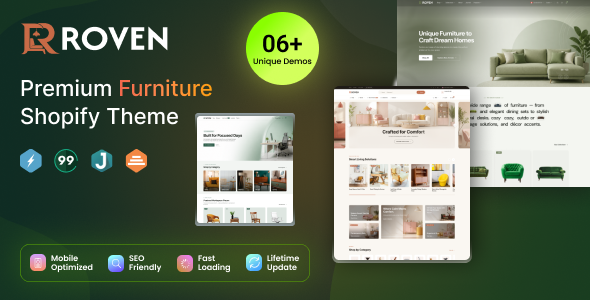
Roven - Furniture & Home Decor Shopify Theme OS 3.0 (Theme Block) Roven - Furniture & Home Decor Shopify Theme OS 3.0...
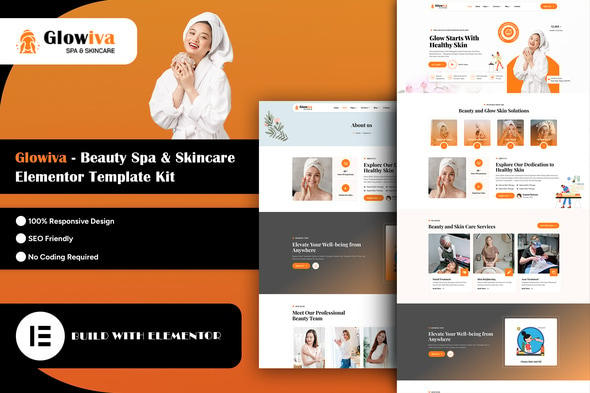
Glowiva – Beauty Spa & Skincare Elementor Template Kit Glowiva – Beauty Spa & Skincare Elementor Template Kit is a modern and...

Farmilk – Dairy Farm & Milk HTML Template Farmilk – Dairy Farm & Milk HTML Template is a professionally designed website template...
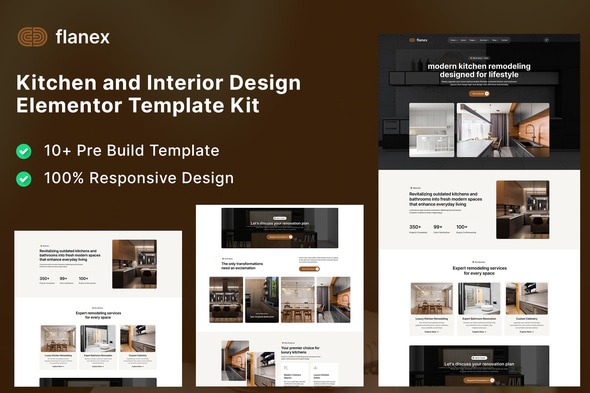
Flanex – Kitchen and Interior Design Elementor Template Kit Flanex – Kitchen and Interior Design Elementor Template Kit is a modern and...
