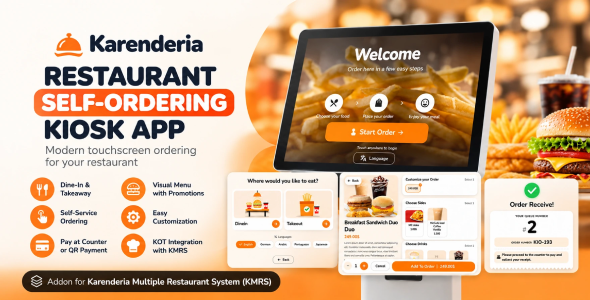
Karenderia | Restaurant Self-Ordering Kiosk App is a restaurant technology application designed to support self-service ordering and improve the customer ordering experience. This app template provides a starting point for businesses and developers interested in creating digital ordering solutions for restaurants, cafés, fast-food outlets, food courts, and other food service establishments. By enabling customers to explore menu items and place orders through a kiosk-style interface, Karenderia offers a foundation for modernizing ordering workflows and reducing dependence on traditional counter-based ordering.
Designed for restaurant-focused applications, Karenderia can be customized to suit different food service environments and operational requirements. Its self-ordering concept offers opportunities to streamline menu browsing, order selection, and ordering interactions while helping businesses explore more efficient ways to serve customers.
Self-service ordering allows customers to browse a digital menu and select their preferred food items without requiring a staff member to enter the entire order manually. A kiosk-based system can be particularly useful in restaurants with high customer volumes or fast-paced service environments.
Karenderia provides a starting point for building a digital ordering experience that can be adapted to a restaurant’s menu, branding, and service model.
Depending on the included implementation, developers can customize menu navigation, item selection, order summaries, and other supported ordering workflows.
A well-organized digital menu helps customers discover available dishes and understand their options before placing an order. A restaurant kiosk application can present menu categories, food descriptions, prices, and images in a structured format.
Potential customization areas include:
The actual menu management capabilities depend on the supplied application and any connected backend services.
A self-ordering kiosk should be easy to navigate, even for customers who are using it for the first time. Clear buttons, readable text, attractive food images, and straightforward navigation can help create a comfortable ordering experience.
Developers can customize the interface to match a restaurant’s branding and operating environment.
Potential improvements include larger touch targets, simplified category navigation, clear order summaries, accessible text, and multilingual menu support where implemented.
The interface should be tested on the intended kiosk screen size and hardware before deployment.
Customers often need to customize their orders according to personal preferences or restaurant offerings. A digital ordering workflow can provide an organized way to select menu items and review available options.
Depending on the original implementation, developers may be able to customize food variations, portion sizes, toppings, extras, and special instructions.
More advanced features, such as ingredient substitutions, allergen filters, and dynamic pricing, may require additional development. Allergen information should be accurate and maintained according to the restaurant’s food safety procedures.
An order summary helps customers review their selections before confirming an order. A self-ordering application may provide a structured view of selected items, quantities, customizations, and the total amount.
Potential enhancements include item editing, quantity adjustments, discount calculations, tax handling, and order confirmation screens.
The availability of these features depends on the original application. Integration with payment systems or a restaurant’s order management backend may require additional configuration.
Once a customer submits an order, restaurant staff need a reliable way to receive and prepare it. A connected kiosk solution can form part of a broader ordering workflow that passes order details to the appropriate restaurant system.
Depending on the implementation, developers can explore integration with kitchen displays, receipt printers, point-of-sale systems, or order management platforms.
Real-time kitchen synchronization, automatic order routing, and preparation status updates require suitable backend support and integrations.
Digital ordering systems may support different payment methods depending on the restaurant’s requirements and the application’s technical capabilities.
Potential integrations include card payments, supported digital wallets, QR-based payment flows, or payment at the counter.
Payment processing should use an appropriate payment provider and secure integration. Do not assume that every payment method is included with the original application; confirm the available gateways and compatibility before deployment.
Karenderia can be evaluated as a starting point for creating a kiosk experience that reflects a restaurant’s identity.
Developers may customize available logos, colors, typography, food images, buttons, and menu layouts. Different configurations can be considered for fast-food restaurants, cafés, food courts, bakeries, and casual dining establishments.
The extent of customization depends on the supplied source files, application architecture, and licensing permissions.
Restaurants may need a self-ordering kiosk to exchange information with existing business systems.
Depending on the application’s architecture, possible integrations include:
These integrations may require API access, compatible hardware, backend development, and additional testing.
Self-service ordering can help customers review a menu at their own pace and may reduce the amount of manual order entry required at the counter.
A well-designed kiosk workflow can also help present menu options consistently and make order details easier to review before submission.
Actual improvements in waiting times and operational efficiency depend on restaurant layout, staff workflows, system reliability, and customer adoption.
Restaurant operators can benefit from structured information about ordering activity. Depending on the connected backend, a customized kiosk solution may support reports on order volumes, popular menu items, sales totals, and peak ordering periods.
More advanced analytics, staff reports, inventory tracking, and multi-location dashboards may require additional implementation or integration with restaurant management software.
Accurate reporting depends on reliable order records and consistent data synchronization.
A restaurant kiosk must be configured carefully because it may be accessible to many customers throughout the day.
Important security considerations include restricting administrative functions, protecting customer information, securing payment transactions, validating order data, and preventing unauthorized access to management screens.
If customer accounts or loyalty information are collected, suitable privacy protections should be implemented. The security features of the original application should be reviewed before production deployment.
Karenderia may be considered for projects involving:
The suitability of each use case depends on the supported hardware, software integrations, and included functionality.
A kiosk interface is typically designed for direct touch interaction, but the intended hardware and display configuration should be confirmed before deployment.
Developers should test screen resolution, touch accuracy, navigation, session handling, and accessibility on the target device.
If the application is also intended for tablets or other screens, additional layout adjustments may be necessary to provide a consistent experience across supported devices.
Karenderia is suitable for developers building restaurant technology solutions, businesses exploring self-service ordering, and agencies creating digital ordering experiences for food service clients.
It can also serve as a foundation for evaluating kiosk workflows and planning integrations with existing restaurant systems.
Before purchasing or deploying the application, review its technical stack, supported platforms, source-code availability, payment integrations, and licensing conditions.
Karenderia | Restaurant Self-Ordering Kiosk App provides a starting point for developing digital ordering experiences for restaurants and other food service businesses. Its kiosk-focused concept offers opportunities to customize menu browsing, food selection, order review, and integrations with restaurant operations.
Whether you are developing a self-service solution for a fast-food outlet, modernizing a restaurant’s ordering workflow, or building a customized kiosk application for clients, Karenderia can support your project planning and development process. Review the included features, hardware requirements, supported integrations, and licensing terms to determine whether the application meets your business needs.
1. All digital products are the most recent version, with no possibility of free updates. After payment, you can request an update to the most recent version for 5 days if a new version is released. We free support within 5 days.
2. If a license is required (Excludes WHMCS license , we provide only method not license), please contact us via email or ticket for assistance with activation. Our license is only valid for activation and does not include support.
3. We provide Mobile, PHP script installation services for $19.90 / ₹1700. Please create a backup after installation as we do not support re-installation. For mobile app source code, we do not offer installation services.
4. If you have any questions, please contact us by email [email protected] or create a ticket on this page
5. Please note that any digital products presented on the website do not contain malicious code, viruses or advertising. You will receive the original files from the developers. We do not sell any products that have been downloaded from other websites.
6. The response time can last up to 6 hours.
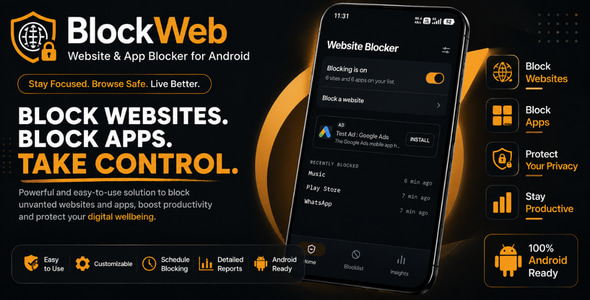
BlockWeb | Website Blocker for Android with Ads BlockWeb is a powerful Android application designed to help users improve productivity, reduce distractions,...
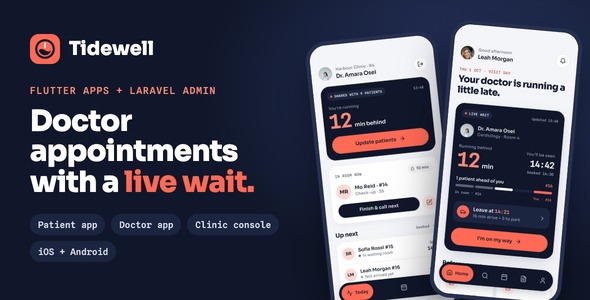
Tidewell | Flutter Doctor Appointment App With Live Wait Tidewell | Flutter Doctor Appointment App With Live Wait is a modern healthcare...
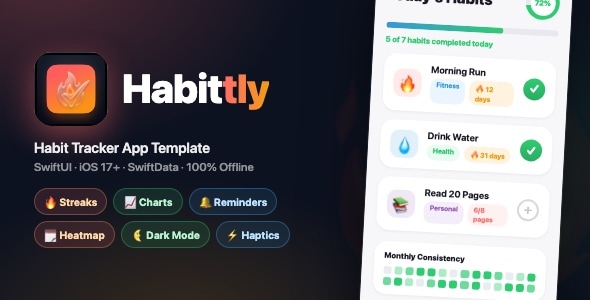
Habbitly | Habit Tracker App with Streaks, Charts, Heatmap & Local Reminders — SwiftUI iOS 17 Habbitly is a modern and feature-rich...
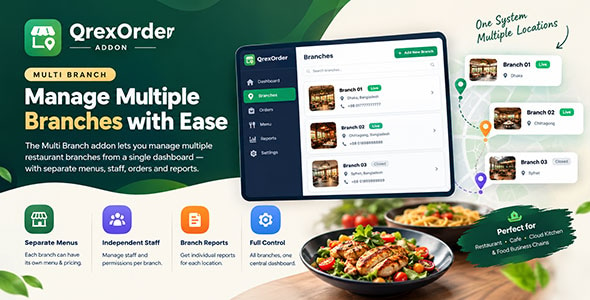
Qbranch - Multi Branch Add-on for QrexOrder | Branch Wise Staff, Orders,Rep Qbranch - Multi Branch Add-on for QrexOrder is an extension...
