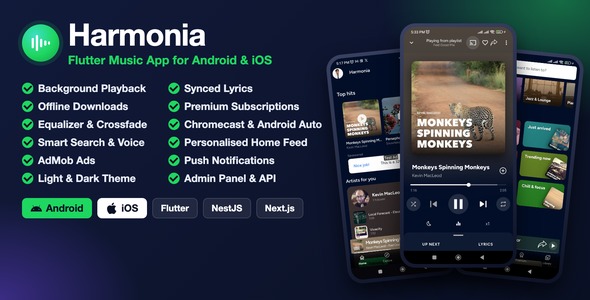
Harmonia | Flutter Music Streaming App With NestJS Backend and Next.js Admin Panel is a modern music streaming application project designed to provide a foundation for building a personalized audio streaming platform. Combining a Flutter-based mobile application, a NestJS backend, and a Next.js administration panel, this solution brings together the essential components required to develop and manage a digital music streaming service.
Music streaming platforms have transformed how people discover, listen to, and organize their favorite audio content. Users increasingly expect convenient access to music libraries, personalized listening experiences, organized playlists, and smooth playback across supported devices. Harmonia provides a starting point for developers, entrepreneurs, and businesses interested in creating their own branded music streaming application.
The project follows a multi-component architecture that separates the mobile listening experience, backend services, and administrative management. Flutter provides the foundation for the mobile application, NestJS handles server-side operations and API communication, while Next.js offers a web-based interface for platform administration.
Whether you are planning a commercial music streaming startup, a niche audio platform, or a customized music application, Harmonia can be adapted to meet different product requirements depending on the included modules and integrations.
The Flutter mobile application serves as the primary interface through which listeners interact with the music platform. Flutter provides a cross-platform development approach that helps developers build applications for compatible Android and iOS devices using a shared codebase.
A modern music streaming interface should make it easy for users to explore available tracks, access their favorite music, and control playback without unnecessary complexity.
Harmonia provides a foundation for developing a customized mobile listening experience with a branded interface and music-focused navigation.
Depending on the included implementation, the application may support features such as:
The exact features and supported playback capabilities should be verified against the supplied source code and product documentation.
Audio playback is the central functionality of any music streaming application. Users expect a convenient listening experience with accessible playback controls and reliable audio delivery.
Harmonia can serve as a starting point for implementing a music playback experience within a Flutter mobile application.
Depending on the included audio player and streaming implementation, playback functionality may be extended to support:
A complete streaming experience also requires a suitable audio delivery infrastructure. Music files must be stored and served through compatible storage or streaming services, and the application must be configured to retrieve and play supported audio formats.
Features such as adaptive bitrate streaming, audio caching, offline downloads, and synchronized playback may require additional development or external services if they are not already included.
The NestJS backend provides the server-side foundation for managing application data and coordinating communication between the mobile application and administrative panel.
NestJS is a TypeScript-based Node.js framework designed for developing structured and maintainable backend applications.
In a music streaming platform, the backend can manage application requests, user-related information, music catalog data, and other business operations depending on the included modules.
Potential backend functionality includes:
The backend can also be extended to support listening history, subscription management, recommendation systems, and analytics.
The actual availability of these modules depends on the supplied implementation. Database configuration, external APIs, and additional business logic may be required to create a complete production service.
The Next.js administration panel provides a web-based management interface for operating the music streaming platform.
Administrators need a centralized system for maintaining music content, organizing categories, managing users, and controlling supported application settings.
Depending on the included dashboard modules, the administration panel can be customized to support:
A dedicated admin panel can make routine content management more organized and reduce the need for direct database operations.
The Next.js interface must be connected to the NestJS backend through properly configured APIs. Administrative authentication and role-based permissions should also be implemented to protect sensitive platform operations.
A well-organized music library is essential for delivering a convenient listening experience. It allows users to browse different types of audio content and discover tracks according to their interests.
The music library can be structured using information such as track titles, artists, albums, genres, descriptions, artwork, and audio file references.
Depending on the supplied functionality, administrators may be able to organize and manage music content through a centralized interface.
Possible music management capabilities include:
A production platform should also use suitable storage and content delivery infrastructure to distribute audio efficiently.
Large music libraries may require cloud object storage, CDN integration, metadata indexing, and appropriate media processing workflows.
Music discovery helps listeners explore content beyond the tracks they already know. A well-organized discovery experience can make an application more engaging and encourage users to spend more time listening.
Harmonia can be customized to present music through different categories and collections, depending on the available modules.
Possible discovery sections include:
Additional discovery capabilities can include search, sorting, filters, trending sections, and personalized suggestions.
Advanced recommendation functionality may require a dedicated recommendation engine, listening analytics, or third-party services. It should not be assumed to be included unless confirmed in the product documentation.
Playlists allow listeners to organize their favorite tracks into personalized music collections.
A playlist feature can improve the listening experience by allowing users to group songs according to mood, activity, genre, occasion, or personal preference.
Depending on the included implementation, playlist functionality can be extended to support:
More advanced implementations may support collaborative playlists, public playlist sharing, playlist recommendations, and synchronized playlist updates across devices.
These capabilities depend on the available backend functionality and may require additional development.
User accounts provide a foundation for delivering a personalized music experience. They allow listeners to maintain account information and access supported music-related features.
Depending on the included authentication and account modules, the platform can be extended with registration, login, profile management, and account settings.
Additional personalization opportunities may include favorite tracks, saved albums, listening history, recently played music, and personalized content sections.
A more advanced system could use listening activity to generate customized recommendations. This would require appropriate data collection, backend processing, and privacy controls.
User account functionality should be implemented with secure authentication, protected API access, and appropriate handling of personal information.
Music streaming businesses can use different monetization strategies depending on their target audience and content licensing arrangements.
A subscription-based model is one possible approach, allowing businesses to offer different service levels to listeners.
Potential monetization options include:
A subscription system can be developed to manage membership status, billing periods, premium access, and subscription expiration.
Payment processing may require integration with external payment gateways or platform-specific billing systems. For mobile applications distributed through app stores, developers should review applicable Apple and Google billing policies.
Music licensing is particularly important for commercial streaming platforms. Businesses must obtain the necessary rights and permissions for the music they distribute. A technically functional streaming application does not automatically provide rights to stream copyrighted recordings.
Reliable media infrastructure is essential for delivering audio content to users. Unlike a basic music player that accesses locally stored files, a streaming platform needs a system for storing, organizing, and distributing audio assets.
Depending on the project architecture, developers may integrate cloud storage, media servers, or content delivery networks.
Important infrastructure considerations include:
For a larger music platform, efficient audio delivery can improve playback reliability and reduce unnecessary server load.
Advanced features such as adaptive streaming, transcoding, and offline downloads may require additional infrastructure and specialized development.
Notifications can help keep listeners informed about relevant updates and encourage continued application engagement.
Depending on the included notification functionality, the application can be extended to send updates about new music releases, featured playlists, account activity, or subscription-related events.
Possible notification options include:
Push notification services may require external integrations and platform-specific configuration. Businesses should also provide appropriate notification preferences so users can control the messages they receive.
Harmonia can be used as a foundation for creating a music streaming application with your own brand identity.
Developers can customize the mobile interface, administrative dashboard, application content, and backend workflows according to the intended business model.
Customization opportunities may include:
The separation between Flutter, NestJS, and Next.js also provides a structured foundation for extending the platform as business requirements evolve.
A music streaming application may process user accounts, personal preferences, listening activity, subscription records, and payment-related information. Protecting this data is important for maintaining a reliable service.
A production implementation should include secure authentication, authorization checks, protected administrative routes, input validation, encrypted API communication, and safe storage of sensitive credentials.
Audio access may also need suitable access controls depending on the platform’s licensing and subscription model.
Businesses should establish clear privacy policies explaining how user information and listening activity are collected, processed, and retained.
Regular software updates, database backups, infrastructure monitoring, and security testing are important for long-term platform maintenance.
Deploying a complete music streaming service requires configuring the Flutter mobile application, NestJS backend, Next.js admin panel, database, and audio storage infrastructure.
Before deployment, developers should review the supplied documentation to identify the required software versions, dependencies, environment variables, database configuration, and supported platforms.
Important deployment considerations include:
The final infrastructure requirements depend on the included project modules, expected user traffic, music library size, and selected streaming technology.
Harmonia is suitable for different types of businesses and development teams interested in creating audio streaming products.
Harmonia | Flutter Music Streaming App With NestJS Backend and Next.js Admin Panel provides a multi-component development foundation for building a modern music streaming platform. By combining Flutter for mobile applications, NestJS for backend services, and Next.js for administration, it offers a structured starting point for creating a customized digital audio experience.
Whether you are planning a music streaming startup, developing a branded audio application, or creating a platform for authorized music distribution, Harmonia can help organize the core application components into one development project.
With the appropriate audio storage, streaming infrastructure, music licensing, payment integrations, and security configuration, the project can be extended toward a production-ready music streaming service.
Note: Please review the official product documentation and included source code to confirm the actual playback features, audio streaming implementation, music management modules, backend functionality, admin panel capabilities, database requirements, and Android/iOS compatibility. Music licensing, cloud storage, CDN delivery, payment services, and third-party integrations may involve separate configuration and costs.
1. All digital products are the most recent version, with no possibility of free updates. After payment, you can request an update to the most recent version for 5 days if a new version is released. We free support within 5 days.
2. If a license is required (Excludes WHMCS license , we provide only method not license), please contact us via email or ticket for assistance with activation. Our license is only valid for activation and does not include support.
3. We provide Mobile, PHP script installation services for $19.90 / ₹1700. Please create a backup after installation as we do not support re-installation. For mobile app source code, we do not offer installation services.
4. If you have any questions, please contact us by email [email protected] or create a ticket on this page
5. Please note that any digital products presented on the website do not contain malicious code, viruses or advertising. You will receive the original files from the developers. We do not sell any products that have been downloaded from other websites.
6. The response time can last up to 6 hours.
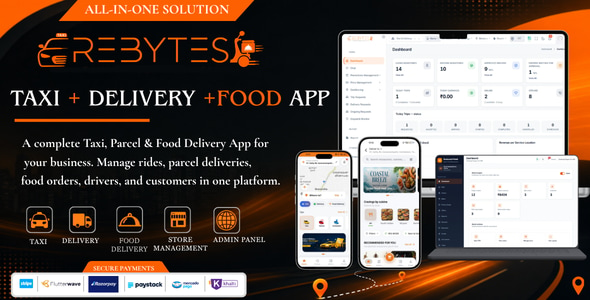
Rebytes | Taxi, Delivery & Food Delivery Platform Rebytes | Taxi, Delivery & Food Delivery Platform is a multi-service platform concept designed...
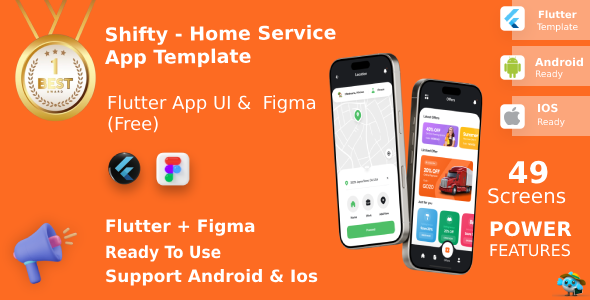
Shifty | Multi-Service Booking App UI Kit for Flutter Shifty | Multi-Service Booking App UI Kit for Flutter is a modern mobile...
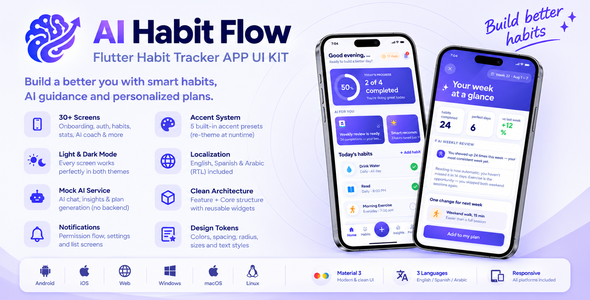
AI Habit Flow | Flutter Habit Tracker UI Kit AI Habit Flow is a beautifully crafted Flutter Habit Tracker UI Kit designed...
Aigenta | Multi-Purpose Flutter WebView App With Laravel Admin Panel Aigenta | Multi-Purpose Flutter WebView App With Laravel Admin Panel is a...
