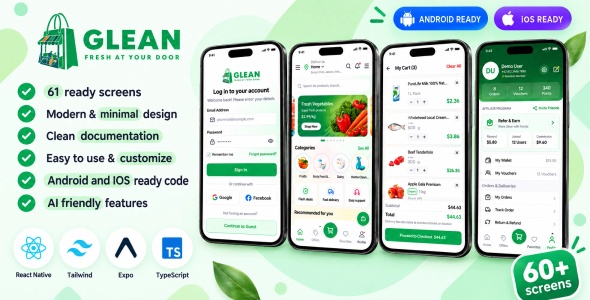
Glean | Grocery Shopping App React Native Expo UI Kit is a modern mobile UI kit designed for developers and businesses looking to build an attractive and user-friendly grocery shopping application. Built around the React Native and Expo development ecosystem, this UI kit provides a foundation for creating cross-platform shopping interfaces for customers who want to browse grocery products, explore categories, and shop for everyday essentials through their mobile devices.
With its grocery-focused design, Glean is suitable for developers, UI/UX designers, startups, eCommerce businesses, and entrepreneurs planning to launch a digital grocery shopping experience. Its reusable interface components can help streamline the initial design and development process while providing opportunities to customize the application according to specific business requirements.
Glean focuses on the essential screens and interactions associated with a grocery shopping application. A well-organized interface can help customers discover products, browse categories, review prices, and navigate the shopping experience more comfortably.
The UI kit provides a starting point for developing a visually consistent mobile application. Developers can customize available screens, colors, typography, icons, and interface components to match their preferred design system.
The actual screens and components included depend on the original UI kit package.
React Native enables developers to build mobile applications using JavaScript or TypeScript and reusable UI components. Expo provides tools and services that simplify the development, testing, and deployment of React Native applications.
Glean is designed around the React Native Expo ecosystem, making it suitable for developers who want to establish a cross-platform grocery shopping interface.
Depending on the included source code and configuration, developers can adapt the application for supported Android and iOS devices. Backend services, authentication systems, and production integrations may require additional implementation.
An organized product catalog is an essential part of any grocery shopping application. Customers should be able to discover fresh produce, packaged foods, beverages, household essentials, and other everyday items.
Potential interface elements include:
Developers can customize the catalog structure to reflect the products and categories offered by their business.
Dynamic product information generally requires a backend, database, or eCommerce API integration.
Product detail screens help customers review important information before adding an item to their shopping list.
Depending on the available components, developers can customize product images, descriptions, prices, package sizes, and quantity selection controls.
Additional features may include product variants, nutritional information, ingredient details, and related product suggestions. These capabilities depend on the supplied UI kit and any additional development.
A clear product detail interface can make the shopping process easier to understand and navigate.
A shopping cart provides a central place for customers to review selected grocery items before proceeding to checkout.
Potential interface components include item quantities, product prices, subtotal displays, delivery charges, discount fields, and order summaries.
Developers can customize these screens to match the intended purchasing workflow. Actual cart calculations, inventory validation, and order persistence require suitable application logic and, in most production systems, backend integration.
Search functionality can help customers locate grocery products quickly, particularly when an online store offers a large catalog.
Glean can serve as a starting point for designing search interfaces, category filters, and product discovery components.
Potential enhancements include keyword search, popular searches, recent searches, price filters, and sorting options.
Live search results, personalized recommendations, and advanced filtering generally require additional data handling and backend or API integration.
Simple navigation is important for mobile shopping applications. Customers should be able to move between product categories, product details, the cart, and account-related screens without unnecessary complexity.
Developers can customize the navigation structure and available interface components to support the needs of their application.
Potential improvements include clearer navigation labels, accessible icons, consistent screen layouts, and streamlined transitions.
The exact navigation components depend on the original source code.
A grocery shopping application should provide a consistent experience across supported mobile devices.
React Native enables developers to create interfaces that adapt to different screen dimensions, while Expo provides tools for testing and developing mobile applications.
Developers should evaluate Glean’s layouts on different Android and iOS screen sizes and adjust spacing, text sizes, images, and touch targets as needed.
A well-tested interface can improve usability for customers shopping on a variety of devices.
Glean provides a starting point for creating a grocery shopping app with a distinct brand identity.
Developers can customize available colors, fonts, logos, icons, product cards, buttons, and screen layouts to align with a company’s visual guidelines.
Possible application concepts include neighborhood grocery delivery, organic food shopping, supermarket ordering, fresh produce marketplaces, and specialty food stores.
The degree of customization depends on the editable assets and components included with the UI kit.
A production grocery shopping app may require a checkout workflow that collects delivery information, calculates order totals, and processes payments.
Depending on the existing components, developers can customize address forms, order summaries, delivery options, and payment selection screens.
Payment processing can be integrated through suitable providers, while order submission and confirmation generally require backend services.
The presence of payment screens in a UI kit does not necessarily mean that functional payment processing is included.
Grocery delivery applications often need a way for customers to provide delivery addresses and review the progress of their orders.
Potential enhancements include saved addresses, delivery instructions, order confirmation screens, and status displays.
Live delivery tracking, driver assignment, estimated arrival times, and map-based location services may require additional APIs and backend development.
These features should be verified against the original package before being treated as included functionality.
A UI kit primarily establishes the visual and interaction foundation of an application. A complete grocery shopping service generally requires additional infrastructure to manage products, customers, orders, and inventory.
Depending on the business requirements, developers can integrate the interface with:
Integration requirements depend on the chosen technology stack and the features included in the original project.
Glean may be useful for several types of projects, including:
The suitability of each application depends on the UI kit’s actual components, technical requirements, and licensing terms.
React Native and Expo provide a development workflow that supports rapid iteration and cross-platform testing. Developers can customize reusable components and test the interface as the application evolves.
Useful development practices include optimizing product images, managing component state effectively, testing navigation flows, and checking performance on representative devices.
Before production deployment, developers should also review dependency compatibility, application permissions, accessibility, and security requirements.
Glean is suitable for React Native developers, Expo users, UI/UX designers, startups, and eCommerce businesses looking to establish a grocery shopping app interface.
Beginners can use the UI kit as a starting point for learning mobile interface development, while experienced developers can customize its components and connect them to existing backend systems.
It can also help agencies establish an initial design foundation for grocery shopping applications developed for clients.
Glean | Grocery Shopping App React Native Expo UI Kit provides a mobile interface foundation for developers planning to create a modern grocery shopping application. Its React Native and Expo focus offers opportunities to customize product browsing, shopping interfaces, cart screens, and other mobile shopping experiences.
Whether you are building a supermarket app, launching a grocery delivery startup, or developing a custom eCommerce solution for a client, Glean can support your initial design and development workflow. Review the included screens, source code, dependencies, supported platforms, and licensing terms to determine whether the UI kit meets your project requirements.
1. All digital products are the most recent version, with no possibility of free updates. After payment, you can request an update to the most recent version for 5 days if a new version is released. We free support within 5 days.
2. If a license is required (Excludes WHMCS license , we provide only method not license), please contact us via email or ticket for assistance with activation. Our license is only valid for activation and does not include support.
3. We provide Mobile, PHP script installation services for $19.90 / ₹1700. Please create a backup after installation as we do not support re-installation. For mobile app source code, we do not offer installation services.
4. If you have any questions, please contact us by email [email protected] or create a ticket on this page
5. Please note that any digital products presented on the website do not contain malicious code, viruses or advertising. You will receive the original files from the developers. We do not sell any products that have been downloaded from other websites.
6. The response time can last up to 6 hours.
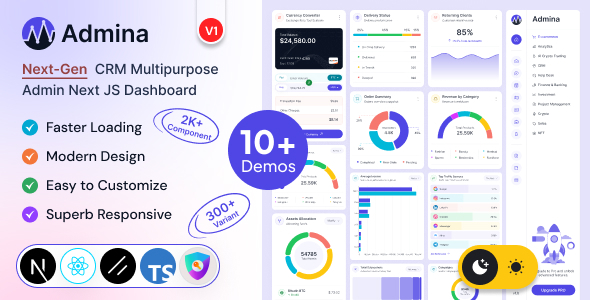
Admina - Tailwind & Nextjs Admin Dashboard with shadcn UI Admina - Tailwind & Nextjs Admin Dashboard with shadcn UI is a...
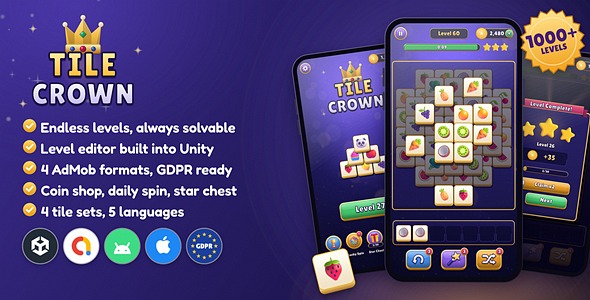
Tile Crown | Triple Tile Match Game for Unity Tile Crown is a premium Triple Tile Match Game Template developed with Unity,...
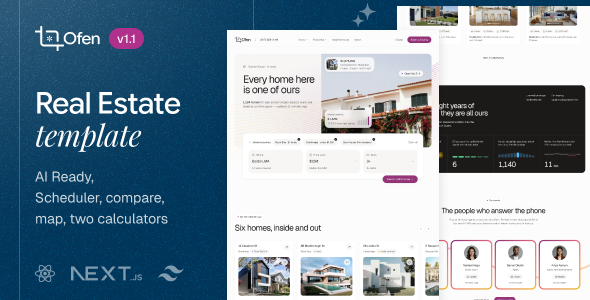
Ofen — Real Estate React NextJs Template Ofen — Real Estate React NextJs Template is a modern website template designed for real...
CircuitLab | Hardware Pinouts and Electronics Calculators - Android App Template CircuitLab is a powerful Android application template designed for electronics enthusiasts,...
