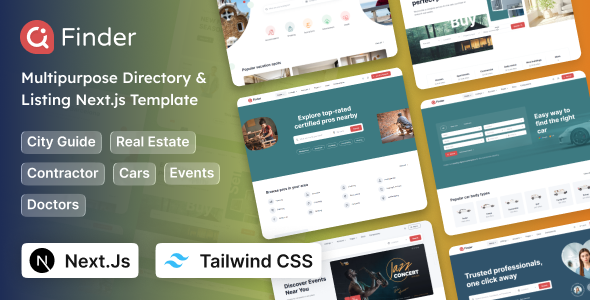
Finder – Multipurpose Tailwind CSS 4 Directory & Listing Next.js Template is a modern website template designed for creating directory websites, business listing platforms, service discovery portals, and online marketplaces focused on helping users find relevant businesses, services, and places. Built around the Next.js framework and Tailwind CSS 4, Finder provides a frontend foundation for developing organized, responsive, and visually appealing listing websites. Its multipurpose approach makes it suitable for developers, startups, digital agencies, and entrepreneurs who want to build a directory platform tailored to a specific industry or audience.
Whether you are planning a local business directory, a professional services portal, a property discovery website, a travel listing platform, or a specialized marketplace, Finder can help simplify the initial frontend development process. Developers can customize the available layouts, styling, and interface components to match their business requirements while extending the application with the data sources and functionality needed for a complete platform.
Directory websites bring information from multiple businesses, service providers, or locations into one organized destination. A well-designed interface helps visitors browse categories, compare available options, and discover relevant information without unnecessary complexity.
Finder is positioned for directory-oriented projects where search, listing presentation, and category navigation are important parts of the user experience. Depending on the layouts included in the package, developers may adapt the interface to display business profiles, listing cards, category collections, search areas, and detailed information pages.
The multipurpose design approach can support different visual identities. A local business directory may emphasize contact information and locations, while a travel directory may focus on destinations, attractions, and visitor services.
Developers can further customize colors, typography, images, spacing, and page structures to establish a recognizable brand. The exact page variations and included components should be confirmed from the product documentation.
Next.js is a React-based framework for developing modern websites and web applications. It provides capabilities for application routing, page rendering, asset optimization, and other frontend development requirements.
Finder’s Next.js foundation can help developers organize a directory website into reusable components and structured page layouts. Instead of creating every interface element from scratch, developers can adapt the supplied code to meet the needs of their project.
Depending on its implementation, a Next.js application can use server-side rendering, static generation, or other rendering strategies. These capabilities can be useful for directory platforms that need to present numerous listing pages and support search engine discovery. The actual rendering approach used by Finder should be verified in the source code.
Before installation, review the package documentation for the supported Next.js and React versions, Node.js requirements, dependencies, styling configuration, build commands, and deployment instructions.
Tailwind CSS 4 uses a utility-first approach to styling interfaces. Developers can combine utility classes to control spacing, typography, colors, borders, grids, and responsive behavior without relying entirely on extensive custom CSS.
For a directory website, consistent styling helps users navigate different page types without feeling that each section belongs to a separate application. Shared visual patterns can make search results, listing cards, category pages, and navigation elements easier to maintain.
With Tailwind CSS 4, developers can customize the visual presentation to reflect their business identity and audience. Common customization areas include:
The exact styling configuration and reusable components depend on the supplied source code.
A directory platform generally organizes information into categories so visitors can discover relevant listings efficiently. Depending on the business model, each listing may include a title, description, images, category, address, contact details, website URL, and other useful information.
Finder can serve as a starting point for presenting these records in an organized frontend. Developers can customize category structures and listing layouts to support different industries and content requirements.
Potential applications include:
Local Business Directories: Help visitors discover restaurants, shops, healthcare providers, repair services, and other local businesses.
Professional Service Portals: Organize consultants, freelancers, contractors, and specialized service providers.
Real Estate Directories: Present properties and related details when the necessary property data and functionality are implemented.
Travel and Tourism Platforms: Showcase destinations, attractions, hotels, and visitor services.
Automotive Listing Websites: Organize vehicle dealers, garages, workshops, and automotive service providers.
Event and Venue Directories: Present event locations, venues, and useful visitor information.
Niche Business Directories: Build specialized platforms around a particular profession, location, industry, or interest.
These examples represent possible customizations and do not guarantee that individual industry demos are included in the package.
Search functionality is central to many directory websites. Visitors need convenient ways to find relevant listings instead of manually browsing every category.
A Finder-based project can be adapted to support search by keyword, category, location, or other listing attributes. Depending on the requirements, developers may also implement filters for price, service type, rating, availability, or other criteria.
An effective search experience should make it easy for users to understand the available options, apply filters, and revise their selections. Search results should display useful information consistently so visitors can compare relevant businesses or services.
However, a search input or filter control in a frontend template does not automatically provide functional search. Dynamic queries, filtering logic, sorting, pagination, and location-based results may require integration with a backend API, database, or external data service.
For larger directories, developers should consider query performance, result relevance, indexing, and how the interface handles empty results or invalid search terms.
Listing cards help users scan multiple options quickly, while category pages organize related entries into meaningful groups. Both elements are important when a directory contains a large amount of information.
Depending on the supplied layouts, Finder can be customized to present listing titles, images, descriptions, category labels, and other relevant details. Developers can prioritize the information most useful to the intended audience.
For example, a local services directory may emphasize location and contact details, while a travel platform may highlight destination imagery and visitor information.
Category pages can group listings into clear sections and provide convenient navigation between related subjects. Responsive grids can then adapt the number of visible cards according to the available screen width.
The actual card designs, pagination controls, category navigation, and responsive behavior should be tested using the supplied implementation.
Individual listing pages provide visitors with more comprehensive information about a business, service, place, or provider. These pages can help users evaluate their options before taking the next step.
A listing detail layout may be customized to include a business overview, photographs, contact information, address, operating hours, website link, and relevant service descriptions. Depending on the project, additional information such as maps, galleries, reviews, or related listings may also be useful.
Interactive features such as maps and reviews generally require suitable data sources or third-party integrations. Developers should verify whether these capabilities are included or need to be implemented separately.
A strong listing detail page should prioritize accuracy and clarity. Business information should be maintained regularly, and visitors should have a clear way to contact the provider or access its official website.
Directory websites must work well across desktop computers, tablets, and smartphones. Visitors may discover a listing through a search engine or shared link and access it from virtually any screen size.
When implementing Finder, developers should verify that navigation, search fields, listing cards, filters, images, and content sections adapt appropriately to different viewports.
Tailwind CSS responsive utilities can help developers adjust layouts at defined breakpoints. Nevertheless, the final mobile experience depends on the actual implementation and any custom modifications.
Important testing areas include mobile navigation, filter accessibility, long business names, image cropping, card spacing, touch targets, and form usability. Testing on multiple browsers and device sizes can help identify issues before launch.
Every directory business has its own audience and visual requirements. A property directory may need a different presentation from a restaurant guide or professional services platform.
Finder can be customized to reflect these differences through changes to typography, colors, images, content structure, and component layouts. Developers can replace sample content, add brand assets, adjust navigation, modify listing cards, and create additional pages where required.
A consistent visual system helps maintain a professional appearance throughout the website. Reusable React components can also make common design changes easier to apply across multiple pages.
The degree of customization depends on the supplied source code, component architecture, and developer familiarity with Next.js and Tailwind CSS.
A functional directory platform usually needs a reliable way to retrieve and manage listing information. Depending on the project, this information may come from a database, a custom backend, a content management system, or an external API.
Finder can provide a frontend foundation for connecting listing interfaces to suitable data sources, subject to the architecture of the supplied project.
Potential integrations include business listing APIs, map services, search services, content management systems, analytics tools, and contact form providers. The appropriate approach depends on the project’s technical requirements and the available data.
Developers should handle loading states, errors, missing records, and invalid data carefully so the interface remains useful when a service is unavailable or a listing cannot be found.
API credentials and other sensitive values must be handled securely. Secrets should not be exposed in publicly accessible client-side code, and access to protected data should be enforced by the appropriate backend service.
Some directory platforms allow businesses or individuals to create accounts and submit their own listings. This approach can help expand a directory’s content while reducing manual data entry.
A Finder-based project may be extended with account registration, login, profile management, listing creation, listing updates, and submission review workflows where required.
A complete implementation may also need listing ownership checks, moderation tools, status management, and administrative permissions. These features require appropriate backend logic and should not be assumed to be included merely because the template uses Next.js.
Before implementing these workflows, developers should determine how users, listings, and permissions will be stored and managed. Secure authentication and authorization are essential when the platform allows users to modify information.
Directory websites can support different business models depending on the target market and audience. Once the core listing experience is established, a platform owner may consider monetization features.
Potential models include paid listing submissions, featured placements, premium business profiles, subscription packages, sponsored categories, and advertising placements.
Implementing these options may require a backend, payment gateway integration, billing records, subscription management, and rules that determine which features each listing plan provides.
The availability of these capabilities depends on the supplied package and any additional development. They should not be advertised as included features unless confirmed by the documentation.
Performance and SEO are important for directory websites because individual listing pages may attract visitors directly from search engines.
Developers can improve performance by optimizing images, reducing unnecessary JavaScript, using suitable loading strategies, and minimizing avoidable network requests. For large directories, efficient data fetching, pagination, caching, and appropriate backend queries can also make a significant difference.
SEO tasks include creating descriptive page titles and meta descriptions, using logical headings, writing unique listing descriptions, adding meaningful image alternative text, and maintaining clear URLs. Where appropriate, developers may also implement structured data for eligible businesses or other supported listing types.
Next.js offers rendering and metadata capabilities that can support SEO when configured correctly. However, a template alone does not guarantee search rankings, valid structured data, or optimal performance. These outcomes depend on content quality, technical implementation, hosting, and ongoing maintenance.
Finder may be suitable for web developers, digital agencies, startups, entrepreneurs, and businesses planning a directory or listing website using Next.js and Tailwind CSS 4.
It can be a useful starting point for building local business directories, niche discovery portals, professional service listings, and other projects where structured information and search-based navigation are important.
Before purchasing or deploying the template, review the package documentation, included pages, source code, dependencies, supported framework versions, licensing terms, and deployment requirements. Confirm which essential features are already implemented and which will require additional development.
Finder – Multipurpose Tailwind CSS 4 Directory & Listing Next.js Template provides a potential foundation for building modern directory websites and listing platforms. Its Next.js and Tailwind CSS 4 positioning makes it relevant to developers who want a customizable frontend for organizing businesses, services, places, and other types of listings.
With well-structured listing data, functional search, responsive layouts, secure integrations, and relevant content, developers can adapt Finder to a wide range of directory-based business ideas. Reviewing the included features and testing the finished implementation before deployment will help ensure that the final platform meets its technical, usability, and business requirements.
1. All digital products are the most recent version, with no possibility of free updates. After payment, you can request an update to the most recent version for 5 days if a new version is released. We free support within 5 days.
2. If a license is required (Excludes WHMCS license , we provide only method not license), please contact us via email or ticket for assistance with activation. Our license is only valid for activation and does not include support.
3. We provide Mobile, PHP script installation services for $19.90 / ₹1700. Please create a backup after installation as we do not support re-installation. For mobile app source code, we do not offer installation services.
4. If you have any questions, please contact us by email [email protected] or create a ticket on this page
5. Please note that any digital products presented on the website do not contain malicious code, viruses or advertising. You will receive the original files from the developers. We do not sell any products that have been downloaded from other websites.
6. The response time can last up to 6 hours.

Fertilys – IVF, Pregnancy React Template Fertilys – IVF, Pregnancy React Template is a modern and professionally designed website template created for...
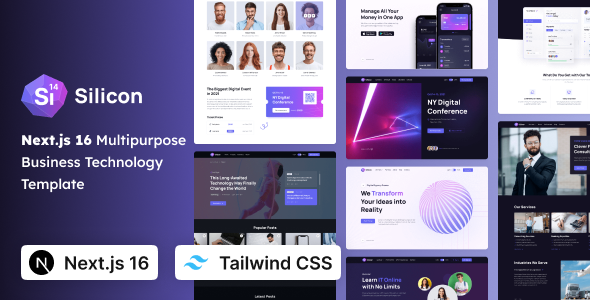
Silicon - Multipurpose Business, SaaS & Technology Tailwind CSS Next Template Silicon - Multipurpose Business, SaaS & Technology Tailwind CSS Next Template...

Coral - Multipurpose React Js Landing Template Coral - Multipurpose React Js Landing Template is a modern, responsive, and professionally designed landing...
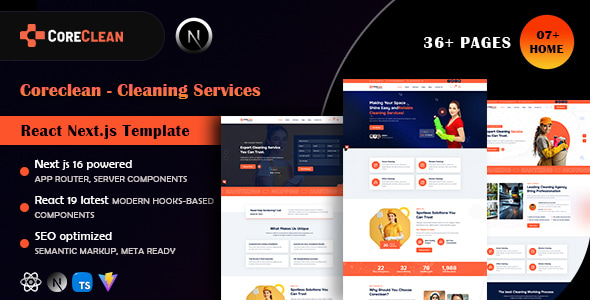
Coreclean - Cleaning Services React Next.js Template Coreclean - Cleaning Services React Next.js Template is a modern and professional website template designed...
