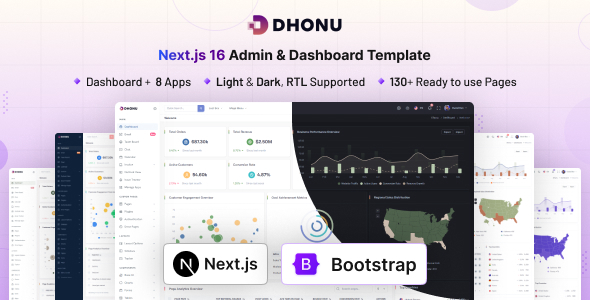
Dhonu – Next.js Admin & Dashboard Template is a modern dashboard template designed for developers, startups, businesses, and software teams building web applications with Next.js. It provides a structured frontend interface for administrative panels, data management systems, analytics dashboards, and business applications. Moreover, its reusable design approach helps developers create consistent user interfaces while reducing repetitive layout work.
Dhonu is a suitable starting point for projects that need a professional dashboard experience. You can customize its layouts, colors, navigation, and interface components to match your application requirements. As a result, you can build a consistent foundation for managing business information and presenting important data.
Dhonu focuses on providing a dashboard-oriented interface for modern web development. Its exact components and available pages depend on the supplied product package.
Next.js-Based Structure: Build your frontend using Next.js, a React framework for developing modern web applications. Developers can integrate the template into compatible projects and customize its structure as needed.
Modern Dashboard Layout: Organize important information into clear sections. Dashboard pages can present business statistics, recent activities, summaries, and other relevant data when connected to the appropriate data sources.
Reusable UI Components: Maintain a consistent interface across your application by reusing common design elements. Available components depend on the included package.
Organized Navigation: Create a clear navigation system that helps users move between dashboard pages, settings, reports, and management sections.
Responsive Interface: Adapt the dashboard layout for desktop computers, tablets, and mobile devices, subject to the template’s implementation.
Customizable Styling: Adjust colors, typography, spacing, and other visual elements to match your application’s branding.
Developer-Friendly Foundation: Customize the frontend and connect it to suitable APIs or backend services to support your application’s requirements.
Dhonu can serve as a frontend foundation for a wide range of business and software projects. Its administrative layout makes it adaptable to different industries and application types.
Furthermore, developers can customize the layout to support their specific workflows. For example, a CRM application may need customer tables and lead summaries, while an analytics platform may prioritize charts and reporting screens.
An effective dashboard helps users understand important information quickly. Dhonu can provide a visual foundation for presenting statistics, summaries, and application data in an organized layout.
For example, a sales dashboard might display total revenue, active customers, pending orders, and recent transactions. Similarly, a project management dashboard could highlight open tasks, completed projects, and upcoming deadlines.
Charts and tables can make complex information easier to review. However, live data requires integration with a database, API, or another suitable data source.
Depending on the components included in the package, you may need to configure a charting library or develop custom visualizations. Therefore, review the demo and documentation to confirm which dashboard elements are available.
Next.js builds on React and supports the development of modern web applications. Dhonu gives developers a starting point for building dashboard interfaces within a Next.js project.
Developers familiar with React can customize components, organize pages, and adapt the interface to their application’s structure. The available routing approach, rendering strategy, and project organization depend on the template’s implementation.
You can also integrate compatible libraries for forms, charts, tables, and other interface requirements. In addition, you may connect the frontend to external APIs or backend services to retrieve and update application data.
Before beginning development, check the supplied package for its Next.js version, React version, package manager, dependencies, and setup instructions. This step can help prevent compatibility problems during installation.
Administrative applications often use forms and tables to manage business information. Dhonu can provide a consistent visual foundation for these common interface patterns.
Forms may support screens for creating records, editing user information, updating settings, or submitting data. Tables can organize customer records, product lists, transactions, and other structured information.
Depending on the included components, you may be able to customize input fields, buttons, cards, navigation menus, dropdowns, and status indicators. Reusing these elements helps maintain a consistent design across different pages.
However, visual components do not automatically provide complete application functionality. Developers must implement form validation, data processing, API requests, error handling, and database operations as required.
A dashboard should reflect your product’s identity while remaining easy to use. Dhonu provides a starting point that developers can customize for their business or client projects.
You can adapt colors, typography, spacing, page layouts, and navigation elements to suit your branding. For example, a financial application may need a compact interface with detailed tables, while a SaaS product may prioritize summary cards and simplified navigation.
You can also remove unnecessary interface elements and create new pages for your application-specific requirements. This flexibility helps you maintain a focused user experience.
Before making extensive changes, review the component structure and styling approach. Following the template’s existing conventions can make future maintenance easier.
Dhonu is an admin and dashboard frontend template, not automatically a complete backend application. A fully working product may require additional services and development.
You can connect the interface to a backend built with Laravel, Node.js, PHP, or another suitable technology. The integration depends on the APIs you create and the requirements of your application.
For example, authentication may require login endpoints, session management, or token-based access. User management may need database operations and role-based permissions. Likewise, dashboard statistics require reliable data sources and appropriate business logic.
Security should remain a priority throughout development. Validate inputs on the server, protect sensitive endpoints, enforce permissions, and store secret credentials outside publicly accessible frontend code.
A dashboard should remain usable across different devices. Dhonu can provide a starting point for creating interfaces that adapt to desktop, tablet, and mobile screens.
Use clear navigation labels, readable text, and consistent spacing. Keep important actions easy to find, and avoid displaying too much information in a single section.
Additionally, test tables, forms, charts, and navigation menus on smaller screens. Complex tables may require horizontal scrolling or an alternative mobile layout.
Consider adding loading indicators, clear error messages, and useful empty states when connecting the interface to live data. These details help users understand what is happening when the application loads information or encounters a problem.
Good performance improves the overall dashboard experience. Developers can optimize their implementation by using appropriate Next.js features and avoiding unnecessary dependencies.
Optimize images and other static assets where needed. Review package dependencies and remove components that the application does not use. In addition, avoid unnecessary API requests and process large datasets efficiently.
The best rendering strategy depends on the application. Some pages may benefit from server rendering, while interactive dashboard components may require client-side functionality. Follow the template’s existing implementation and the official framework guidance when making changes.
Test the application after modifying dependencies or upgrading framework versions. This helps identify build errors, layout issues, and compatibility problems before deployment.
Administrative dashboards are often private or authenticated, so SEO may not be their primary purpose. However, public-facing pages associated with your application can benefit from good SEO practices.
For example, a SaaS product may have public landing pages, feature descriptions, documentation, and pricing pages. These pages can use clear titles, descriptive content, meaningful headings, and optimized images.
Configure metadata appropriately for public pages and review indexing settings for private sections. Avoid exposing confidential information through public routes or search engine indexes.
SEO requirements depend on your application’s purpose. Focus on discoverability for public content while protecting private dashboards and user data.
Dhonu may be suitable for frontend developers, React developers, Next.js developers, software agencies, startups, and businesses building custom web applications.
It can help teams establish a dashboard interface before implementing application-specific backend functionality. Freelancers and agencies can also use the template as a starting point for client projects, subject to its license terms.
Before purchasing, review the live demo, included pages, source files, dependencies, documentation, and supported framework versions. Confirm that the package matches your development requirements and intended project scope.
Dhonu offers a structured starting point for building modern administrative interfaces with Next.js. Its dashboard-focused design can help developers organize application pages and create a consistent frontend experience.
Moreover, its customizable structure allows developers to adapt the interface to different industries and business workflows. You can extend the frontend with APIs, databases, authentication systems, and other services as your project develops.
For the best results, combine the template with clean component organization, secure backend integration, responsive design, and thorough testing. Always verify the included functionality before making a purchase.
Dhonu – Next.js Admin & Dashboard Template is a useful starting point for developers who want to create modern admin panels, SaaS dashboards, analytics interfaces, and business management applications.
With thoughtful customization and suitable backend integration, you can adapt the template to your project’s requirements. Review its documentation, dependencies, and included components before installation to ensure compatibility with your Next.js development workflow.
1. All digital products are the most recent version, with no possibility of free updates. After payment, you can request an update to the most recent version for 5 days if a new version is released. We free support within 5 days.
2. If a license is required (Excludes WHMCS license , we provide only method not license), please contact us via email or ticket for assistance with activation. Our license is only valid for activation and does not include support.
3. We provide Mobile, PHP script installation services for $19.90 / ₹1700. Please create a backup after installation as we do not support re-installation. For mobile app source code, we do not offer installation services.
4. If you have any questions, please contact us by email [email protected] or create a ticket on this page
5. Please note that any digital products presented on the website do not contain malicious code, viruses or advertising. You will receive the original files from the developers. We do not sell any products that have been downloaded from other websites.
6. The response time can last up to 6 hours.

Ornato - NextJS Elegant Jewelry Store Landing Page Template Ornato is a luxurious and professionally crafted NextJS landing page template designed specifically...

Matterly - AI Law Firm Management SaaS With Smart Forms Matterly is a modern and intelligent law firm management SaaS platform designed...

Cyber Cube Runner 3D | Cyberpunk Endless Space Runner HTML5 Game Enter a futuristic digital universe with Cyber Cube Runner 3D |...
Admina - Tailwind & Nextjs Admin Dashboard with shadcn UI Admina - Tailwind & Nextjs Admin Dashboard with shadcn UI is a...
