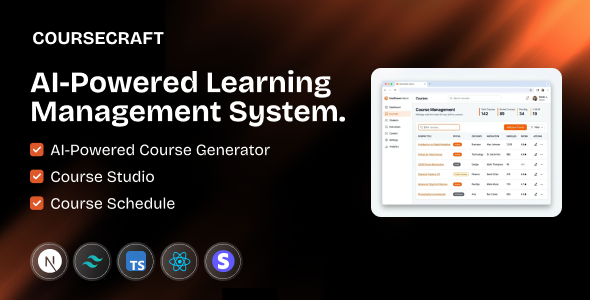
CourseCraft – AI Learning Management System Script for Next.js is a modern software solution designed for entrepreneurs, educators, training organizations, online course creators, and developers who want to build an AI-powered learning platform using Next.js. Combining the concept of a digital learning management system with artificial intelligence, CourseCraft provides a foundation for creating an online education experience where learning materials, course content, and educational workflows can be organized within a web-based platform. It is suitable for businesses exploring online education, instructors looking to expand their digital teaching activities, and developers interested in launching a customizable learning platform.
Online learning continues to provide opportunities for educators and businesses to deliver training beyond traditional classrooms. A dedicated learning management system can help organize educational resources, structure courses, and provide students with a central place to access learning materials. CourseCraft is positioned for this type of application, with an AI-focused approach that may support more efficient educational content workflows depending on the functionality included in the script.
Built around the Next.js development ecosystem, CourseCraft can be an option for developers and technology teams seeking a modern foundation for an online learning application. Before deployment, review the official product documentation to confirm the included AI features, user roles, course management capabilities, technology requirements, and available integrations.
Artificial intelligence is creating new possibilities for online education, from assisting with educational content creation to supporting personalized learning experiences. CourseCraft brings together the concepts of AI and learning management in a software product intended for modern digital education environments.
An AI-enabled learning platform may help educators explore more efficient ways to prepare learning resources, organize course materials, or support student learning workflows. Depending on the implemented functionality, CourseCraft may provide tools that help simplify selected educational tasks and improve the overall course delivery process.
For example, an online training business might use an LMS to organize lessons and make learning resources available through a centralized platform. AI-related capabilities, where supported, could provide additional assistance with specific educational activities.
The exact AI models, automation tools, and supported workflows should be verified in the product’s official documentation rather than assumed from its name.
Next.js is a React-based web development framework used to build modern web applications. It provides developers with tools for structuring application pages, handling rendering strategies, organizing routes, and developing responsive user experiences.
CourseCraft’s Next.js foundation makes it relevant to developers who work with the React ecosystem and want to explore a learning management application built on modern web technologies.
Developers can evaluate the source code, architecture, dependencies, and configuration options to determine how the application fits their technical requirements. Depending on the project’s implementation and licensing terms, the codebase may also provide a starting point for further customization.
A Next.js application still requires appropriate configuration, hosting, environment variables, and any required backend services or database connections. Review the included setup instructions to understand the actual deployment process and technical dependencies.
Course organization is an essential part of any learning management system. A structured course experience allows educators to present information in a logical sequence and helps students navigate their learning materials more easily.
CourseCraft is intended for the online learning software category, making course management an important area to evaluate when considering the script. Depending on its available functionality, the platform may support workflows for organizing courses, preparing lessons, and presenting educational content.
An online course can cover a wide range of subjects, including programming, business management, marketing, design, professional development, academic learning, and technical training.
Before purchasing, verify the actual course creation tools, lesson formats, curriculum structure, content upload options, and publishing controls included in CourseCraft. These details determine whether the script is suitable for your intended educational model.
Creating useful educational material requires planning, research, writing, and regular updates. AI tools can potentially assist educators with selected content-related tasks, helping them explore new ways to organize information and prepare learning resources.
CourseCraft’s AI-focused positioning makes it relevant to organizations interested in combining educational delivery with artificial intelligence. The precise content-generation capabilities, however, depend on the features implemented in the script.
Possible AI-assisted educational workflows across this product category include generating draft lesson outlines, preparing quiz questions, summarizing learning materials, and developing explanations for complex topics. These are examples of common AI learning applications, not a verified list of CourseCraft features.
Educators should review AI-generated materials for accuracy, clarity, relevance, and suitability for their learners before publishing them. Human review remains important for technical subjects, academic content, professional training, and other areas where incorrect information could cause problems.
A well-designed learning management system should make educational content easy to access and navigate. Students benefit from a clear structure that helps them understand where to begin, which lessons are available, and how learning materials are organized.
CourseCraft can be evaluated as a foundation for a student-facing learning platform. Depending on the included functionality, a deployment may provide an interface through which learners access relevant educational content and interact with the learning environment.
For online education businesses, the student experience should remain simple and consistent across different devices. Clear course descriptions, readable lesson content, and intuitive navigation can help students focus on learning rather than figuring out how to use the platform.
Review the official product screenshots and documentation to confirm which student-facing features are included, such as dashboards, lesson progress tracking, course access controls, or learning history.
CourseCraft may be relevant to businesses and individuals who want to explore the development of a web-based education platform. Its application depends on the available features and the level of customization required.
Potential use cases include:
Each use case may require different features, such as paid course access, certificates, student assessments, instructor accounts, or reporting tools. Verify that the script supports your requirements before selecting it for a production project.
Educational platforms can support many forms of learning content, depending on their supported formats and technical implementation. These may include written lessons, downloadable resources, presentations, videos, assignments, and assessments.
CourseCraft can be assessed for its ability to organize the types of content your educational business intends to deliver. For example, a programming course may require code examples and downloadable project files, while a business training program may rely on videos, reading materials, and practical exercises.
The supported content formats and upload limits should be checked against the official documentation. Additional integrations may be required for specialized media hosting, interactive learning activities, or external educational tools.
Organizing content into clearly defined modules and lessons can help create a more coherent learning experience and make it easier to maintain courses as information changes.
Students may access online courses using desktop computers, tablets, or smartphones. A responsive interface helps ensure that course information remains accessible across different screen sizes.
As part of evaluating CourseCraft, review how its pages, navigation, course content, and interactive components behave on mobile devices. If the source code is available for customization under the applicable license, developers may be able to refine the interface to better match their learners’ needs.
Accessibility is also an important consideration for online education. Readable typography, meaningful headings, keyboard navigation, descriptive labels, and appropriate contrast can improve usability for a wider range of learners.
Responsive behavior and accessibility should be tested in the deployed application rather than assumed solely from the framework used to build it.
Educational businesses often want their platforms to reflect a distinctive brand identity. A customized learning website can help create a consistent experience across course pages, educational resources, and student-facing interfaces.
Depending on the project’s architecture and license, CourseCraft may provide a starting point for customizing colors, typography, logos, page layouts, navigation, and other visual elements.
You can adapt the branding to suit an individual educator, a professional training company, a technology academy, or an online education startup. Consistent visual elements and clear messaging can help learners recognize the platform and understand its purpose.
The scope of customization depends on the included source code, available configuration options, and any restrictions specified by the product’s license.
For businesses planning to sell educational content, monetization is an important part of platform selection. Different learning businesses may offer one-time course purchases, recurring subscriptions, membership access, corporate training packages, or free educational resources.
CourseCraft may be evaluated as a possible foundation for a commercial learning platform, but the availability of payment and monetization features must be confirmed before purchase.
Check whether the script supports payment gateways, pricing plans, subscription management, discount codes, paid course access, invoices, or order management. If these capabilities are not included, additional integrations or custom development may be necessary.
For paid educational services, test the full purchase and access process carefully, including successful payments, failed transactions, refunds, and changes to course permissions. Clear pricing information and transparent refund policies are also important for a professional learning business.
SEO can help prospective learners discover courses through search engines. A well-structured education website can make it easier for search engines and visitors to understand the topics covered by each course.
Because CourseCraft is built around Next.js, developers can evaluate its rendering approach, page metadata, routing, and content structure when planning search optimization. The framework offers tools that can support SEO implementation, but the final results depend on how the application is configured.
Useful optimization tasks may include writing descriptive page titles, preparing informative course descriptions, organizing content with meaningful headings, optimizing images, and linking related educational pages.
If course information is publicly accessible, creating useful landing pages for relevant subjects can help communicate the value of each learning program. Private course materials should remain protected by the appropriate authentication and authorization controls.
Search rankings are not guaranteed by using Next.js or installing a particular script. SEO performance depends on technical implementation, content quality, competition, and ongoing optimization.
CourseCraft requires a suitable development and deployment environment based on its actual project dependencies. Before installation, review the official requirements for the Node.js version, package manager, database, environment variables, external APIs, and any additional services used by the application.
A typical setup process may involve obtaining the source package, installing dependencies, configuring environment variables, preparing the required database or backend services, and starting the application according to the developer’s instructions.
For production deployment, developers should also configure an appropriate hosting environment, secure API credentials, enable HTTPS, and establish a backup and update process.
If the platform relies on external AI services, verify whether API keys, usage limits, or separate subscription fees apply. AI-related operating costs can be separate from the initial script purchase.
Testing the application locally or in a staging environment before public launch can help identify configuration issues and compatibility problems.
A learning management system may handle user accounts, course access information, learning activity, and other sensitive operational data. Appropriate security controls are important when deploying any education platform.
Before launching CourseCraft, review its authentication mechanisms, role permissions, data handling practices, and protection of restricted course content. Keep application dependencies updated and ensure that server-side authorization checks prevent unauthorized access to private resources.
If AI integrations process user prompts or educational content, understand what information is transmitted to external providers and review the applicable data processing policies.
Regular backups, secure environment variables, access restrictions, and appropriate logging can help support ongoing maintenance. Businesses that collect personal information from learners should also provide appropriate privacy disclosures and comply with relevant data protection requirements.
Specific security features and certifications should be verified through the source code and official product documentation.
CourseCraft is worth evaluating for developers, educators, and entrepreneurs interested in the intersection of online learning, AI, and modern web application development.
Potential advantages of choosing a script in this category include:
The exact benefits depend on the features included in the purchased version, the project’s technical quality, and the additional development required for your intended business model.
CourseCraft – AI Learning Management System Script for Next.js is a software product aimed at users interested in developing modern online education platforms with an AI-focused approach. Its Next.js foundation makes it relevant to developers working in the React ecosystem, while its learning management focus may appeal to educators, training providers, and entrepreneurs exploring digital education.
Before using the script for a production learning business, verify its actual course management tools, AI capabilities, user roles, payment options, database requirements, and deployment instructions. These details will help determine how well it fits your project and what additional development may be required.
For a digital products marketplace, CourseCraft can be positioned as a Next.js learning management system script for buyers researching AI-oriented education software. A precise, feature-verified product listing will help customers understand the solution and make an informed purchasing decision.
1. All digital products are the most recent version, with no possibility of free updates. After payment, you can request an update to the most recent version for 5 days if a new version is released. We free support within 5 days.
2. If a license is required (Excludes WHMCS license , we provide only method not license), please contact us via email or ticket for assistance with activation. Our license is only valid for activation and does not include support.
3. We provide Mobile, PHP script installation services for $19.90 / ₹1700. Please create a backup after installation as we do not support re-installation. For mobile app source code, we do not offer installation services.
4. If you have any questions, please contact us by email [email protected] or create a ticket on this page
5. Please note that any digital products presented on the website do not contain malicious code, viruses or advertising. You will receive the original files from the developers. We do not sell any products that have been downloaded from other websites.
6. The response time can last up to 6 hours.
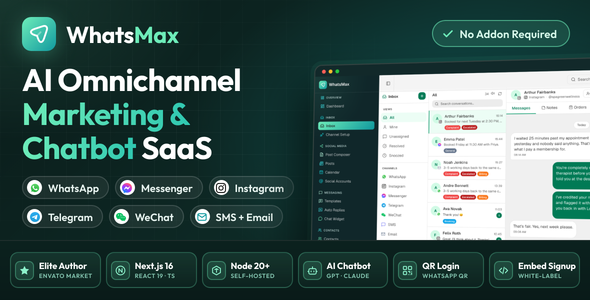
WhatsMax | AI Omnichannel Marketing, Automation and Chatbot SaaS NodeJS Script WhatsMax is a powerful AI-driven omnichannel marketing, automation, and chatbot SaaS...
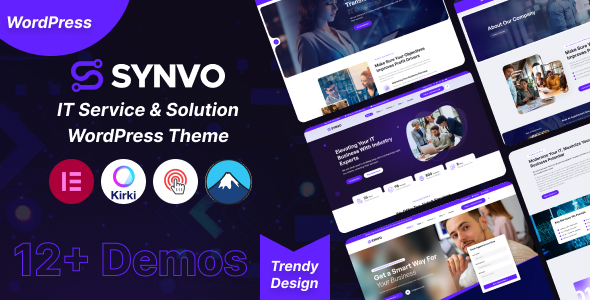
Synvo – IT Service & Solution WordPress Theme Synvo – IT Service & Solution WordPress Theme is a modern, professional, and technology-focused...
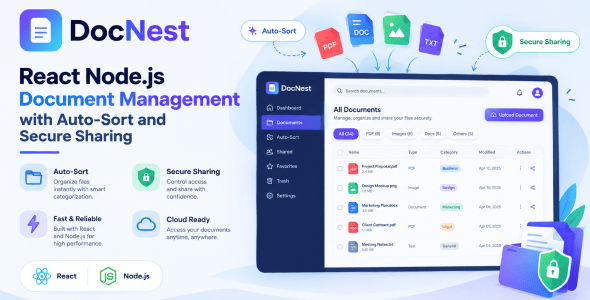
DocNest | React Node.js Document Management with Auto-Sort and Secure Sharing DocNest is a modern and intelligent document management platform built with...
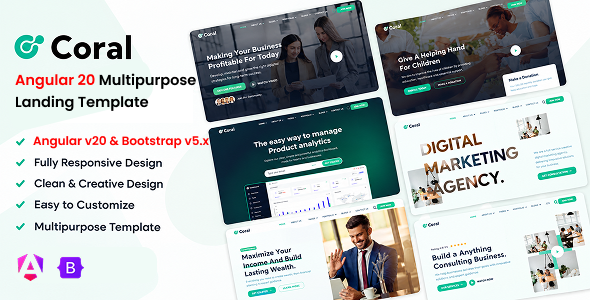
Coral - Angular 20 Multipurpose Landing Template Coral - Angular 20 Multipurpose Landing Template is a modern, responsive, and professionally crafted landing...
