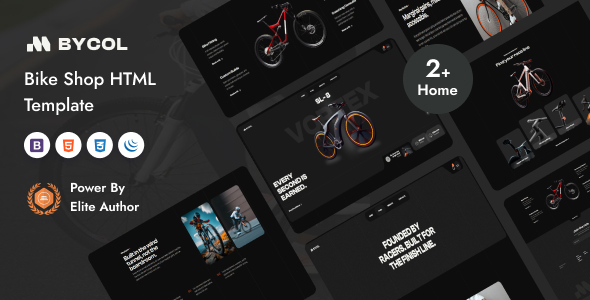
Bycol – Bike Shop HTML Template is a modern and visually appealing website template designed for bicycle shops, bike retailers, cycling equipment stores, bicycle repair services, and businesses operating in the cycling industry. With a product-focused design approach, Bycol provides a foundation for building a professional online presence where businesses can showcase bicycles, highlight cycling accessories, introduce repair services, and connect with cycling enthusiasts.
The cycling industry serves a diverse audience, including commuters, recreational riders, mountain biking enthusiasts, professional cyclists, and customers searching for reliable bicycle maintenance. A well-designed website helps businesses present their products and services clearly while making it easier for potential customers to explore available options. Bycol is intended to support these goals by providing a customizable HTML-based website structure suitable for bicycle-related businesses.
Whether you operate a local bicycle showroom, sell mountain bikes and road bikes, provide bicycle servicing, or specialize in cycling accessories, Bycol can serve as a starting point for creating a website that reflects your brand identity. Developers can customize the template’s content, colors, images, layouts, and navigation to suit the business’s specific requirements.
A bicycle shop website should combine attractive product presentation with straightforward navigation and useful information. Customers often want to compare different bicycle styles, review specifications, explore accessories, and find information about servicing or purchasing options.
Bycol is designed for the bicycle retail and cycling market, making it suitable for a website that emphasizes product discovery and brand presentation.
A customized implementation can incorporate high-quality bicycle photography, organized product sections, bold headings, clear calls to action, and visually distinct content areas. These elements can help create a professional shopping experience while reflecting the energy and lifestyle associated with cycling.
For example, a mountain bike retailer might emphasize rugged bicycles and outdoor riding, while a premium road bike showroom could focus on lightweight designs, performance features, and professional cycling equipment. A neighborhood bicycle store might prioritize everyday bicycles, affordable accessories, and repair services.
The template’s visual presentation can be adapted to match the business’s preferred style and target audience.
Bycol can be customized for several businesses within the bicycle and cycling industry.
Bicycle Retail Stores: Present available bicycles, product categories, brand information, and purchasing options.
Mountain Bike Shops: Showcase mountain bikes, trail-riding equipment, protective gear, and related accessories.
Road Bike Retailers: Highlight road bicycles, performance cycling equipment, lightweight components, and specialist products.
Electric Bicycle Businesses: Introduce e-bikes, explain relevant product specifications, and present available models.
Bicycle Repair Shops: Promote maintenance, servicing, repairs, and other workshop services.
Cycling Accessories Stores: Display helmets, gloves, lights, locks, pumps, clothing, and other cycling essentials.
Professional Cycling Equipment Retailers: Present performance-oriented products and equipment for experienced riders.
Local Bicycle Dealers: Provide store information, opening hours, contact details, and product inquiries.
Cycling Communities and Clubs: Adapt suitable sections to introduce cycling activities, events, and community information.
The final website structure should reflect the actual services and products offered by the business.
Product presentation is an important part of a bicycle retail website. Customers often compare multiple bicycle types before deciding which model best suits their needs, budget, and riding style.
A website built with Bycol can be customized to organize products into clear categories, making browsing more convenient.
Potential categories include:
Each category can contain product photographs, short descriptions, and links to more detailed information.
For example, a mountain bike category could introduce bicycles designed for trail riding, while a commuter bicycle category could focus on practical features for everyday transportation.
The exact category layouts available in the original template should be confirmed from its supplied files. Additional product sections can be created by modifying the HTML and CSS when necessary.
Customers researching bicycles often need more than a product photograph. They may want to understand the frame material, wheel size, gear configuration, braking system, suspension, intended use, and available sizes.
A customized Bycol website can provide structured product information to help visitors compare available models.
A product detail page could include:
Accurate specifications are especially important for bicycles because the right configuration depends on the customer’s intended use, physical fit, riding conditions, and budget.
If Bycol includes product detail layouts, developers can customize them with the retailer’s information. If the template only provides general page layouts, dedicated product pages may need to be developed.
Dynamic product filtering, stock management, and automatically updated prices require additional functionality unless explicitly included in the package.
A bicycle store can increase the usefulness of its website by presenting accessories alongside its primary bicycle offerings.
Customers may need helmets, gloves, cycling jerseys, water bottles, lights, locks, pumps, repair kits, racks, and other equipment to support their riding experience.
Bycol can be adapted to showcase these products through category sections, featured product areas, and dedicated content pages.
Each accessory listing can include a product image, a concise description, relevant specifications, and a suitable call to action.
For instance, a helmet listing might highlight available sizes and safety certifications, while a bicycle light listing could describe its intended use, mounting method, and power source.
Retailers should ensure that all technical claims, product specifications, safety information, and warranty details are accurate and supported by manufacturer documentation.
A well-organized accessories section can also help customers discover complementary products while exploring bicycles.
Many bicycle businesses offer repair and maintenance services in addition to retail products. A dedicated services section can help customers understand what the workshop provides.
A customized Bycol website could present services such as routine bicycle maintenance, brake adjustments, gear tuning, tire replacement, puncture repairs, chain replacement, wheel truing, and general bicycle inspections.
Each service description can explain what is included, when the service may be useful, and how customers can request assistance.
For example, a basic maintenance service might cover a general inspection and selected adjustments, while a more comprehensive service could involve additional component checks.
The exact services should reflect the business’s capabilities and policies.
If the retailer accepts workshop appointments, developers can integrate an appropriate appointment scheduling tool or build a booking workflow. An HTML template does not automatically provide appointment management unless that feature is explicitly included.
Customers may browse bicycle products from a desktop computer, tablet, or smartphone. A responsive website helps maintain usability across different screen sizes.
When implemented with appropriate responsive styling, Bycol can be adapted to display product images, navigation menus, text, and content sections across different devices.
A mobile-friendly bicycle website should make it easy for visitors to browse categories, inspect product details, find store contact information, and access purchase or inquiry links.
Important considerations include readable text, appropriately sized buttons, accessible navigation, and product photographs that display clearly without unnecessary cropping.
Developers should test the supplied template across common screen sizes and browsers before deployment. Responsive support and actual performance should be verified from the source code rather than assumed from the product name.
Bycol is an HTML website template, making it a potential starting point for developers who want to create a customized bicycle retail website.
Depending on the supplied package, the source files may include HTML pages, CSS stylesheets, JavaScript files, images, fonts, and other front-end resources. The actual structure, framework, and dependencies should be confirmed through the official product documentation.
Developers familiar with HTML, CSS, and JavaScript can adapt the source code to match the retailer’s branding and business requirements.
Common customization tasks include:
Because HTML templates primarily provide front-end layouts, a separate backend or content management system may be required for features such as dynamic product management, inventory synchronization, user accounts, or order processing.
A bicycle retailer may want to use its website to generate product inquiries, direct customers to an existing online store, or sell products directly through an integrated e-commerce system.
Bycol can provide a front-end design foundation for these approaches, depending on the available layouts and the retailer’s requirements.
Product inquiry website: Display bicycles and accessories with contact buttons that allow customers to request availability, specifications, or quotations.
Catalog website: Present products and categories without processing transactions directly on the website.
Affiliate or external retail website: Direct visitors to a separate purchasing platform using appropriate product links.
Integrated online store: Connect the front-end design to an e-commerce platform or custom backend that supports product management and checkout.
A working online store generally requires additional components for shopping carts, checkout, payment processing, inventory management, order confirmation, and customer information handling.
These functions should not be assumed to be included in Bycol merely because it is designed for a retail business. The actual product documentation should be reviewed before selecting it for an e-commerce project.
Search engine optimization can help potential customers discover a bicycle shop when searching for bicycles, cycling accessories, or repair services.
Bycol can be customized with descriptive page titles, relevant meta descriptions, logical headings, informative product content, and meaningful image alternative text.
A bicycle retailer can also create pages focused on specific product categories, services, and geographic locations.
Useful SEO practices include:
For local bicycle shops, location-specific content can help customers find nearby retail stores and repair services.
Product-related content should be accurate and useful rather than simply repeating search keywords. Search visibility also depends on competition, website quality, technical implementation, and ongoing SEO efforts.
A smooth browsing experience helps customers explore bicycle models and accessories without unnecessary delays.
Product photography can significantly affect website performance, particularly when pages contain multiple large images. Developers should resize and compress images appropriately and consider modern formats such as WebP or AVIF when supported.
Other performance improvements may include minimizing unnecessary scripts, reducing unused CSS, configuring caching, and enabling suitable server-side compression.
Navigation links, interactive elements, and inquiry forms should be tested to ensure they function correctly.
Performance should be evaluated after customization because the final result depends on the number of images, page complexity, third-party services, and hosting environment.
Customers may need reassurance about a bicycle’s suitability, product availability, store reliability, and after-sales services before making a purchase.
A well-organized website can provide information that helps answer these questions.
A customized Bycol website could include sections describing the retailer’s background, customer service approach, available brands, workshop capabilities, warranty policies, and frequently asked questions.
Potential FAQ topics include bicycle sizing, selecting a bicycle for commuting, maintenance requirements, accessory compatibility, repair appointments, and product availability.
Where appropriate, the website can also provide customer testimonials or links to genuine reviews.
Transparent product information and accurate service descriptions help customers make informed decisions and establish realistic expectations.
The final page structure depends on the actual layouts included with Bycol. Depending on the business’s requirements, a customized website could include the following pages:
These are suggested implementation possibilities and should not be interpreted as a guarantee that every page is included in the original template.
Bicycle Shop Owners: Create a professional website for presenting bicycles, accessories, and retail services.
Cycling Equipment Retailers: Organize products into categories and help customers explore available equipment.
Bicycle Repair Businesses: Promote maintenance services and provide contact information for workshop inquiries.
Electric Bike Dealers: Present e-bike models, specifications, and purchasing information.
Web Designers and Freelancers: Use the HTML source as a starting point for bicycle-related client projects, subject to the applicable license.
Digital Agencies: Develop customized websites for businesses operating in the cycling and sporting goods industries.
Cycling Brands: Create a product-focused promotional website or a front-end foundation for a larger digital experience.
Bycol is most suitable for projects that need a customizable front-end website and can accommodate additional development where dynamic functionality is required.
Before purchasing or deploying Bycol, review the official product documentation and included files to confirm the template’s actual capabilities.
Check the available pages, responsive behavior, browser compatibility, JavaScript dependencies, CSS framework, image assets, and installation instructions. Confirm whether the package includes functional forms or only their visual layouts.
Review the license and the permitted use of any bundled images, fonts, icons, and third-party assets.
If your project requires a complete e-commerce system, dynamic product filtering, inventory management, customer accounts, online payments, or workshop appointment scheduling, determine whether these features are included or require additional development.
An HTML template should generally be treated as a front-end design foundation rather than a complete online store or inventory management system.
Bycol – Bike Shop HTML Template is designed for bicycle retailers and cycling-related businesses seeking a customizable website foundation. Its product-focused purpose makes it relevant to bicycle shops, mountain bike retailers, electric bicycle dealers, cycling accessory stores, and bicycle repair businesses.
With appropriate customization, the website can showcase bicycle categories, present product specifications, promote repair services, highlight accessories, and make essential business information easy to find.
Its HTML-based structure provides developers with flexibility when adapting the website to a retailer’s branding and requirements. Additional integrations can support e-commerce, appointment scheduling, or dynamic product management when needed.
For businesses looking to establish or improve their online presence in the cycling industry, Bycol can serve as a useful starting point for building a professional, informative, and visually engaging website.
Product Information:
1. All digital products are the most recent version, with no possibility of free updates. After payment, you can request an update to the most recent version for 5 days if a new version is released. We free support within 5 days.
2. If a license is required (Excludes WHMCS license , we provide only method not license), please contact us via email or ticket for assistance with activation. Our license is only valid for activation and does not include support.
3. We provide Mobile, PHP script installation services for $19.90 / ₹1700. Please create a backup after installation as we do not support re-installation. For mobile app source code, we do not offer installation services.
4. If you have any questions, please contact us by email [email protected] or create a ticket on this page
5. Please note that any digital products presented on the website do not contain malicious code, viruses or advertising. You will receive the original files from the developers. We do not sell any products that have been downloaded from other websites.
6. The response time can last up to 6 hours.
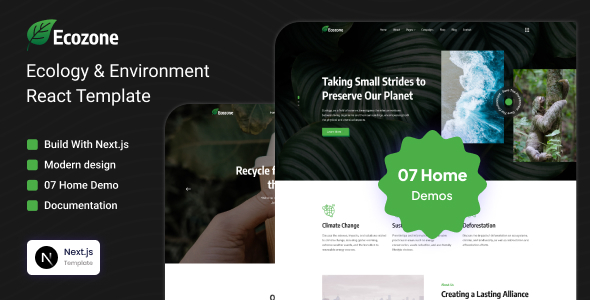
Ecozone – Ecology & Environment Next.js Template Ecozone is a modern, clean, and nature-inspired Ecology & Environment Next.js Template designed for environmental...
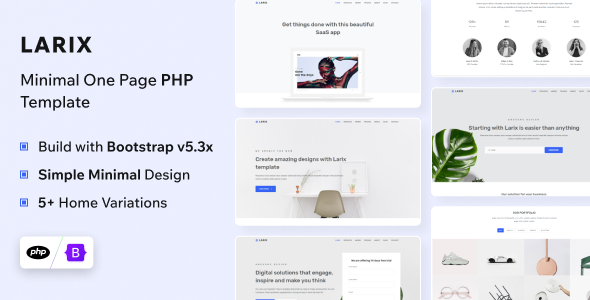
Larix - PHP Landing Page Template Larix is a modern and highly versatile PHP landing page template designed for startups, SaaS businesses,...
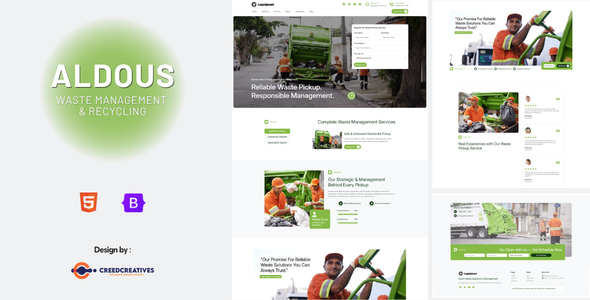
Aldous – Waste Pickup & Management HTML Bootstrap Template Aldous is a modern, professional, and environmentally focused Waste Pickup & Management HTML...
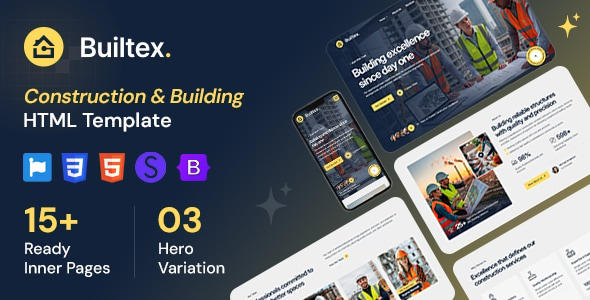
Builtex - Construction HTML Template Builtex is a modern and professionally designed HTML template created specifically for construction companies, building contractors, engineering...
