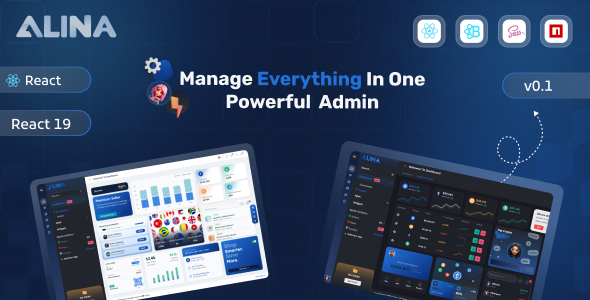
Alina React 19 + Typescript Admin Dashboard Template is a modern administrative dashboard template designed for developers, businesses, startups, and software teams looking to build professional web application interfaces. Built around React 19 and TypeScript, Alina provides a foundation for creating organized admin panels, business management dashboards, internal tools, and data-driven application interfaces.
A well-structured admin dashboard helps users manage information, navigate application features, and monitor important business activities from a centralized workspace. Alina is intended to support this process with a customizable interface that developers can adapt to different project requirements, business workflows, and visual identities.
Whether you are developing a SaaS platform, a customer management system, an analytics dashboard, or an internal business application, Alina React 19 + Typescript Admin Dashboard Template can serve as a starting point for building a consistent and maintainable administrative interface.
An effective administrative dashboard should present information clearly and make frequently used functions easy to access. Alina can be customized to provide a structured workspace where administrators can review relevant data, navigate between application sections, and perform routine management tasks.
A dashboard interface may include summary cards, navigation menus, data tables, charts, forms, and application settings, depending on the components supplied with the template. These elements can be organized around the needs of a particular business rather than forcing every project into the same workflow.
The interface can be adapted for different industries, including technology, e-commerce, professional services, finance, education, and customer support. Developers can customize labels, content, visual styling, and navigation to create an administration experience that aligns with the intended application.
React is a widely used JavaScript library for building component-based user interfaces. React 19 introduces improvements to the React development experience and provides capabilities that developers can use when building modern web applications.
Alina React 19 + Typescript Admin Dashboard Template gives developers a starting point within the React ecosystem. Its component-oriented approach can help organize interface elements into reusable building blocks, making it easier to maintain consistent layouts and extend existing screens.
Developers can customize dashboard sections, introduce new application views, and adapt existing components to match specific requirements. Reusable components can also reduce duplication when the same interface patterns appear across multiple pages.
The exact React configuration, project structure, supported dependencies, and build tooling should be confirmed in the product documentation before installation.
TypeScript extends JavaScript with static typing, helping developers identify certain programming errors during development and describe the expected structure of application data.
The inclusion of TypeScript in Alina can be useful for projects that benefit from more explicit component properties, data models, and function definitions. These practices can improve code readability and make larger applications easier to maintain as their requirements grow.
For example, developers may define types for customer records, dashboard metrics, user profiles, service requests, or application settings. Typed interfaces can make it easier to understand how data moves between components and identify mismatches during development.
TypeScript does not eliminate every runtime error, but it can support a more predictable development workflow when used consistently.
Business dashboards often provide a quick overview of important operational information. Alina can be adapted to display relevant metrics and summaries that help administrators understand the current state of an application.
Depending on the included components, dashboard sections may be configured to present totals, activity summaries, recent records, performance indicators, or other business-specific information.
For example, an e-commerce administration panel could display order statistics, customer counts, and sales summaries. A service management application could present open requests, completed tasks, and pending activities.
The most useful dashboard is one that prioritizes actionable information rather than overwhelming users with unnecessary numbers. Developers should organize metrics according to the responsibilities of the people using the application.
Live statistics, automatic refreshes, and calculations based on actual business data require suitable data sources and application logic.
Data tables are commonly used in administrative applications to organize large amounts of structured information. Depending on the components included, Alina can be adapted to display records in a clear and manageable format.
Potential applications include customer directories, employee records, order histories, product inventories, support tickets, and transaction listings.
Developers may customize table columns, labels, status indicators, and record actions. Additional capabilities such as sorting, search, filtering, pagination, bulk actions, and export functionality can be implemented where they are not already available.
When working with large datasets, the interface should remain responsive and provide useful feedback during loading, filtering, and updating operations. Server-side pagination and filtering may be appropriate for applications that manage substantial volumes of records.
Actual data management functionality depends on the supplied implementation and any additional backend development.
Analytics dashboards help organizations interpret data and monitor trends. Alina can serve as a foundation for building reporting interfaces when paired with suitable chart components and data sources.
Depending on the available package features, developers may configure charts, summary panels, and reporting sections to present business information in a visual format.
Possible reporting use cases include revenue trends, user activity, sales performance, website engagement, service completion rates, and operational workload. The specific metrics should reflect the goals of the application.
Charts should be accompanied by clear labels and meaningful time ranges so that users can understand the information being presented. Developers should also consider loading states, empty datasets, and error handling when reports depend on external APIs.
The availability of particular chart libraries and prebuilt analytics components should be verified in the product documentation.
Administrative applications frequently require forms for creating records, updating details, and managing configuration options. Alina can be customized to support these workflows using the form components available in the template.
Potential applications include profile editing, customer registration, product entry, employee information, notification preferences, and application settings.
Well-designed forms should provide clear labels, appropriate input types, validation messages, and useful submission feedback. Developers can implement required-field checks and contextual error messages to help users correct mistakes.
For applications that process sensitive or business-critical information, validation should also occur on the server. Client-side validation improves usability but should not be treated as a substitute for backend validation and authorization.
Many administrative applications need to distinguish between different types of users. For example, an owner may manage the entire system, a manager may access selected business functions, and an employee may only be permitted to view or update assigned records.
Alina can provide an interface foundation for user administration when extended with the necessary application logic. Developers can implement user lists, account detail screens, profile settings, and role-management interfaces according to their requirements.
Authentication, account registration, password recovery, session handling, and role-based access control should be verified in the included package rather than assumed to be available by default.
Secure access restrictions must be enforced through appropriate backend or server-side authorization. Hiding a button or menu item in the frontend alone does not prevent unauthorized access to protected data or operations.
Every business has its own design standards and operational needs. A customizable admin dashboard allows developers to adapt the interface to the organization’s brand and the application’s purpose.
Alina React 19 + Typescript Admin Dashboard Template can be customized through supported styling options, component adjustments, content changes, and layout modifications. Depending on the implementation, developers may adapt colors, typography, logos, icons, spacing, navigation labels, and dashboard sections.
A corporate application may benefit from a restrained visual style and compact data layouts, while a creative SaaS platform might use more prominent visual elements and graphical summaries.
Maintaining consistency across buttons, forms, navigation, tables, and dashboard cards can improve usability and make the application feel cohesive. Developers should follow the existing component and styling conventions to keep future maintenance manageable.
Administrative applications are frequently accessed from desktop computers, but some users also need to review information on tablets or mobile devices. A responsive layout helps the interface adapt to different screen sizes.
Alina should be evaluated across the target devices and browsers to confirm that its navigation, forms, tables, charts, and interactive elements remain usable. Customizations may include flexible content layouts, mobile navigation patterns, scrollable tables, and appropriately sized controls.
Accessibility should also be considered throughout development. Clear labels, keyboard navigation, visible focus states, readable contrast, and appropriate semantic elements can make the interface more practical for a wider range of users.
The exact responsive and accessibility characteristics depend on the template’s implementation and any modifications made during development.
An admin dashboard typically becomes fully functional when its interface connects to real application data and business processes. Alina can be used as the frontend foundation for an application that communicates with a suitable backend.
Depending on the architecture, developers may integrate REST APIs, authentication services, databases through backend endpoints, or external business platforms.
Possible integration tasks include retrieving dashboard statistics, loading customer records, submitting forms, updating order statuses, and generating reports. The interface should handle loading indicators, failed requests, empty responses, and validation errors appropriately.
Sensitive operations should be protected by server-side authorization, and credentials or private API keys should not be exposed in browser-accessible code.
The React and TypeScript technologies do not automatically provide a complete backend, database, or API. These elements must be included in the package or implemented separately.
A maintainable dashboard is easier to extend as application requirements evolve. React components and TypeScript definitions can support a more organized codebase when developers establish consistent conventions and avoid unnecessary duplication.
Performance optimization may involve reducing unnecessary component updates, optimizing large data displays, limiting unnecessary dependencies, and managing network requests efficiently.
Developers should also review the template’s dependency versions, build configuration, and project structure before introducing additional libraries or making substantial architectural changes.
Actual performance depends on the implementation, dataset size, application logic, third-party dependencies, and hosting environment. Testing with realistic data and common user workflows can help identify bottlenecks before deployment.
Alina React 19 + Typescript Admin Dashboard Template can be adapted to a variety of web application projects, depending on its included components and the functionality added during development.
These are potential use cases rather than confirmation that all related features are included in the original download.
Alina may be suitable for frontend developers, software agencies, startups, and businesses that want to build a custom administrative application using React 19 and TypeScript.
It can be particularly useful for developers who want a starting interface for a dashboard project and prefer to customize an existing component structure rather than create every screen independently.
Before selecting the template, review its live preview, included pages, documentation, dependency versions, licensing conditions, and available source files. Confirm that the package supports your planned workflow and identify any additional development required for authentication, database connectivity, reporting, or advanced record management.
Getting started with Alina React 19 + Typescript Admin Dashboard Template generally involves preparing the development environment and following the instructions supplied with the package.
A typical workflow includes:
The precise commands, supported Node.js version, dependency requirements, and deployment configuration depend on the supplied project files. Always follow the product’s documentation for accurate setup instructions.
Alina React 19 + Typescript Admin Dashboard Template is a development resource for building and customizing administrative interfaces. Before purchasing, review the official product listing and documentation to confirm the included pages, components, supported dependencies, licensing terms, and technical requirements.
Do not assume that the template automatically includes a production-ready backend, database, authentication system, role-based permissions, or every feature described as a potential application. Some functionality may require additional development or separate services.
Hosting, domain registration, third-party integrations, premium dependencies, and custom development may involve additional costs.
Alina React 19 + Typescript Admin Dashboard Template provides a foundation for developers and businesses looking to create a modern administrative interface with React 19 and TypeScript. Its dashboard-oriented purpose makes it suitable for projects that need organized navigation, structured data presentation, customizable interface components, and a consistent administrative experience.
From SaaS management panels and customer administration systems to analytics dashboards and internal business applications, Alina can be adapted to a range of development requirements. By combining the template with appropriate APIs, secure backend services, carefully structured data, and thoughtful customization, developers can build an interface aligned with their application’s specific goals.
For anyone planning a React-based administrative application, Alina React 19 + Typescript Admin Dashboard Template is worth evaluating as a starting point for a customizable and maintainable web project.
1. All digital products are the most recent version, with no possibility of free updates. After payment, you can request an update to the most recent version for 5 days if a new version is released. We free support within 5 days.
2. If a license is required (Excludes WHMCS license , we provide only method not license), please contact us via email or ticket for assistance with activation. Our license is only valid for activation and does not include support.
3. We provide Mobile, PHP script installation services for $19.90 / ₹1700. Please create a backup after installation as we do not support re-installation. For mobile app source code, we do not offer installation services.
4. If you have any questions, please contact us by email [email protected] or create a ticket on this page
5. Please note that any digital products presented on the website do not contain malicious code, viruses or advertising. You will receive the original files from the developers. We do not sell any products that have been downloaded from other websites.
6. The response time can last up to 6 hours.
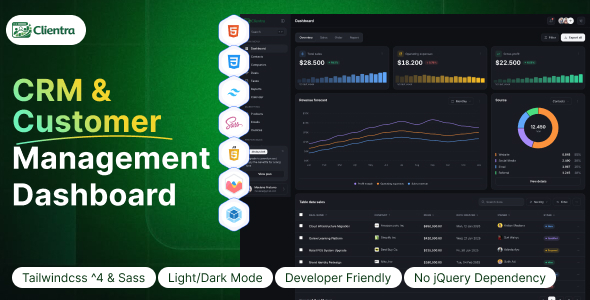
Clientra - CRM & Customer Management Dashboard HTML Template Clientra - CRM & Customer Management Dashboard HTML Template is a modern and...
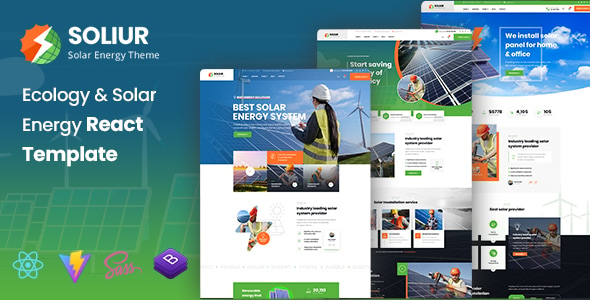
Soliur - Ecology & Solar Energy React Template Soliur - Ecology & Solar Energy React Template is a modern, sustainable, and professionally...
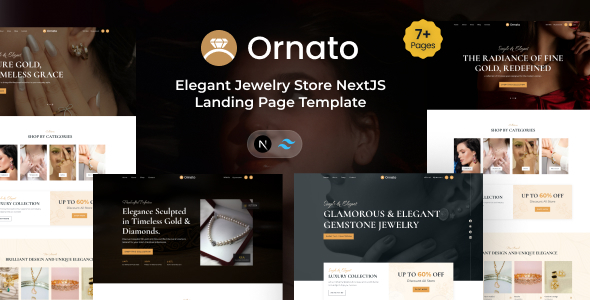
Ornato - NextJS Elegant Jewelry Store Landing Page Template Ornato is a luxurious and professionally crafted NextJS landing page template designed specifically...

Builtex - Construction HTML Template Builtex is a modern and professionally designed HTML template created specifically for construction companies, building contractors, engineering...
